
A boiler that stops working is the single most common out-of-hours call a landlord gets, and in UK rentals there is a good chance the unit on the wall is a Vaillant. The most common faults of Vaillant combi boilers are predictable, well documented and — crucially — mostly cheap to put right if you catch them early and describe them accurately when you book an engineer.
You also have no choice about acting. Section 11 of the Landlord and Tenant Act 1985 requires you to keep the installations that supply space heating and hot water in repair and in proper working order, and the Gas Safety (Installation and Use) Regulations 1998 require an annual safety check on every gas appliance you provide. Between them, a broken boiler is both a repair obligation and a safety matter.
This guide covers the faults you will actually meet, what each Vaillant fault code means, what you or your tenant may safely touch, what legally must go to a Gas Safe registered engineer, and how to stop the same call-out happening every winter.
Key takeaways
- Low water pressure (fault code F.22) is the most common Vaillant combi fault and is usually a two-minute fix with the filling loop.
- A frozen condensate pipe locks the boiler out on F.28 every cold snap. Lagging the external pipe is the cheapest repair you will ever make.
- Anything involving the gas supply, burner, gas valve or flue is gas work — only a Gas Safe registered engineer may touch it. Doing it yourself is a criminal offence.
- Under section 11 of the Landlord and Tenant Act 1985 you must repair heating and hot water within a reasonable time; in winter, “reasonable” is short.
- An annual service, a magnetic filter and the right dose of inhibitor prevent most repeat call-outs, and protect the Vaillant guarantee.
- Teach your tenant to read the code off the display before they call you. It halves your diagnosis time and your bill.
Your first 30 minutes when a Vaillant combi fails
Get the exact fault code from the display
Check gas, power, pressure and thermostat
Try the safe fixes: repressurise, thaw, one reset
Still locked out? Book a Gas Safe engineer
Offer temporary heating and log everything
Where you stand legally when the boiler stops
Before the diagnostics, get the legal framing right, because it drives how fast you have to move.
- Repair duty. Section 11 of the Landlord and Tenant Act 1985 makes you responsible for keeping installations for space heating and heating water in repair and proper working order. You cannot contract out of it in an assured shorthold tenancy.
- Reasonable time. There is no fixed statutory deadline, but the clock starts when you are put on notice and “reasonable” is judged on the facts. A cold house in January with a young child in it is an emergency; a noisy pump in June is not.
- Fitness for habitation. The Homes (Fitness for Human Habitation) Act 2018 inserted section 9A into the 1985 Act, letting tenants sue directly where a property is unfit. Excess cold is a prescribed hazard under the Housing Health and Safety Rating System, so a long heating outage can become a fitness claim as well as a repair claim.
- Gas safety. Under the Gas Safety (Installation and Use) Regulations 1998 you must maintain gas appliances and flues in a safe condition, arrange an annual safety check by a Gas Safe registered engineer, give tenants the record within 28 days (or before a new tenant moves in), and keep records for two years. Since the 2018 amendment you can carry out the check up to two months early without losing your existing anniversary date.
- Coming down the track. The Renters’ Rights Act 2025 extends Awaab’s Law and a Decent Homes Standard to the private rented sector. Government has signalled Awaab’s Law applying to private lettings from around 2027 and a Decent Homes Standard by 2035, with fixed timescales for investigating and fixing serious hazards. None of that is in force yet, so treat it as direction of travel rather than today’s rule.
For the paperwork side of all this, see our guides to the landlord gas safety certificate for Vaillant boilers and the broader UK gas safety certificate requirements for landlords.
Vaillant combi models you will meet in rentals
Vaillant’s UK domestic range has been fairly stable, which is good news: parts are widely stocked and most engineers know the platform. The combis you are most likely to inherit are:
- ecoTEC plus (825, 832, 835, 838, 843) — the workhorse. Common in family houses and larger flats.
- ecoTEC pro (24, 28, 30) — the budget-tier combi often specified in new-build and buy-to-let flats.
- ecoFIT pure (825, 830, 835) — compact, cupboard-friendly, very common in one and two-bed rentals.
- ecoTEC exclusive (835, 843) — the premium unit with self-adjusting Green iQ technology.
Guarantee length matters more than landlords realise. Vaillant offers extended guarantees of up to ten years on the ecoTEC plus, ecoTEC exclusive and ecoFIT pure ranges when the boiler is installed by an approved installer, registered in time and — the part people miss — serviced annually and the service recorded. Skip one service and you can find a £600 heat exchanger claim refused. Check the guarantee status before you pay for any major part.
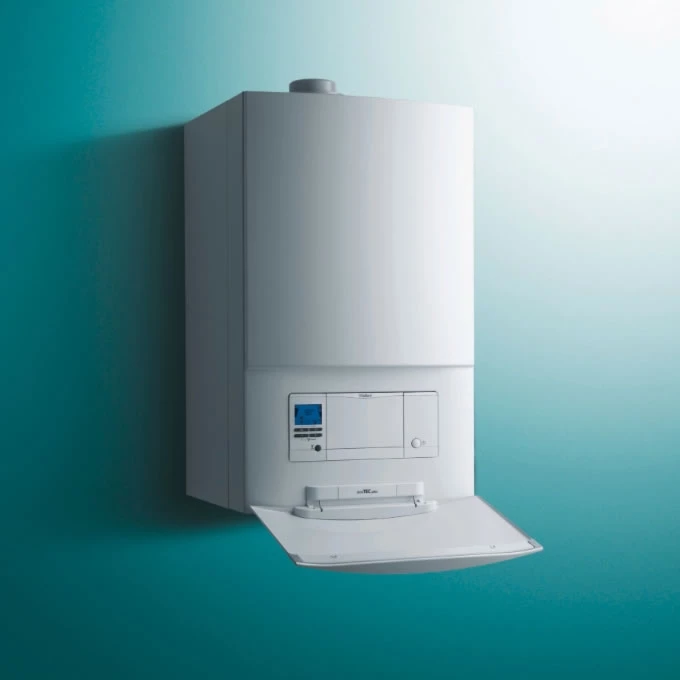
Vaillant fault codes at a glance
Vaillant boilers show an “F.” code on the display when they lock out. Getting the exact code from your tenant before you phone anyone is the highest-value thirty seconds in the whole process — it tells the engineer what to bring, and it tells you whether you are looking at a £0 fix or a £400 one.
| Code | What it means | Usual cause | Who fixes it |
|---|---|---|---|
| F.22 | Safety shut-off: low water pressure | System leak, radiators bled, faulty pressure sensor | You or tenant (repressurise) |
| F.23 | Temperature difference between flow and return too large | Blocked or seized pump, sensors swapped | Gas Safe engineer |
| F.24 | Temperature rising too quickly | Low pressure, blocked pump, sludge restricting flow | Engineer (check pressure first) |
| F.27 | Flame simulation — flame detected when there should be none | Moisture on the PCB, leaking gas valve | Gas Safe engineer only |
| F.28 | Failure to ignite on start-up | Gas supply off or low, frozen or blocked condensate, ignition lead, gas valve | Check gas and condensate, then engineer |
| F.29 | Flame lost during operation | Interrupted gas supply, flue gas recirculation, earthing fault | Gas Safe engineer only |
| F.20 | Safety shut-off: overheat / temperature limiter | Poor earthing, faulty NTC sensor, no circulation | Gas Safe engineer |
| F.32 | Fan fault | Blocked or seized fan, disconnected plug, hall sensor | Gas Safe engineer |
| F.61–F.65 | Gas valve or PCB / electronics faults | Failed control board or gas valve actuation | Gas Safe engineer only |
| F.73 / F.74 | Water pressure sensor fault | Broken sensor wiring or short circuit | Gas Safe engineer |
| F.75 | Pump fault / water shortage after a pressure change | Failed pump or pressure sensor, air in the system | Gas Safe engineer |
| F.83 / F.84 / F.85 | Flow and return temperature sensor faults | Sensors misfitted, swapped, or no water movement | Gas Safe engineer |
The most common Vaillant combi boiler faults, one by one
1. Low water pressure (F.22)
What you see: the gauge sits below 1 bar, the boiler will not fire, and the display shows F.22. Radiators may be cold at the top of the house first.
Why it happens: the system has lost water. Bleeding radiators does it, a weeping radiator valve does it slowly, and a failed pressure relief valve dumps water outside through the discharge pipe.
The fix: repressurise using the filling loop until the gauge reads between 1 and 1.5 bar cold, then close both valves fully. This is plumbing, not gas work, so a competent tenant can be shown how. Write the steps into your tenant handbook with a photo of the actual loop in that property.
The landlord’s tell: if it needs topping up more than two or three times a year, you do not have a pressure problem — you have a leak. Get it traced before it becomes a ceiling.
2. Frozen condensate pipe (usually shows as F.28)
What you see: the boiler locks out during a cold snap, often overnight, sometimes with a gurgling or bubbling noise before it stops. Blocked condensate is one of the listed causes of an F.28 ignition failure.
Why it happens: condensing boilers drain acidic water through a plastic pipe. Where that pipe runs outside, it freezes. It is the single most seasonal fault in the UK housing stock and it produces a wave of identical call-outs every January.
The fix: pour warm — not boiling — water along the external pipe, particularly at bends and at the open end, then reset the boiler. Boiling water can crack the plastic or the fittings.
The permanent fix: lag the external run with weatherproof pipe insulation, or have an engineer re-route it internally or upsize it. A few pounds of foam lagging removes a £120 winter call-out for the life of the tenancy.
Check weatherproof condensate pipe lagging on Amazon
3. Ignition failure (F.28 and F.29)
What you see: repeated clicking as the boiler tries to light, then a lockout. F.28 means it never lit; F.29 means it lit and then lost the flame.
Why it happens: no gas at the appliance (check the meter and any prepayment credit first — it is free to rule out), a failed ignition electrode or lead, a faulty gas valve, blocked condensate, or flue gas recirculation.
The fix: confirm other gas appliances work, confirm the condensate is clear, then reset the boiler once. If it locks out again, stop. Repeatedly resetting a boiler that will not light is how you turn a £90 electrode into a damaged gas valve. Everything past this point is gas work and legally requires a Gas Safe registered engineer.
4. Pump and circulation faults (F.75, F.23, F.24)
What you see: the boiler fires then cuts out quickly, radiators are hot at the bottom and cold at the top, or the unit hums and vibrates. F.75 is the classic pump-or-pressure-sensor code; F.23 and F.24 are the safety shut-offs that follow poor circulation.
Why it happens: pumps seize after years of running through dirty water. Magnetite sludge — the black iron oxide that builds up in every unprotected steel system — is the usual culprit, along with trapped air.
The fix: an engineer’s job. Expect a conversation about a system flush and a magnetic filter, because replacing a pump into the same dirty water simply resets the clock on the next failure.
5. Diverter valve failure
What you see: the classic combi symptom — plenty of heating but lukewarm taps, or hot water but stone-cold radiators. Often there is no fault code at all, which is why tenants describe it as “the boiler is fine, it’s the shower”.
Why it happens: the diverter valve switches flow between the heating circuit and the hot water plate. It sticks through limescale in hard-water areas and through ordinary wear.
The fix: engineer. Sometimes it is just the valve head or cartridge rather than the whole assembly, so ask which is being quoted — the price difference is significant.
6. Leaks and pressure loss
What you see: water under the boiler, staining on the casing, damp on the ceiling below, or pressure that will not hold.
Why it happens: corroded pipework, perished seals, a failed expansion vessel forcing water out through the pressure relief valve, or a pinhole in the heat exchanger.
The fix: never let a boiler leak “for now”. Water plus electrics plus a gas appliance is not a wait-and-see situation, and an internal leak will corrode the PCB and turn a seal job into a new boiler. Isolate the water supply, turn the boiler off, and get it looked at.
7. Hot water running hot then cold
What you see: the shower runs hot for a minute, goes cold, then comes back. Tenants report this more than any other complaint that is not a total failure.
Why it happens: a scaled or blocked plate heat exchanger, a failing thermistor, low incoming mains flow, or a partially stuck diverter valve. In hard-water parts of the country, scale is the usual answer.
The fix: check the hot water temperature setting and the mains flow rate first, then have the plate exchanger chemically cleaned or replaced. Fitting a scale reducer on the mains is worth it in hard-water areas.
8. Kettling, banging and other noises
What you see: a sound like a kettle boiling, whistling, gurgling or banging when the heating comes on.
Why it happens: kettling is limescale or sludge on the heat exchanger causing water to boil locally. Gurgling is usually trapped air. Banging on shutdown often points to circulation problems.
The fix: bleeding radiators and checking pressure will clear air. Persistent kettling needs a chemical clean or power flush plus fresh inhibitor. Ignoring it shortens the heat exchanger’s life, and a heat exchanger is one of the most expensive parts on the boiler.
What you may safely do — and what you must not
This is the line that gets landlords into trouble. Work on gas fittings and gas appliances is restricted by law to Gas Safe registered engineers. It is not a best-practice guideline; carrying out gas work without being registered is a criminal offence, and the Health and Safety Executive treats gas safety breaches as serious enough for substantial fines and, in the worst cases, custody.
Safe for you or your tenant
✓ Repressurising via the filling loop
✓ Bleeding radiators
✓ Thawing a frozen condensate pipe with warm water
✓ One boiler reset
✓ Checking the timer, thermostat and TRVs
✓ Checking gas credit and other gas appliances
Gas Safe registered engineer only
✗ Removing the boiler casing
✗ Anything touching the gas valve or burner
✗ Ignition electrodes and leads
✗ Flue inspection or alteration
✗ Pump, diverter valve, PCB or sensor replacement
✗ The annual gas safety check
You can confirm any engineer’s registration and the specific work categories they are qualified for on the Gas Safe Register. Ask to see the ID card, check the back of it, and check it against the register — cards are cloned. The HSE’s own landlord gas safety guidance is the authoritative source on your duties.
Prevention: how to stop paying for the same fault twice
Almost every fault above is a maintenance failure wearing a fault code. Five things cut boiler call-outs more than anything else:
- Service annually and combine it with the gas safety check. One visit, one fee, and it keeps the Vaillant guarantee alive. Book it in late summer, not in the November rush.
- Fit a magnetic system filter. It catches the magnetite that kills pumps, blocks heat exchangers and causes kettling. It is one of the cheapest parts on the system and it protects the most expensive ones.
- Keep inhibitor in the system. Corrosion inhibitor gets diluted every time the system is drained or topped up. Ask your engineer to test the concentration at each service and re-dose.
- Lag the external condensate pipe. Do it once, in autumn, and you remove the most predictable winter call-out on the list.
- Brief the tenant at check-in. Show them the pressure gauge, the filling loop and the reset button; leave a one-page card with photos and the fault-code table. Most “the boiler’s broken” calls are an F.22.
It is also worth remembering that a faulty or badly burning gas appliance is a carbon monoxide risk. Since October 2022 a carbon monoxide alarm is legally required in any room in an English rental containing a fixed combustion appliance other than a gas cooker, and it must be repaired or replaced if the tenant reports it faulty. Our guide to smoke and carbon monoxide detector requirements for landlords covers the detail, and our carbon monoxide detector reviews cover which alarms are worth fitting.
Sealed 10-year sensor and battery, so there is nothing for a tenant to remove.
Digital display and 10-year life; easy to check at an inspection.
Ask your engineer to fit and dose at the annual service; browse current options first.
Repair or replace? The landlord’s calculation

There is no clean rule, but three questions usually settle it.
- How old is it? A well-serviced Vaillant combi should give you 12–15 years. Past 12, a major part failure — heat exchanger, gas valve, PCB — is usually the moment to replace rather than repair.
- What proportion of a new install is the repair? If a single part quote approaches half the cost of a new boiler and fit, replacement is normally better value across a tenancy.
- Is it out of guarantee and repeat-failing? Two significant faults in twelve months on an out-of-guarantee unit is your answer.
If you do replace, remember the Boiler Plus standards that have applied in England since April 2018: a new gas boiler must meet a minimum seasonal efficiency, and a new combi installation must include one additional efficiency measure — flue gas heat recovery, weather compensation, load compensation, or smart controls with automation and optimisation. Smart controls are usually the easiest to satisfy and the most useful in a let property; see our comparison of the best smart thermostats for rental properties.
On energy standards, the current legal minimum for letting remains EPC band E. The government has said it intends to require band C from 1 October 2030 for privately rented homes, subject to a cost cap, but that is confirmed policy rather than law until the regulations are made. If a boiler replacement is coming anyway, it is worth planning it alongside your wider EPC C upgrade plan rather than in isolation.
Finally, decide deliberately whether to buy cover. Landlord boiler policies can smooth costs and give you an out-of-hours number, but they exclude a lot and often insist on the annual service you should be doing anyway — we weigh it up in boiler cover for landlords.
Common mistakes landlords make
- Resetting repeatedly. Lockouts are protective. Forcing a boiler past one turns cheap faults into expensive ones.
- Treating pressure loss as normal. Repeated topping up means a leak somewhere, and the water is going somewhere.
- Using a plumber for gas work. “Plumber” is not a gas qualification. Check the Gas Safe card and its categories every time.
- Confusing a service with a safety check. The annual gas safety check is a legal duty and produces the record you must give the tenant. A service is separate maintenance that protects the guarantee. Ideally you buy both.
- Not documenting the response. Record when the tenant reported it, when you contacted the engineer, when they attended and what temporary heating you supplied. In any later dispute, that log is your defence.
- Leaving a property unheated over a void. Set the frost protection rather than switching everything off, or you will meet frozen pipes and a seized pump in February.
What to do next
Vaillant combis are reliable units, and the faults that take them out are overwhelmingly the same handful: pressure, condensate, ignition, circulation and scale. Get the fault code first, know the short list of things that can safely be tried, and hand everything else to a Gas Safe registered engineer without delay.
Three actions this week: book the annual service and gas safety check together for late summer; add a fault-code card and filling-loop photo to your tenant handbook; and check whether the boiler still carries a Vaillant guarantee before you authorise any major part. For everything else on the property, our rental property maintenance checklist keeps the rest of the year organised.
Frequently asked questions
How often should a Vaillant boiler in a rental be serviced?
Annually. That is separate from the legally required annual gas safety check, though most engineers will do both in one visit. Annual servicing is also normally a condition of keeping a Vaillant extended guarantee valid.
What pressure should a Vaillant combi boiler run at?
Between 1 and 1.5 bar when the system is cold. It will rise as the system heats up, which is normal. Many models flash a low-pressure warning from around 0.8 bar and lock out with F.22 when pressure falls further, so check the manual for the specific unit.
Can my tenant reset the boiler themselves?
Yes — pressing the reset button is not gas work. Tell them to try it once only and to report the fault code if it locks out again, rather than resetting repeatedly.
How long can a tenant be left without heating or hot water?
There is no fixed statutory deadline. Section 11 requires repair within a reasonable time from when you are put on notice, and what is reasonable depends on the season, the household and the severity. In cold weather, treat a total heating failure as an emergency, attend within about 24 hours and provide temporary heaters if a same-day repair is not possible.
Why does my Vaillant boiler keep losing pressure?
Because water is escaping. The usual suspects are a weeping radiator or valve, a leaking towel rail, a failed expansion vessel, or a pressure relief valve discharging outside. If it needs topping up more than two or three times a year, have it traced.
What does F.28 mean on a Vaillant boiler?
The boiler tried to ignite and failed. Common causes are no gas at the appliance, low gas pressure, a frozen or blocked condensate pipe, or a faulty ignition component or gas valve. Check the gas supply and the condensate pipe, reset once, then call a Gas Safe registered engineer.
Do I have to give my tenant the gas safety record?
Yes. You must give existing tenants a copy within 28 days of the check, give new tenants a copy before they move in, and keep records for two years.
Written by the Landlords Portal team, who work with UK residential landlords on compliance, maintenance and letting practice. This article is general information for landlords in England and Wales and is not legal advice; rules differ in Scotland and Northern Ireland. Always use a Gas Safe registered engineer for gas work and take professional advice on your own circumstances.