
If your rental property has a gas boiler, fire, hob or any other gas appliance, you need a landlord gas safety certificate. More precisely, you need a gas safety record, renewed every year, carried out by a Gas Safe registered engineer and given to your tenants on time. It is one of the few landlord duties that is a criminal matter: the Health and Safety Executive (HSE) prosecutes landlords who ignore it, and the worst cases end in prison sentences.
This guide sets out exactly what the law requires under regulation 36 of the Gas Safety (Installation and Use) Regulations 1998, how to time the annual check so you never have a gap, what to do when a tenant will not let the engineer in, and how the rules fit with carbon monoxide alarms.
Key takeaways
- Every gas appliance and flue you provide must be safety-checked at least every 12 months by a Gas Safe registered engineer.
- Give existing tenants a copy of the record within 28 days of the check, and new tenants a copy before they move in.
- You can have the check done up to two months early and keep your original renewal date.
- Keep each record until two further checks have been done.
- The brand of boiler makes no difference to the rules: a Baxi, Vaillant, Ideal or Worcester boiler needs the same annual check.
- In England you also need a carbon monoxide alarm in any room with a fixed combustion appliance, such as a gas boiler or gas fire.
What the law requires: your gas safety duties
Regulation 36 places three separate duties on landlords of residential property in Great Britain. It is worth thinking of them separately, because landlords often meet the first and forget the other two.
1. Keep gas fittings and flues safe at all times
You must keep the gas fittings you provide, including the installation pipework, and any flue serving them in a safe condition. This is an ongoing duty, not a once-a-year one. If a tenant reports a smell of gas, a sooty boiler or a fire that burns with a lazy yellow flame, you must act straight away rather than wait for the next annual check.
2. Have every appliance and flue checked at least every 12 months
Each gas appliance and flue you provide must be checked for safety within 12 months of installation and then at intervals of no more than 12 months. The check must be done by a Gas Safe registered engineer. For a new letting, there must be a check within the 12 months before the tenancy starts.
3. Keep a record and give tenants a copy
The engineer records each check. You must:
- Give existing tenants a copy within 28 days of the check.
- Give new tenants a copy of the latest record before they move in. Our guide on whether you need the certificate before the tenant moves in covers the timing in detail.
- For stays of 28 days or less, such as holiday lets, you can display the record prominently in the property instead.
- Keep each record until two further checks have been carried out. See how long to keep old gas certificates.
What the engineer checks and what the record shows
The check covers each appliance and flue you provide: typically the boiler, any gas fire, and a gas hob or cooker if it belongs to you. The engineer looks at how the appliance is set up and burning, whether the flue clears fumes properly, whether there is enough ventilation, and whether the safety devices work.
By law the record must include:
- the date of the check and the address of the property;
- your name and address, or your agent’s;
- a description and the location of each appliance and flue checked;
- any safety defect found and any remedial action taken;
- the engineer’s name, signature and Gas Safe registration number.
Before the visit, check the engineer on the Gas Safe Register and make sure their card shows they are qualified for the type of appliance you have. A record from someone who is not registered does not meet the law.
Appliances the tenant owns
You are not responsible for checking a gas appliance the tenant brought with them, such as their own cooker. You are still responsible for the pipework and any flue you provide that serves it. If you are unsure who owns an appliance, record it in your inventory at check-in so there is no argument later.
Timing the annual check so you never have a gap
The most common breach is not a dangerous boiler but a late certificate. A booking slips, the tenant is away, and the record lapses for a few weeks. Since 2018 the rules have helped: under regulation 36A, a check carried out in the two months before your deadline is treated as if it was done on the deadline. Your renewal date stays the same, just like an MOT.
The annual gas safety cycle, step by step
Note the date 12 months after the last check, and a reminder 10 weeks before it.
A check in the two months before the deadline keeps your existing renewal date.
Confirm the date and time in writing and keep a copy.
An appliance marked “at risk” or “immediately dangerous” must not be used until it is repaired.
Email it with a note of the date sent, or hand it over and get a signature.
Keep it until two more checks have been done.
There is one more flexibility. If a property has several appliances on different dates, regulation 36A also lets you have one appliance checked up to two months after its deadline, once only, to bring all the dates into line. Use it deliberately and keep a note of why, because otherwise a late check is a breach.
If you have already missed a renewal, act today. Our guide to what to do if your gas safety certificate has expired walks through the steps.
Does the boiler brand change anything?
No. The legal duty is the same whether you have a Baxi, Vaillant, Ideal, Worcester Bosch or any other make. What does differ is the manufacturer’s servicing schedule, which matters for the boiler’s warranty. A gas safety check and a boiler service are not the same thing: the check confirms the appliance is safe, while a service cleans and adjusts it to keep it working well. Many landlords book both on the same visit to save a call-out.
If the engineer finds a fault, our brand guides explain the common error codes: Baxi boiler faults and Vaillant combi boiler faults.
When the tenant will not let the engineer in
A tenant refusing access does not cancel your duty, but you are expected to take reasonable steps and to be able to prove you did. Never let yourself in with your own key and never cut off the gas supply to force the issue: both can amount to harassment or unlawful interference with the tenant’s home.
A sensible, well-documented approach is:
- Write to the tenant proposing a date, explaining that the check is a legal safety requirement, and offering to fit around them.
- If there is no reply, write again with an alternative date and explain that carbon monoxide has no smell or taste.
- Send a final letter asking them to contact you urgently, and keep copies, emails and the engineer’s notes of any wasted visits.
- If access is still refused, take legal advice about an injunction or, where appropriate, possession based on the tenant’s breach of the tenancy agreement.
For the wider rules on entering a rented home, see a landlord’s right to access the property during a tenancy.
Carbon monoxide and smoke alarms
In England, the Smoke and Carbon Monoxide Alarm (England) Regulations sit alongside the gas rules. Since 1 October 2022 you must:
- fit at least one smoke alarm on every storey with a room used as living accommodation;
- fit a carbon monoxide alarm in any room used as living accommodation that has a fixed combustion appliance, such as a gas boiler or gas fire (gas cookers are excluded);
- check the alarms work on the first day of each new tenancy;
- repair or replace an alarm once you are told it is faulty.
Councils can fine up to £5,000 per breach for not complying with a remedial notice. Our smoke and carbon monoxide alarm rules guide covers the detail, and our carbon monoxide alarm buying guide compares sealed long-life models that suit rentals.
Penalties for getting it wrong
Breaching the gas safety regulations is a criminal offence, enforced by the HSE. Penalties can include an unlimited fine and imprisonment. In a 2024 HSE case, a Kent landlord who failed to maintain gas appliances and ignored an improvement notice received a 26-week suspended prison sentence and a four-month curfew. Your landlord insurance may also refuse a claim linked to an appliance with no valid check.
Common mistakes landlords make
- Letting the record lapse by a few weeks because the booking was left too late.
- Getting the check done but never sending the tenant a copy.
- Assuming a boiler service counts as a gas safety check.
- Using a “heating engineer” who is not on the Gas Safe Register.
- Throwing away old records as soon as a new one arrives.
- Forgetting that holiday lets and HMOs are covered too.
Your gas safety checklist
| Task | When |
|---|---|
| Gas safety check by a Gas Safe registered engineer | At least every 12 months (up to 2 months early keeps your date) |
| Copy to existing tenants | Within 28 days of the check |
| Copy to new tenants | Before they move in |
| Record kept | Until two further checks are done |
| Smoke and CO alarms tested (England) | On the first day of each new tenancy |
| Electrical safety report (EICR) | At least every 5 years: see our EICR guide |
Gas safety is one of several checks every landlord in England now needs to keep on top of. Our Renters’ Rights Act 2026 landlord checklist brings them together.
Written by The Landlords Portal Team and checked against the Gas Safety (Installation and Use) Regulations 1998 and GOV.UK guidance. The gas rules apply in England, Wales and Scotland; the alarm rules described are for England. This is general information, not legal advice.
Frequently asked questions
How long is a landlord gas safety certificate valid for?
The next check must be done within 12 months. A check carried out in the two months before the deadline keeps your original renewal date.
Do I need a gas safety certificate if the property is all-electric?
No. The gas rules only apply where there are gas appliances, fittings or flues. You still need a valid EICR and working smoke alarms.
Can I email the certificate to my tenant?
Yes, a copy sent by email is common practice. Keep a record of when you sent it, and use an address the tenant has confirmed.
Who pays for the gas safety check?
The landlord. It is a legal duty on you, and charging the tenant for it would be a prohibited fee under the Tenant Fees Act 2019.
Are holiday lets and HMOs covered?
Yes. The duty applies to residential lettings including HMOs and holiday accommodation. For stays of 28 days or less you can display the record in the property instead of handing each guest a copy.
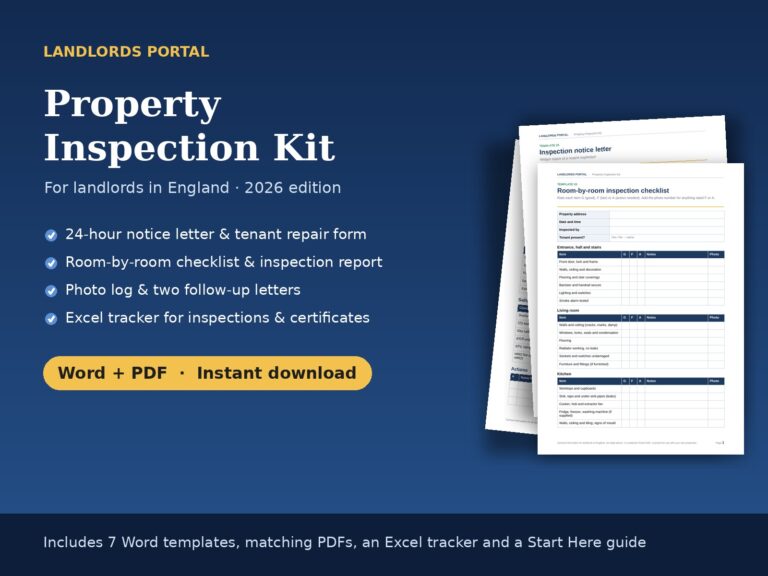
Template pack from Landlords Portal
Run every inspection properly: the Property Inspection Kit
Dated evidence of the property's condition protects you in repair, damp and deposit disputes. This kit gives you every document for an inspection, written for landlords in England.
- 24-hour notice letter and tenant repair report form
- Room-by-room checklist, inspection report and photo log
- Follow-up letters, plus an Excel tracker for gas safety, EICR and EPC dates