
A rent repayment order can make you hand back up to two years’ rent, even if you were never prosecuted. Since the Renters’ Rights Act changes started on 1 May 2026, the orders are bigger, tenants have longer to apply, and they can now reach head landlords in rent-to-rent deals and the directors of landlord companies. This guide explains how rent repayment orders work in England under Chapter 4 of Part 2 of the Housing and Planning Act 2016, how the tribunal decides how much you pay, and the practical steps that keep you out of one.
Key takeaways
- A rent repayment order (RRO) is made by the First-tier Tribunal (Property Chamber) when a landlord has committed one of a list of housing offences. No conviction is needed; the tribunal only has to be sure beyond reasonable doubt.
- For offences from 1 May 2026, tenants have two years to apply and can recover up to two years’ rent. Before that, both limits were 12 months.
- The most common trigger is letting an HMO or a house that needed a licence without one.
- Orders can now be made against superior landlords in rent-to-rent chains and against company directors. Letting agents cannot be named.
- Repeat offenders normally have to repay the maximum.
What is a rent repayment order?
A rent repayment order is a tribunal order requiring a landlord who has committed certain offences to repay rent. A tenant can apply to recover rent they paid. The local council can apply to recover Universal Credit or housing benefit that was paid towards the rent.
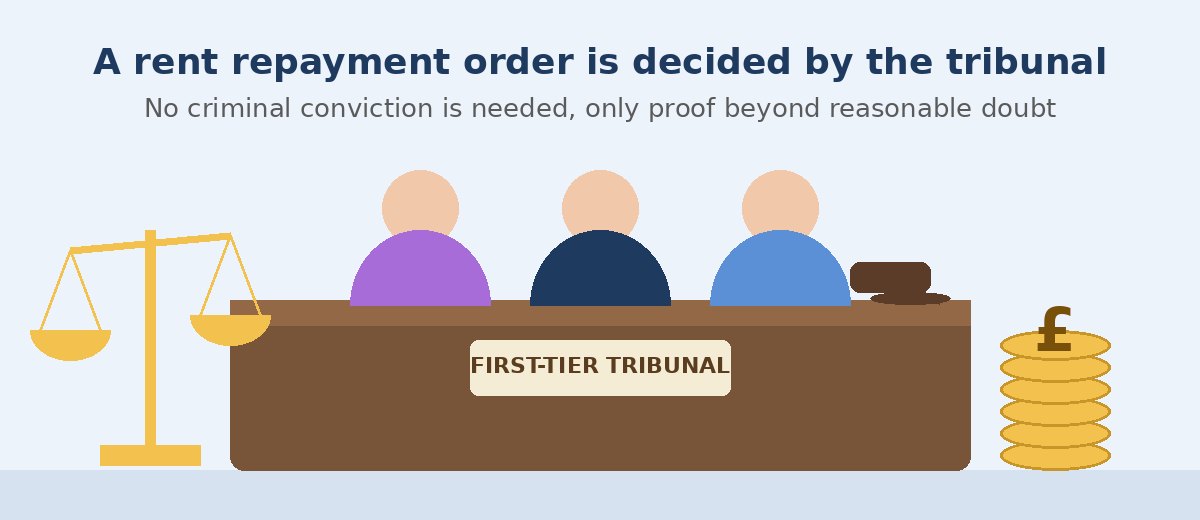
It is not a criminal prosecution and it is not a fine, although it often follows one. Under section 43 the tribunal can make an order whether or not you have been convicted, as long as it is satisfied beyond reasonable doubt that you committed the offence. A council can prosecute you or fine you and seek an RRO for the same offence, and tenants can apply on top.
Rent repayment orders in this form apply to England. Wales has its own system for rented homes.
What changed on 1 May 2026
The government’s implementation roadmap put the rent repayment order changes in the first phase of the Renters’ Rights Act. The new rules apply to offences committed on or after 1 May 2026. Where an offence ran across that date, the tribunal applies the old rules to the earlier part and the new rules to the later part.
| Offences before 1 May 2026 | Offences from 1 May 2026 | |
|---|---|---|
| Time for a tenant to apply | 12 months from the offence | 2 years from the offence |
| Maximum order | 12 months’ rent | 2 years’ rent |
| Who can be ordered to pay | Only the tenant’s immediate landlord | Immediate landlord, superior landlords and company officers |
| Repeat offenders | Maximum if convicted or fined for the offence being claimed | Maximum also if previously convicted, fined or given an RRO for the same offence |
| Offences covered | 7 offences | 3 new possession and re-letting offences added; database and ombudsman offences to follow |
Which offences can lead to a rent repayment order?
Only the offences listed in section 40(3) count. Breaching your deposit rules or failing to give a gas safety record does not lead to an RRO by itself, although it can lead to other penalties.
| Offence | Law | In plain terms |
|---|---|---|
| Using violence to secure entry | Criminal Law Act 1977, s6(1) | Using or threatening violence to get into a home while someone inside opposes it |
| Unlawful eviction or harassment | Protection from Eviction Act 1977, s1 | Changing the locks, removing belongings, cutting off utilities or pressuring a tenant to leave without a court order |
| Misusing a possession ground (new) | Housing Act 1988, s16J(1) | Relying on a ground you know (or are reckless about whether) you could not win on, after which the tenant gives up the tenancy within four months |
| Re-letting or marketing after Ground 1 or 1A (new) | Housing Act 1988, s16J(2) | Letting or advertising the property in the 12-month restricted period after using the moving-in or selling ground |
| Continuing a breach after a fine (new) | Housing Act 1988, s16J(3) | Carrying on with conduct you have already been fined for under the Renters’ Rights Act rules |
| Ignoring an improvement notice | Housing Act 2004, s30(1) | Not doing works the council has ordered to fix a hazard in the home |
| Breaching a prohibition order | Housing Act 2004, s32(1) | Letting or using a property, or part of it, the council has banned from use |
| Unlicensed HMO | Housing Act 2004, s72(1) | An HMO that needs a mandatory or additional licence and does not have one |
| Unlicensed house | Housing Act 2004, s95(1) | A home in a selective licensing area let without the licence |
| Breaching a banning order | Housing and Planning Act 2016, s21 | Letting while banned from doing so |
The Act also adds offences linked to the private rented sector database (giving false information, and continuing breaches after a fine) and to the landlord ombudsman. Those three entries had not been brought into force when we checked in November 2026. They will start alongside those schemes.
In practice, licensing is where most landlords get caught. Councils keep adding selective licensing schemes, and an ordinary single let can fall inside one when a scheme starts or expands. Additional HMO licensing catches smaller shared houses that the national mandatory scheme does not. Our HMO licensing guide explains the three types.
Who can apply, and how long they have
Tenants
Under section 41, a tenant can apply if the offence related to housing let to them at the time and was committed in the two years ending on the day they apply. For an ongoing offence, such as running an unlicensed HMO, the clock effectively runs from the last day of the offence.
There is one exception that catches landlords out. For misusing a possession ground and re-letting after Ground 1 or 1A, the tenant does not need to be living there when the offence happens. A tenant who moved out because you said you were selling can apply if you then re-let the property within the restricted period.
Councils
A council can apply to recover Universal Credit or housing benefit paid for the rent. It must first serve a notice of intended proceedings within two years of the offence and give you at least 28 days to respond. If a council learns that a landlord in its area has been convicted of a listed offence, it must consider applying. Councils can also help tenants bring their own claims.
Who can be ordered to pay
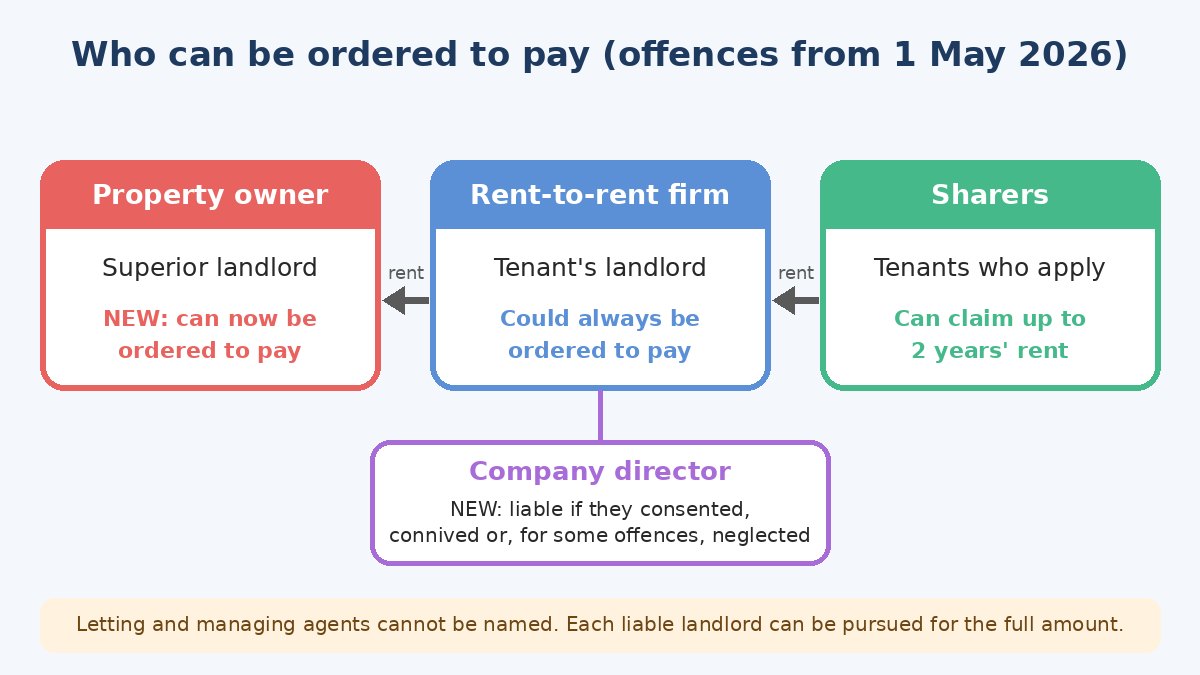
Until 1 May 2026, only the tenant’s immediate landlord could be ordered to pay. In Rakusen v Jepsen the Supreme Court confirmed that an owner who let to a rent-to-rent company was out of reach. The Renters’ Rights Act reversed that for offences from 1 May 2026.
- Superior landlords. An owner or head landlord above the tenant’s landlord can now be ordered to pay. For licensing, the owner also commits the offence in their own right. A clause in the head lease making the operator responsible for licensing is not, by itself, a defence.
- Company directors and officers. Where a landlord company commits an offence with an officer’s consent or connivance, or for some offences through their neglect, that officer is treated as having committed it too.
- Several landlords at once. Where more than one person in the chain committed the offence, each is liable for the full amount until it is paid.
- Not letting agents. Government guidance confirms that letting and managing agents cannot be named as respondents. You remain responsible even if your agent forgot to apply for the licence.
How the tribunal decides how much you pay
The law sets a ceiling, not a fixed amount. Under section 44, the maximum for a tenant is the rent they paid for the relevant period, less any Universal Credit or housing benefit paid towards that rent. For most offences the relevant period is up to two years during which the offence was being committed. For violence for entry, unlawful eviction or harassment, and misusing a possession ground, it is the two years ending on the date of the offence. For re-letting after Ground 1 or 1A, it is the two years ending on the offence or on the end of the tenancy, if that came first.
To set the figure within that ceiling, tribunals follow the four-stage approach the Upper Tribunal set out in Acheampong v Roman [2022] UKUT 239 (LC):
How the tribunal works out the amount
All rent the tenant paid during the offence, up to two years, less any Universal Credit or housing benefit paid towards it.
Bills you paid that benefited only the tenant, such as gas, electricity and internet in a bills-included let, are usually deducted.
The tribunal sets a percentage as a starting point, compared with other offences and other cases of the same offence.
Up or down for the landlord’s and tenant’s conduct, the landlord’s finances, any previous convictions, fines or RROs.
Seriousness matters a great deal. Unlicensed letting of a safe, well-run property is usually treated as less serious than harassment or ignoring an improvement notice on a dangerous hazard. Conduct cuts both ways: a landlord who kept the home in good repair and dealt with problems quickly can expect a lower figure, while fire safety failures, disrepair or threatening messages push it up. A tenant’s rent arrears or damage can also reduce the award.
When you have to pay the maximum
Under section 46, the tribunal must order the full maximum, ignoring the stage 4 factors, if you have been convicted of the offence or given a final financial penalty for it, or if you have previously been convicted, fined or given an RRO for the same offence. Running an unlicensed HMO and an unlicensed house count as the same offence for this rule. The only escape is if the tribunal finds exceptional circumstances that would make the full amount unreasonable.
Worked example: an unlicensed HMO
Illustrative figures only. Every tribunal decision depends on its own facts.
A landlord lets a five-bedroom house to five sharers at £700 a month each, bills included. The council’s additional licensing scheme covers the house, but the landlord never applies. The house is unlicensed for 18 months from June 2026, and all five tenants apply together. None received Universal Credit.
| Step | Per tenant | All five tenants |
|---|---|---|
| 1. Rent paid over 18 months (£700 × 18) | £12,600 | £63,000 |
| 2. Less utilities the landlord paid (say £60 a month) | £11,520 | £57,600 |
| 3. Seriousness starting point (say 60%) | £6,912 | £34,560 |
| 4. Good repair record, no other issues (say less 10%) | £6,221 | £31,104 |
| If the landlord had already been fined for the same offence | £12,600 (full maximum) | £63,000 |
The repeat-offender row is the one to remember: the maximum is the rent paid, so the utilities deduction and the discount for good conduct no longer apply. On top of any order, the council can still prosecute or issue a civil penalty for the same licensing failure.
Defences and what helps your case
Because the tribunal has to be sure you committed the offence, the defences to that offence are your defences to the RRO. For licensing offences, section 72 of the Housing Act 2004 (and section 95 for selective licensing) gives you a defence if:
- A licence application had been duly made and was still being considered, or was under appeal. The offence stops from the day a complete application is made, so applying late still limits the period you can be ordered to repay.
- You had notified the council that you were taking steps to stop the property needing a licence, and that notification was still effective.
- You had a reasonable excuse. Tribunals set a high bar. Not knowing about a scheme the council publicised, or relying on an agent who said it was handled, rarely succeeds on its own. Superior landlords have a specific defence if they did not know, and had a reasonable excuse for not knowing, that the property was an HMO, or took all reasonably practicable steps to make sure it was licensed.
Outside licensing, the facts are usually the whole fight: whether a lock change was really an eviction, whether a ground was used in good faith, or whether you had actually re-let. Dated records win these arguments.
How to avoid a rent repayment order
Landlord checklist
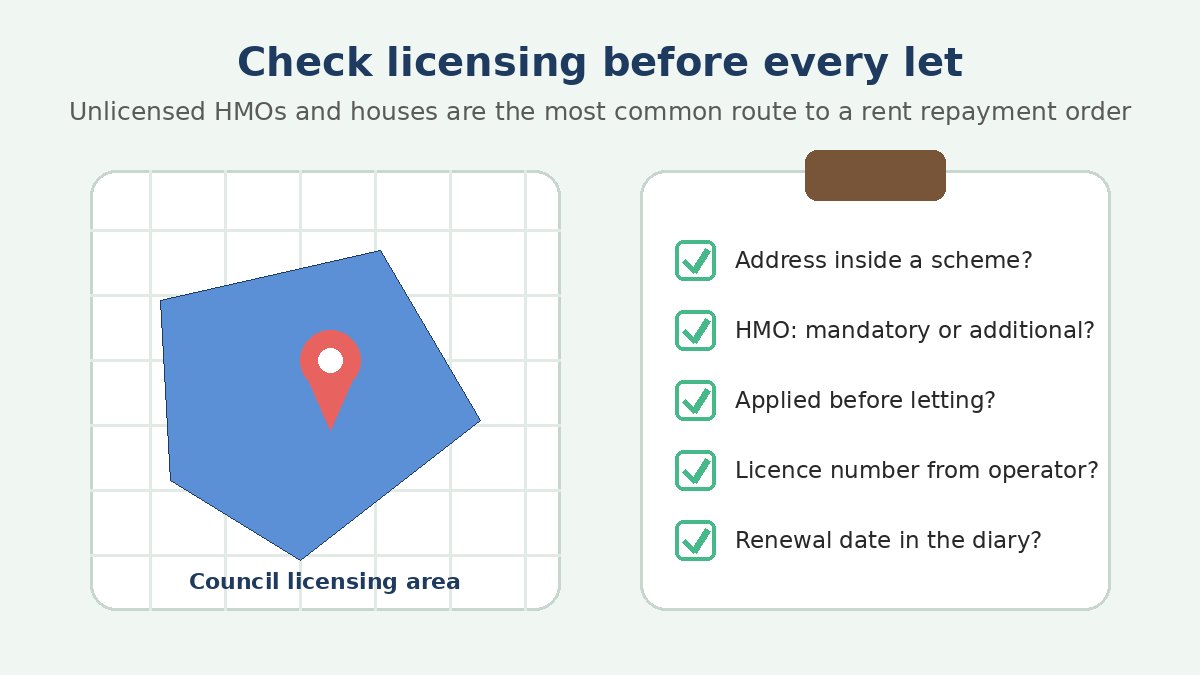
- Check licensing for every property, every year. Search the council’s website by postcode, and check again when you buy, change the number of sharers or hear of a consultation. Our selective licensing table is a starting point, not a substitute for the council’s map.
- Apply before you let, not after. If you discover a property needs a licence, submit a complete application the same day. The offence stops from that point.
- Treat improvement notices as deadlines. Start the works within the time given and keep invoices and photos.
- Never take possession yourself. No lock changes, no removing belongings, no cutting off utilities. Use the Section 8 grounds and the courts.
- Only use Ground 1 or 1A if you mean it. If you serve notice to move in or sell, do not re-let or advertise the property within the 12-month restricted period. Our Renters’ Rights Act guide explains the rules.
- Vet rent-to-rent operators. If you let to a company that sublets, ask for the licence number before handover and check it with the council. You are now liable alongside them.
- Keep records for at least two years after a tenancy ends. Licence applications, council letters, inspection reports, repair invoices and messages with tenants.
If a tenant applies for a rent repayment order against you
- Read the tribunal’s directions straight away. They set deadlines for your statement and bundle of evidence. Missing them can lead to your case being barred.
- Check the dates. Was the offence within two years of the application (12 months for offences before 1 May 2026)? When exactly did a licence application go in?
- Work out the rent actually paid. Use your rent records, and identify any Universal Credit or housing benefit paid towards the rent and any utilities you paid.
- Gather conduct evidence. Safety certificates, repair records, inspection reports and messages show the tribunal how you ran the property. Rent arrears or damage by the tenant are relevant too.
- Put your finances before the tribunal if they matter. The landlord’s financial circumstances are a factor, but you will need documents to rely on them.
- Take advice early. A housing solicitor or a landlord association such as the NRLA can tell you whether a defence is realistic or whether to focus on reducing the amount.
The tenant pays an application fee and, if there is a hearing, a hearing fee. If the claim succeeds, the tribunal can order you to reimburse those fees as well. An order is enforceable as a debt, and you can appeal to the Upper Tribunal only with permission.
Frequently asked questions
Can a tenant get a rent repayment order if I was never prosecuted?
Yes. The tribunal only needs to be satisfied beyond reasonable doubt that you committed one of the listed offences. A conviction or council fine makes the order larger, because it triggers the full maximum, but it is not needed.
How much rent can a tenant claim back?
For offences from 1 May 2026, up to two years’ rent paid during the offence, less any Universal Credit or housing benefit paid towards it. For earlier offences the cap is 12 months. Unless you are a repeat offender, the tribunal usually orders a proportion of the maximum based on how serious the offence was and how you behaved.
Can a tenant claim after they have moved out?
Yes, as long as they apply within two years of the offence (12 months for offences before 1 May 2026). For misusing a possession ground or re-letting after Ground 1 or 1A, they can claim even though the offence happened after they left.
I let my property to a rent-to-rent company. Am I at risk?
Yes, for offences from 1 May 2026. Superior landlords can now be ordered to pay, and for licensing you commit the offence yourself if the property is unlicensed. A clause making the company responsible for licensing is not a defence on its own, so check the licence yourself.
Does applying for a licence late stop a rent repayment order?
It stops the offence from the date a complete application is made, which limits the period you can be ordered to repay. It does not wipe out the period before the application, so a tenant can still claim for that.
Can my letting agent be ordered to pay instead of me?
No. Government guidance says letting and managing agents cannot be named in a rent repayment order application. If your agent was at fault, any claim against them is a separate matter under your agency contract.
Written by The Landlords Portal Team. Checked against the Housing and Planning Act 2016 as amended by the Renters’ Rights Act 2025, government guidance on rent repayment orders and Upper Tribunal decisions, November 2026. This article is general information for landlords in England, not legal advice. Check the current position or take professional advice before acting.
Get the landlord updates that actually matter
Rule changes, deadlines and the enforcement cases that catch landlords out — one short email when something changes. Free, and you can leave any time.
Template pack from Landlords Portal
Keep every gas safety, EICR and EPC date on track
The Property Inspection Kit includes an Excel tracker for gas safety, EICR and EPC dates, plus every document you need to inspect a property, written for landlords in England.
- Excel tracker for gas safety, EICR and EPC dates
- Room-by-room checklist, inspection report and photo log
- 24-hour notice letter, tenant repair report form and follow-up letters