A guest arrives at 9pm, tired, in a town they don’t know. The heating is off, the Wi-Fi password is somewhere in a message thread, and they have no idea which door gets them out if the smoke alarm goes. Everything they need to know in that moment should be in one place: your holiday let welcome book.
A good welcome book does two jobs. It answers the everyday questions that would otherwise arrive as late-night messages, and it gives guests the fire and emergency information that the government’s fire safety guidance for small paying guest accommodation expects them to have. This guide covers what to include, in what order, and what has changed for UK holiday let owners since the furnished holiday lettings tax regime ended in April 2025.
Key takeaways
- In England, paying guest accommodation falls under the Regulatory Reform (Fire Safety) Order 2005. Guests should be told what to do in a fire, where the escape route and exits are, and the property’s full address with postcode.
- HSE lists rented holiday accommodation among the lets covered by landlord gas safety duties, so an annual gas safety check applies.
- Lead with the five questions guests actually ask: Wi-Fi, heating, parking, bins and what to do in an emergency.
- Keep a printed copy in the property and a phone version you can send by link or QR code before arrival.
- Since 6 April 2025, holiday lets are taxed like other rental property. With thinner margins, reviews and repeat bookings matter more, and a clear welcome book helps both.
What is a holiday let welcome book (and do you legally need one)?
A welcome book, sometimes called a house manual or guest guide, is the document that tells guests how your property works and what to do if something goes wrong. It can be a printed folder on the kitchen worktop, a PDF, or a mobile guide you share by link.
No law says the words “welcome book”. But the fire safety rules do expect guests to receive certain information, and a welcome book is the most practical way to give it. The government guide for small paying guest accommodation in England says guests should be made aware of what to do in a fire at the start of their stay, should be told to leave by the nearest available exit and call the fire and rescue service, and that the information pack should include details of the escape route and the location of exit doors. It also recommends that your welcome materials include emergency contact instructions and the property’s address, including the postcode.
That guidance applies to accommodation you charge guests to stay in, even for a single night. If you’re not sure whether your set-up is covered, read the guide in full. It’s short and written for small hosts.
The safety and legal information to put first
Put safety near the front, not on page 20. A guest who needs it will be stressed and in a hurry.
Fire safety and escape routes
Under the Fire Safety Order you must carry out a fire risk assessment, keep a written record of it, and review it regularly (usually yearly, and after any significant change). Your welcome book is where the guest-facing results of that assessment go:
- What to do if a fire starts or an alarm sounds: get out by the nearest exit, close doors behind you, and call 999 from outside.
- The escape route from each bedroom, and where the exit doors and keys are. A simple floor plan helps.
- Where the smoke and carbon monoxide alarms are, and what the alarm sounds like.
- Where the fire blanket and any extinguisher are kept.
- Your smoking policy, and any rules on candles, log burners or barbecues.
For the detail on alarm types and placement, see our guide to smoke and carbon monoxide alarm requirements for landlords.
Gas, electricity and water
The Health and Safety Executive’s landlord gas safety guidance lists rented holiday accommodation, such as cottages, flats, chalets and caravans, among the lets its landlord duties cover. In practice that means an annual gas safety check by a Gas Safe registered engineer, a record of it, and appliances kept in safe working order. Our gas safety certificate guide covers the details.
In the welcome book itself, tell guests where to find:
- The gas emergency control valve (usually by the meter), and that if they smell gas they should turn it off, open windows, avoid switches and naked flames, and call the National Gas Emergency Service on 0800 111 999.
- The consumer unit (fuse box) and how to reset a tripped switch. In a power cut, guests can call 105 (England, Scotland and Wales).
- The stopcock, so a burst pipe at midnight doesn’t become a flooded floor.
Emergency numbers and your contact details
Many guests are visiting from abroad and won’t know UK numbers. Give them the full set on one page, with the property’s address and postcode printed at the top so they can read it out to an operator:
| Number | What it’s for |
|---|---|
| 999 (or 112) | Police, fire, ambulance or coastguard in a life-threatening emergency |
| 111 | NHS urgent medical advice that isn’t life-threatening (England, Scotland and Wales) |
| 101 | Police non-emergency line |
| 105 | Power cuts and electricity network emergencies (England, Scotland and Wales) |
| 0800 111 999 | National Gas Emergency Service, if guests smell gas |
| Your number | Plus a backup contact who can get to the property if you can’t |
Add the nearest A&E, a 24-hour pharmacy if there is one nearby, and a local GP or walk-in centre.
The everyday sections guests actually read
Most guest messages ask the same five things: the Wi-Fi, the heating, the parking, the bins and what to do in an emergency. Answer those clearly and you cut most of the questions before they’re asked. A sensible order for the whole book looks like this:
Holiday let welcome book: the section order that works
Address and postcode, check-in time, keys or key safe, parking and Wi-Fi on the first page.
Fire action, escape route, alarms, gas valve, fuse box, stopcock and UK emergency numbers.
Heating and hot water, appliances, TV, shower, log burner and anything unusual about the property.
Quiet hours, parties, smoking, pets and maximum guests, written in a friendly tone.
Collection days, where bins go, shops, pubs, walks and how to get around without a car.
Checkout time, a short checklist, where keys go, and a polite review request.
Arrival, keys and Wi-Fi
Put the arrival details on page one: check-in time, how to get in, where to park, and the Wi-Fi network name and password. The Wi-Fi line is the most-read sentence in any welcome book, so make it big. If you use a key safe or smart lock, give step-by-step entry instructions with a photo of the door. Our guides to key safes for short-term rentals and smart locks for holiday rentals cover the hardware.
Heating, hot water and appliances
Explain how to turn the heating up, how long hot water takes, and how the thermostat or timer works. UK boilers, immersion heaters and storage heaters confuse overseas guests, and “the heating doesn’t work” is one of the most common complaints. One photo of each control with an arrow saves a lot of messages. Do the same for the oven, hob, washing machine, dishwasher and TV.
House rules
Keep the rules short, friendly and matching your listing. Cover check-in and checkout times, quiet hours, parties, smoking, pets and the maximum number of guests. Rules that give a reason (“quiet after 10pm, the neighbours are close”) are followed more often than a list of prohibitions.
Bins, recycling and the local area
Councils sort recycling differently, and guests won’t know your system. Say which bin takes what, where full bags go, and the collection day. Then add your local recommendations: the nearest shop, a good pub, a walk, the bus or train. This is the section guests mention in reviews.
Checkout
End with a short checkout list: the time, what to do with towels, dishes and rubbish, where to leave the keys, and a polite line asking for a review. Keep the list reasonable. Long lists of chores at checkout are a frequent cause of lower ratings.
A 29-page printable house manual (A4 and US Letter) plus a 41-screen phone guide to share by link or QR code. Every page already has wording, editable in Canva, PowerPoint or Google Slides, with no Canva Pro needed. You add your property’s own details, including the safety information above.
Print, phone or both?
Do both. A printed copy in the property is what guests reach for during a power cut or when their phone is flat, and it’s the obvious place for the fire action information. A phone version, sent by link or QR code a day or two before arrival, means guests turn up already knowing how to get in and where to park.
- Printed: keep it in the kitchen or by the door, and put a short fire action notice by the main exit as well.
- Digital: link it from your booking confirmation message and from a QR code inside the property.
- Keep them in sync: when you change the Wi-Fi password or a bin day, update both copies the same day.
What changed for holiday lets in 2025 and 2026
The furnished holiday lettings regime has gone
The furnished holiday lettings (FHL) tax regime was abolished from 6 April 2025 for income tax and 1 April 2025 for corporation tax. Holiday lets that used to qualify are now taxed like any other residential rental. Mortgage interest gets a basic-rate tax credit instead of a full deduction, new spending on furniture no longer qualifies for capital allowances, and the capital gains reliefs that came with FHL status no longer apply.
That doesn’t change what goes in your welcome book, but it does change the maths around it. With less tax relief, profit depends more on occupancy, good reviews and repeat guests. A welcome book that prevents the “couldn’t work the heating” review is one of the cheapest ways to protect all three. For the wider picture on your obligations as a short-let host, see landlord obligations for short-term holiday lets compared with long-term lets, and for record-keeping, our guide to Making Tax Digital for landlords.
Registration and licensing
England: the government has committed to a national register for short-term lets and has said it will launch in March 2027. The launch date has slipped before, and the fees and data requirements weren’t published at the time of writing, so check the latest position before you rely on it.
Scotland: short-term lets need a licence from the local council. Existing hosts had to be licensed from 1 October 2023, and new lets need a licence before they take bookings. Booking platforms ask for the licence number.
Common welcome book mistakes
- Burying the safety page. Fire action and emergency numbers belong in the first few pages, not after the restaurant tips.
- No postcode. Guests calling 999 need to give an exact address. Print it in full on the safety page.
- Writing a novel. Thirty pages of text won’t get read. Short sections, headings and photos will.
- Out-of-date details. A changed Wi-Fi password or a closed restaurant makes the whole book look neglected.
- Rules that clash with the listing. If the listing says pets are welcome and the book says no pets, you’re inviting a dispute.
- Forgetting overseas guests. Explain UK-specific things: plug sockets, boilers, immersion heaters, bin collections and the 999 number.
Your holiday let welcome book checklist
| Section | Must include |
|---|---|
| Arrival | Full address and postcode, check-in time, entry instructions, parking, Wi-Fi |
| Fire safety | What to do in a fire, escape route and exits, alarm locations, fire blanket, smoking policy |
| Utilities | Gas valve and gas emergency number, fuse box, stopcock, 105 for power cuts |
| Emergency contacts | 999/112, 111, 101, your number, a backup contact, nearest A&E |
| House guide | Heating, hot water, appliances, TV, anything unusual |
| House rules | Quiet hours, parties, smoking, pets, maximum guests (matching the listing) |
| Local area | Bins and recycling, shops, food, walks, transport |
| Checkout | Time, short checklist, where keys go, review request |
Next steps
Start with your fire risk assessment, because it decides what goes on the safety pages. Then write the five everyday answers (Wi-Fi, heating, parking, bins, emergencies), add the rest of the sections in the order above, and print a copy before the next guest arrives. Review it whenever you change something in the property, and at least once a year alongside your gas safety check.
Written by The Landlords Portal Team, who write practical guides for UK landlords and short-let hosts. This article is general information, not legal or tax advice. Rules differ across England, Scotland, Wales and Northern Ireland, so check the official guidance for your property or speak to a qualified adviser.
Frequently asked questions
Is a welcome book a legal requirement for a holiday let?
Not by that name. But in England, the fire safety guidance for paying guest accommodation expects guests to be told what to do in a fire, where the escape routes and exits are, and the property’s address. A welcome book is the simplest way to provide that information.
Do I need a fire risk assessment for my holiday let?
Yes. Under the Regulatory Reform (Fire Safety) Order 2005, accommodation in England that you charge guests to stay in needs a fire risk assessment, recorded in writing and reviewed regularly.
Do holiday lets need an annual gas safety check?
HSE lists rented holiday accommodation, including cottages, flats, chalets and caravans, among the lets covered by landlord gas safety duties, which include an annual safety check by a Gas Safe registered engineer.
Should my welcome book be printed or digital?
Both. Keep a printed copy in the property for power cuts and emergencies, and send a phone version by link or QR code before arrival so guests know how to get in.
What emergency numbers should I give guests?
999 (or 112) for emergencies, 111 for urgent medical advice, 101 for non-emergency police, 105 for power cuts, 0800 111 999 if they smell gas, and your own number plus a backup contact.
Did the end of the FHL regime change what goes in a welcome book?
No. The FHL abolition from April 2025 changed how holiday let income is taxed, not your safety duties to guests. It does make reviews and repeat bookings more important to profit, which a clear welcome book supports.
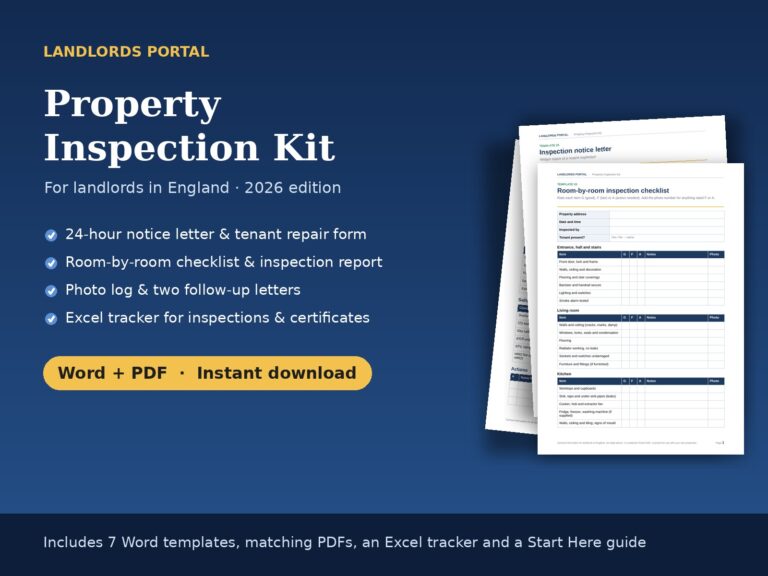
Template pack from Landlords Portal
Run every inspection properly: the Property Inspection Kit
Dated evidence of the property's condition protects you in repair, damp and deposit disputes. This kit gives you every document for an inspection, written for landlords in England.
- 24-hour notice letter and tenant repair report form
- Room-by-room checklist, inspection report and photo log
- Follow-up letters, plus an Excel tracker for gas safety, EICR and EPC dates