Renting to disabled tenants is both a legal duty and a sensible commercial decision — accessible homes are in short supply and disabled tenants often make stable, long-term renters. But the law here is widely misunderstood: the Equality Act 2010 requires you to adjust your policies and provide auxiliary aids, but it does not require you to physically rebuild the let property yourself. This guide sets out what you must do, what you don’t have to do, and how physical adaptations are actually funded.
Last reviewed: 7 August 2026. Applies to England; grant limits and some rules differ in Wales, Scotland and Northern Ireland.
Key takeaways
- Under the Equality Act 2010 you must not refuse to let, charge more, or evict someone because of a disability.
- Your reasonable-adjustments duty covers changing policies and providing auxiliary aids — for example allowing an assistance dog despite a no-pets rule.
- For a let home, you are not required to alter physical features (ramps, widened doors) yourself.
- Physical adaptations are usually arranged by the tenant and funded by a Disabled Facilities Grant (up to £30,000 in England) — you must not unreasonably refuse consent.
- Handle requests promptly and in writing, and offer information in accessible formats.
What the Equality Act 2010 requires
Disability is a protected characteristic. As a landlord, three things are unlawful: direct discrimination (treating someone worse because of disability), discrimination arising from disability (treating them unfavourably because of something connected to it, without good justification), and failing to make reasonable adjustments. In practice that means you cannot refuse an applicant, set a higher rent or deposit, or seek possession because of a disability.
What “reasonable adjustments” actually means
This is the most misunderstood part. For let residential premises, your reasonable-adjustments duty covers:
- Changing a policy, criterion or practice — the classic example is allowing an assistance or guide dog even where you operate a no-pets policy.
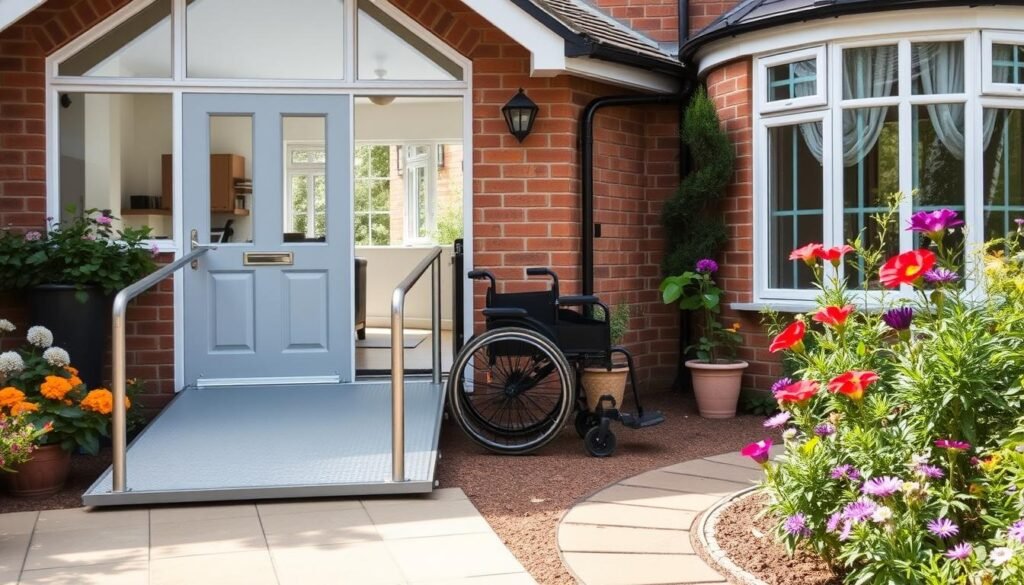
- Providing an auxiliary aid or service — such as a portable temporary ramp for access, or giving the tenancy agreement in large print or an accessible format.
- Common parts (in a block) — a disabled tenant can request reasonable adjustments to shared areas, considered on their merits.
Importantly, the duty for a let dwelling does not extend to removing or altering physical features — you are not legally required to widen doorways, fit a wet room or install a permanent ramp yourself. That distinction surprises many landlords, and getting it wrong (either refusing a legitimate policy adjustment, or assuming you must fund a full conversion) causes problems.
How physical adaptations are funded
When a tenant needs a physical change — a stairlift, a wet room, a permanent ramp — this is normally arranged by the tenant through their local council’s Disabled Facilities Grant (DFG), which provides up to £30,000 in England towards eligible adaptations following an assessment. The tenant will usually need your consent as landlord, and you must not withhold it unreasonably. Agree in writing what happens at the end of the tenancy (whether the adaptation stays or is reinstated), and you can reasonably ask that any work is done to a proper standard by suitable trades.
Handling an adjustment or adaptation request
Handling a request, step by step
Respond promptly; don’t dismiss it.
e.g. an assistance dog or accessible paperwork — that’s your duty; agree it.
Usually DFG-funded and tenant-led — give consent unless you have a genuine, reasonable objection.
Point the tenant to their local authority’s adaptation team.
Keep the request, your response and any agreement on file.
Small changes landlords can make
Even where you’re not obliged to, small, low-cost improvements can make a home far more lettable to a large and under-served group of tenants — and often pay for themselves in longer tenancies. Lever taps, grab rails, a threshold ramp and a flashing/vibrating smoke alarm are inexpensive and widely welcomed.
Simple support by the bath, shower or steps.
Eases a wheelchair or frame over a doorstep.
Far easier to use than traditional twist taps.
Alerts tenants who are deaf or hard of hearing.
How the Renters’ Rights Act fits in
The Renters’ Rights Act 2025 did not change the Equality Act duties, but it reinforces the direction of travel. Section 21 is abolished, so you cannot end a tenancy without a Section 8 ground — and evicting because of a disability would be unlawful discrimination in any case. The Act’s new rules on pet requests also sit alongside the long-standing duty to allow an assistance dog, which is a reasonable adjustment rather than an optional pet.
FAQ
Do I have to pay to adapt my property for a disabled tenant?
No. For a let home you are not required to alter physical features. Physical adaptations are usually arranged by the tenant and funded through a Disabled Facilities Grant; your role is to consider the request fairly and not unreasonably refuse consent.
Can I refuse an assistance dog if I have a no-pets policy?
No. Allowing an assistance or guide dog is a reasonable adjustment under the Equality Act 2010, so a general no-pets policy must give way. An assistance dog is not treated as an ordinary pet.
How much is a Disabled Facilities Grant?
Up to £30,000 in England towards eligible adaptations, administered by the local council after an assessment. Limits differ in Wales, Scotland and Northern Ireland.
Can I charge a disabled tenant a higher rent or deposit?
No. Charging more, refusing to let, or seeking possession because of a disability is unlawful discrimination under the Equality Act 2010.
Written by the Landlords Portal team — experienced UK landlords covering the private rented sector. This article is general information, not legal advice; take professional advice on a specific case, and see the Equality and Human Rights Commission and your local council for guidance.