
Two common letting tactics are now unlawful. Under the Renters’ Rights Act you can’t ask for several months’ rent in advance, and you can’t run a rental bidding war by inviting or accepting offers above your advertised price. Both were everyday tools in hot markets; both are gone. This guide explains the new rules on advance rent and bidding, and what landlords and agents must do at the start of every tenancy.
It’s a supporting guide to our Renters’ Rights Act 2026 landlord checklist.

Key takeaways
- No rent before signing. You can’t take any rent before the tenancy agreement is signed.
- Advance rent capped at one month. Once signed, you can ask for at most one month’s rent up front.
- Rental bidding is banned. You must advertise a fixed rent and can’t invite or accept higher offers.
- Holding deposits still apply, capped at one week’s rent as before.
- Agents are caught too. The rules apply to letting agents acting for you.
The rental bidding ban
When you advertise a property to let, you must state a proposed rent, and you — or your agent — must not invite or encourage offers above that figure, nor accept one. The practice of listing low and letting applicants bid each other up, common in tight markets, is now prohibited. You can still choose between applicants on normal grounds such as affordability and references; you just can’t pick the highest bid above the advertised rent.
The aim is transparency: a renter should be able to trust the advertised price. For landlords it means pricing realistically from the outset, because there’s no longer a mechanism to capture extra demand through a bidding war.
The rent-in-advance cap
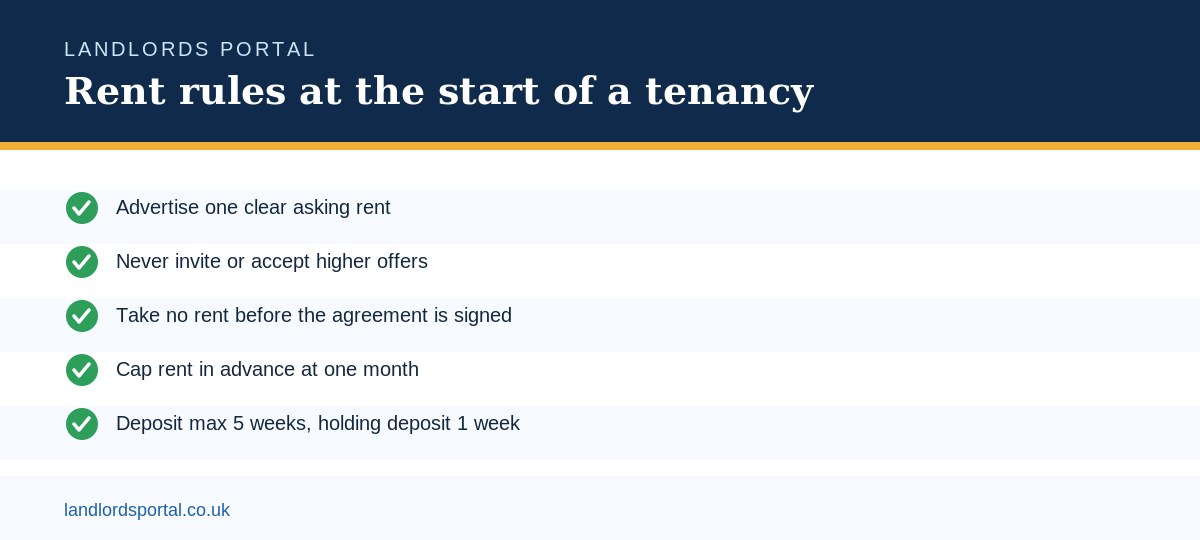
Large upfront payments were often used to secure a tenancy or offset weaker references. The Act restricts this sharply:
- Before the tenancy is signed, you cannot require any rent payment at all.
- After signing, you can ask for a maximum of one month’s rent in advance.
- The deposit cap is unchanged — five weeks’ rent where annual rent is under £50,000, six weeks above — and the holding deposit is still capped at one week.
This particularly affects lets to tenants who previously offered six or twelve months up front — for example some international students or self-employed applicants. With that option gone, robust referencing and guarantors matter more; the rent itself still rises only through the Section 13 process.
What landlords and agents must do
- Advertise a clear, realistic rent and stick to it.
- Don’t invite or accept offers above it — brief your agent in writing.
- Take no rent until the agreement is signed, then no more than one month in advance.
- Lean on referencing and guarantors rather than upfront cash to manage risk.
Written by the Landlords Portal editorial team. General information, not legal or financial advice — confirm the current rules and caps on GOV.UK or with the NRLA before letting.
Why these rules exist
Both measures target the same thing: the way a shortage of homes let some landlords and agents extract more from desperate applicants. In hot markets, properties were sometimes advertised at a low “from” price to draw a crowd, then let to whoever bid highest — pricing out anyone who couldn’t gamble extra money. Large upfront payments did something similar, quietly favouring applicants with cash to spare and disadvantaging everyone else, including many who could comfortably afford the monthly rent. The Renters’ Rights Act tackles both by insisting on a transparent advertised price and a strict cap on how much rent you can take before and at the start of a tenancy. For landlords, the practical effect is that you compete on the quality of your property and the reliability of your applicants, not on who can pay the most up front.
The bidding ban in practice
When you market a property to let you must state a proposed rent, and from that point you — and any agent acting for you — must not invite, encourage or accept an offer above it. That doesn’t strip away your ability to choose a tenant; it simply removes price as a bidding mechanism. You can still assess applicants on the things that actually predict a good tenancy: affordability against the advertised rent, references, employment or income verification, and, where appropriate, a guarantor. If several applicants all meet the criteria at the advertised rent, you choose between them on those merits — not by asking who will pay more.
If you use a letting agent, brief them in writing that the property is to be let at the advertised rent and that no higher offers are to be solicited or accepted on your behalf. The rules apply to agents as much as to landlords, and an agent breaching them exposes you to risk and reputational damage. Pricing realistically from the outset is now the whole game: set the advertised rent at the genuine market level so you attract the right applicants without needing a bidding war you’re no longer allowed to run.
The rent-in-advance cap in detail
The cap on advance rent works in two stages. Before the tenancy agreement is signed, you cannot lawfully require any rent payment at all — not a month, not a token amount. Once the agreement is signed, you can ask for a maximum of one month’s rent in advance. That’s the ceiling, and it applies regardless of who suggests otherwise: even if an applicant offers six or twelve months up front to strengthen their application, you can’t require or accept it. The cap is a hard limit, not a default you can negotiate around.
This is a genuine change of approach for lettings that historically leaned on big upfront sums. The deposit rules sit alongside it, unchanged: a tenancy deposit is capped at five weeks’ rent where the annual rent is under £50,000, or six weeks where it is £50,000 or more, and it must be protected in an approved scheme with the prescribed information served. A holding deposit, taken to reserve a property while referencing is completed, remains capped at one week’s rent and must be dealt with according to the rules on when it is returned or retained.
Who this affects most — and what to do instead
The applicants who relied on paying rent up front are often those with thinner conventional references: international students without a UK credit history, the newly self-employed, people returning from abroad, or those between jobs. Removing the upfront option doesn’t remove these tenants — it just means you manage the risk differently. The main tools are robust referencing and, where appropriate, a UK-based guarantor who agrees to cover the rent if the tenant defaults. A rent guarantee insurance product, taken out by the landlord, can also provide a safety net. The shift is from “show me cash up front” to “show me you can sustainably afford this”, which for most landlords is a more reliable signal anyway.
A worked scenario
Imagine a two-bed flat advertised at £1,400 a month. Three applicants apply. One offers £1,550 to stand out; another offers six months’ rent up front; the third simply meets the affordability criteria with good references and a guarantor. Under the Act, you cannot accept the £1,550 offer, and you cannot accept the six months up front. You let at £1,400, take up to one month’s rent in advance after signing, a deposit of up to five weeks, and a holding deposit of up to one week while referencing completes. You choose between applicants on references and affordability. The applicant who tried to win on price gets no advantage; the one who is genuinely the safest bet does. That is exactly the outcome the rules are designed to produce.
Penalties and enforcement
These rules are backed by enforcement, not just good intentions. Local authorities can issue civil penalties against landlords and agents who breach the advance-rent and bidding rules, so a breach isn’t a victimless shortcut — it’s a financial risk. As with the rest of the Act, the cheapest compliance is to build it into your standard process: advertise a fixed, realistic rent; never solicit or accept higher offers; take no rent before signing and no more than one month after; and keep the deposit and holding deposit within their caps. Document what you took and when, so you can show you stayed inside the limits.
Common mistakes to avoid
- Advertising a “from” price and letting applicants bid up — the ban prohibits exactly this.
- Accepting a higher offer a tenant volunteers. You must let at the advertised rent.
- Taking rent before the agreement is signed. Nothing is payable until signing.
- Accepting more than one month’s rent in advance, even when offered.
- Not briefing your agent in writing — their breach is your problem.
The bottom line
The advance-rent cap and the bidding ban reward landlords who price accurately and assess applicants properly. Advertise a fair, fixed rent, choose tenants on affordability and references rather than upfront cash, and keep every payment within its cap. Manage the genuinely higher-risk applicants with referencing, guarantors and rent guarantee insurance rather than big advance payments, and you’ll stay fully compliant while still letting to a wide pool of good tenants.
Marketing a let without a bidding war
The end of bidding changes how you think about marketing. Under the old approach, a tempting headline price could draw a crowd and let the market find the ceiling. Now the advertised rent is the rent, so the work shifts to setting that number correctly in the first place and presenting the property well enough to attract the right applicants at it. Spend your effort on accurate pricing — checking genuine comparables for similar homes in the same area — and on good photography, a clear description and prompt viewings. A realistically priced, well-presented property let at its advertised rent will usually fill quickly with a strong applicant, which is a better outcome than a chaotic bidding contest that leaves a resentful tenant paying over the odds.
Getting affordability checks right
Because you’re choosing tenants on suitability rather than the size of their offer, your referencing process carries more weight. A sound affordability check looks at income against the advertised rent — a common rule of thumb is that rent should be around a third or less of gross income — together with employment or self-employment evidence, previous landlord references and identity and right-to-rent checks. The goal is a tenant who can comfortably sustain the rent for the long term, which matters all the more now that ending a tenancy requires a Section 8 ground rather than a simple notice. Thorough, consistent checks protect you far more reliably than a lump sum of advance rent ever did.
Guarantors and rent guarantee insurance
For applicants whose references are thin — students, the newly self-employed, those new to the UK — the right safety net is a guarantor or insurance, not upfront cash. A guarantor is usually a UK-based homeowner who agrees in a signed deed to cover the rent if the tenant defaults; make sure the guarantee is properly documented and that the guarantor is themselves referenced. Rent guarantee insurance, taken out by the landlord, pays out if the tenant stops paying and often covers some legal costs of possession, subject to the policy’s conditions. Either route manages the genuine risk these applicants present while keeping you firmly inside the advance-rent cap.
Rent in advance versus a deposit: keep them separate
It’s easy to blur the different sums you can take at the start of a tenancy, but they are governed by separate rules and shouldn’t be mixed up. Rent in advance is payment of future rent — now capped at one month, and nothing before signing. A tenancy deposit is security against damage and unpaid rent — capped at five or six weeks and protected in a scheme. A holding deposit reserves the property during referencing — capped at one week. Each has its own cap and its own purpose, and dressing one up as another to get round a limit is exactly the kind of thing the rules are designed to catch. Itemise clearly what each payment is for, so there’s no ambiguity if it’s ever questioned.
What happens if you breach the rules
Breaching the advance-rent cap or the bidding ban isn’t a grey area you can quietly absorb. Local authorities can investigate and issue civil penalties, and a pattern of breaches invites closer scrutiny of your wider compliance. Beyond the financial risk, there’s a reputational one: tenants increasingly know their rights, and a landlord or agent seen to be flouting the rules can attract complaints and reviews that make future lets harder. The sensible course is to treat the caps as bright lines, brief everyone acting for you accordingly, and keep simple records of what you charged at the start of each tenancy.
Documenting your compliance
As with the rest of the Act, a little record-keeping removes most of the risk. For each new tenancy, keep a note of the advertised rent, the rent actually agreed, the advance rent taken and when, the deposit and holding deposit amounts, and confirmation that no offers above the advertised rent were solicited or accepted. If you use an agent, keep your written instruction that the property was to be let at the advertised rent. Should a council ever ask, you can then demonstrate compliance in minutes rather than reconstructing it from memory.
Choosing fairly between equally strong applicants
One question landlords ask is how to pick a tenant when several applicants all meet the criteria at the advertised rent and you can no longer let price decide. The answer is to choose on objective, defensible factors: the strength and completeness of references, verified affordability, the availability of a suitable guarantor where needed, and practical fit such as the intended move-in date. Apply the same checks to everyone and keep a brief note of why you chose as you did. Be alert, too, to equality law — you must not select or reject applicants on the basis of protected characteristics such as race, disability, sex or family status, and “No DSS”-style blanket bans on benefit claimants are unlawful. A consistent, criteria-based process protects you from both a bidding-ban breach and a discrimination complaint.
A final word
The advance-rent cap and bidding ban formalise a simple principle: renters should be able to trust the advertised price and shouldn’t have to buy their way to the front of the queue. For organised landlords the adjustment is small — price accurately, reference well, use guarantors or insurance for higher-risk applicants, and keep every payment within its cap. Do that and you’ll let your properties quickly and lawfully, to tenants chosen on the things that actually make a tenancy work.
Frequently asked questions
How much rent in advance can I ask for?
None before the tenancy is signed, and a maximum of one month’s rent after signing. Larger advance payments are no longer permitted.
Can a tenant still choose to pay more up front?
The cap applies regardless of who suggests it — you can’t require or accept more than one month’s rent in advance, even if the tenant offers.
Can I accept a higher offer if a tenant volunteers one?
No. You must let at the advertised rent and can’t accept offers above it. You can still select between applicants on affordability and references.
Has the deposit cap changed?
No. Tenancy deposits remain capped at five weeks’ rent (six weeks where annual rent is £50,000 or more) and holding deposits at one week.
Next: back to the Renters’ Rights Act landlord checklist.