
Saying “no pets” by default is over. Under the Renters’ Rights Act, a tenant now has the right to request a pet, and you must consider it properly — answering in writing within 28 days and refusing only where you have a genuine, reasonable ground. This guide explains the new pets in rental properties rules, what counts as a reasonable refusal, and the practical, inexpensive ways to protect your property when you say yes.
It’s a supporting guide to our Renters’ Rights Act 2026 landlord checklist.

Key takeaways
- Tenants can request a pet in writing, and you must respond in writing within 28 days.
- You can’t refuse unreasonably. A blanket “no pets” policy no longer holds.
- Miss the deadline and it’s deemed granted. No timely response can mean the pet is allowed by default.
- You can’t require pet insurance from the tenant — that requirement was dropped from the Act.
- Protect with the deposit and sensible kit, not a refusal.
The new right to request a pet
The Renters’ Rights Act gives tenants a right to request to keep a pet, and places a duty on landlords not to unreasonably refuse. The tenant should make the request in writing and describe the pet. From the moment you receive it, the clock starts: you have 28 days to respond in writing. If you need more information to decide, you can ask for it, and you then have either seven days from receiving that information or the rest of the original 28-day period — whichever is later — to give your answer. The NRLA’s guidance on pets sets out the documents to use.
Crucially, if you simply don’t respond in time, the request can be treated as granted by default. Diarise every pet request the day it arrives.
When is a refusal “reasonable”?
The Act doesn’t give an exhaustive list, but a refusal generally needs to be tied to the specific property and pet rather than a general dislike of animals. Reasonable grounds can include:
- A superior landlord’s ban — for example a head lease or freeholder that prohibits pets in the building.
- An unsuitable property — such as a large dog in a small flat with no outdoor space.
- Too many animals for the size and type of home.
Put your reasons in writing. A tenant who believes a refusal is unreasonable can challenge it, so a clear, property-specific explanation protects you. For more on the consent process, see our guides on whether landlords can refuse pets and amending a tenancy agreement to allow a pet.
Protecting your property when you say yes
Since you can’t require the tenant to take out or pay for pet insurance, and a blanket refusal is off the table, the smart play is to make the property pet-resilient and recover any genuine damage from the deposit at the end of the tenancy. A few inexpensive items go a long way in a pet-friendly let.
Useful kit for a pet-friendly rental
As an Amazon Associate, we earn from qualifying purchases.
- Hard-wearing vinyl flooring — scratch- and moisture-resistant, far more forgiving than carpet between tenancies.
- Pet stain and odour remover — clears accidents at check-out so they don’t become a deposit dispute.
- Washable matt paint — wipe-clean walls survive muddy paws and the odd scuff.
Common mistakes to avoid
- Ignoring or sitting on a request — silence can hand the tenant the pet by default.
- Refusing “because it’s policy” — you need a property-specific, reasonable ground.
- Demanding pet insurance or a higher deposit — neither is permitted; the deposit cap still applies.
Written by the Landlords Portal editorial team. General information, not legal advice — confirm the current pet-request rules on GOV.UK or with the NRLA before responding to a request.
How the 28-day clock actually works
The 28-day deadline sounds simple, but the detail catches people out. The clock starts when you receive a written request that identifies the pet. You must give your decision in writing within 28 days. If you genuinely need more information to decide — say, the breed and size of a dog, or whether a flat’s freeholder permits pets — you can ask the tenant for it, and your deadline becomes either seven days from receiving that information or the remainder of the original 28 days, whichever is later. What you cannot do is let the time run out in silence: if you simply fail to respond, the request can be treated as having been granted by default. In practice that means a pet you never agreed to, on no conditions at all. The safe habit is to acknowledge every request the day it arrives, diarise the deadline, and reply in writing well before it expires.
Reasonable versus unreasonable refusal: a closer look
The Act lets you refuse, but only where it is reasonable, and reasonableness is judged against the specific property and the specific pet — not a general preference. A refusal grounded in the realities of the home tends to hold; a blanket policy does not. Examples that are likely to be reasonable include a freeholder or head-lease ban on pets in the building, a small flat with no outdoor space that is genuinely unsuitable for a large or energetic dog, or a request to keep several animals in a property plainly too small for them. Examples that are likely to be unreasonable include “I just don’t allow pets”, refusing a small, caged animal in a house with a garden, or refusing without giving any property-specific reason at all.
Whatever you decide, put your reasons in writing and tie them to the property. A tenant who believes a refusal is unreasonable can challenge it, and a clear, specific explanation is your best protection. For more on the consent process, see our guides on whether landlords can refuse pets and amending a tenancy agreement to allow a pet.
Leasehold flats and superior landlords
If you let a leasehold flat, your own lease may prohibit pets or require the freeholder’s consent. That is one of the clearest reasonable grounds to refuse, because you genuinely cannot grant what your lease forbids. Check the head lease before you respond, and if it requires the freeholder’s permission, ask for it promptly so you can give the tenant an accurate answer within the deadline. Keep a copy of the relevant lease clause with your decision, so the basis for any refusal is documented.
Assistance animals are not “pets”
One important distinction sits outside the pet-request regime entirely. A disabled tenant’s assistance dog — a guide dog, hearing dog or other trained assistance animal — is not a pet in the ordinary sense, and refusing it can amount to disability discrimination under the Equality Act 2010. The reasonable-refusal grounds that apply to a family pet do not give you cover to turn away an assistance animal, and a “no pets” stance certainly does not. Treat assistance-animal requests as a separate, higher duty and take advice if you are unsure.
What you can and can’t ask for
It’s easy to reach for the old tools to manage pet risk, but most are no longer available. You cannot require the tenant to take out or pay for pet insurance — that proposal was dropped before the Act passed. You cannot charge a separate “pet deposit” or demand a higher deposit, because the deposit cap is unchanged at five weeks’ rent (six weeks where annual rent is £50,000 or more). And you cannot charge a pet “fee”, as that would breach the rules on prohibited payments. What you can do is allow the pet on sensible written conditions — for example that the tenant keeps the property clean, treats for fleas where relevant, and makes good any damage — and rely on the standard deposit, supported by a good inventory, to cover genuine damage at the end of the tenancy.
Protecting your property the practical way
With refusal and insurance off the table, your real protection is preparation and evidence. A thorough check-in inventory, with dated photographs of floors, walls, doors and gardens, is the single most valuable thing you can do — it is what lets you distinguish fair wear and tear from genuine pet damage at check-out, and what a deposit scheme adjudicator will look for if there’s a dispute. Pair that with a property specified to cope: hard, washable surfaces survive pets far better than carpet and delicate paint. The right preparation turns “yes” to a pet from a risk into a non-event.
When a pet causes damage
If a pet does cause damage beyond fair wear and tear, you recover the cost from the deposit at the end of the tenancy, in the normal way. Set out the deductions clearly, supported by your check-in inventory, the check-out report and quotes or invoices for the work. If the tenant disputes it, the deposit scheme’s free adjudication service decides, weighing the evidence from both sides — which is exactly why the inventory and photographs matter so much. Reasonable, evidenced deductions for real damage are routinely upheld; vague claims without a baseline are not.
Pet-friendly as a letting advantage
It’s worth seeing the change as an opportunity, not just an obligation. Pet owners are a large, underserved and often long-staying group of renters who tend to value a landlord that says yes. A well-presented, pet-friendly property can let faster, command a fair rent and keep tenants for longer — and in a world where you can no longer simply end a tenancy at will, a settled, grateful, long-term tenant is worth a great deal. Approached well, the new rules can work in your favour.
Common mistakes to avoid
- Letting the 28 days lapse. Silence can hand the tenant the pet by default, on no conditions.
- Refusing “because it’s policy”. You need a property-specific, reasonable ground, in writing.
- Charging a pet deposit, pet fee or demanding pet insurance. None is permitted.
- Treating an assistance animal as a pet. That can be disability discrimination.
- Saying yes without a good check-in inventory. Without a baseline you can’t prove pet damage later.
Conditions worth setting in writing
When you agree to a pet, you are allowed to attach reasonable conditions, and writing them down protects both sides. Sensible conditions keep the home in good order without being punitive. Common ones include keeping the pet under control and not allowing it to cause a nuisance to neighbours, keeping the property clean and free of odours, treating for fleas and worms where relevant during and at the end of the tenancy, repairing or making good any damage the pet causes, and not keeping additional animals without asking again. Frame these as a short addendum to the tenancy or a simple written consent letter, signed and dated. The point is not to trip the tenant up but to set clear, fair expectations that you can both refer back to.
Be careful, though, not to dress up a prohibited charge as a “condition”. You can require the tenant to make good damage; you cannot require them to pay for professional cleaning as a blanket condition, demand a pet fee, or insist on pet insurance. Keep conditions about behaviour and outcomes, not about extra money.
A simple process you can reuse every time
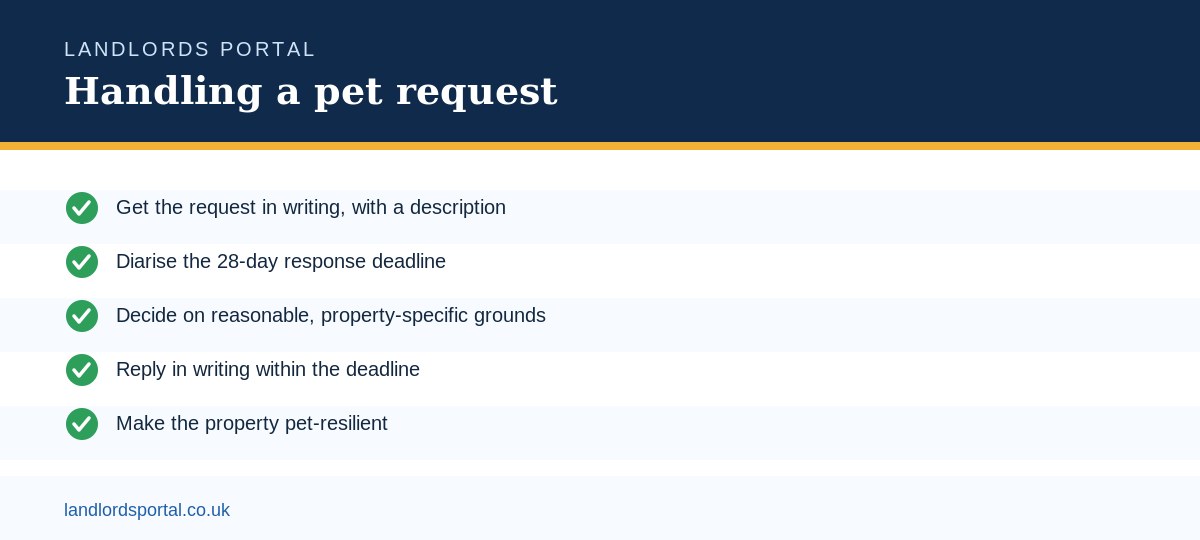
Because pet requests will now be routine, it pays to have a repeatable process rather than treating each one as a one-off. A reliable approach looks like this. First, ask tenants to put any pet request in writing and describe the animal — its type, breed and size. Second, log the date you receive it and set a reminder for the 28-day deadline. Third, check the property and your lease: is there a freeholder restriction, and is the home genuinely suitable for this pet? Fourth, decide and reply in writing within the deadline — either a yes with reasonable conditions, or a no with a clear, property-specific reason. Fifth, where you say yes, record the consent and conditions, and make sure your check-in inventory and photographs are up to date so you have a baseline. Run that same loop every time and you’ll stay compliant without reinventing the wheel.
How this fits the wider Renters’ Rights Act picture
The pet rules don’t sit in isolation. They are part of a broader rebalancing under the Act that also ended Section 21, changed how rent rises work and tightened the rules on advance payments. The common thread is that landlords now have less ability to act unilaterally and more obligation to act reasonably, on the record, and within set timeframes. The landlords who will find the Act easiest to live with are the organised ones: those who respond promptly, document decisions, keep good inventories and treat tenants — and their pets — as long-term relationships rather than short-term risks. For the full set of duties, work through our Renters’ Rights Act landlord checklist.
The bottom line
You can no longer refuse pets by default, but you are far from powerless. Respond to every request in writing within 28 days, refuse only on reasonable and property-specific grounds, set fair written conditions when you say yes, and lean on a thorough inventory and the standard deposit to handle any damage. Do that and a pet-friendly let becomes a competitive advantage — letting faster, holding tenants longer and steering well clear of the penalties that come from getting the process wrong.
Multiple pets and changes during the tenancy
A consent you give is for the pet the tenant asked about, not an open-ended licence. If a tenant later wants a second animal, or a different one, that is a fresh request that restarts the 28-day process and is judged on its own merits — two cats in a flat that suited one may be a reasonable refusal. Make clear in your written consent that additional animals need a further request, so expectations are set from the outset. Equally, be reasonable about a tenant’s changing circumstances: a request that was unsuitable in a tiny flat may be perfectly fine once they move to a larger property of yours. Judge each request on the property and the pet in front of you.
Frequently asked questions
How long do I have to respond to a pet request?
28 days, in writing. If you need more information you can ask for it, then reply within seven days of receiving it or the remainder of the 28 days, whichever is later.
Can I still say no to pets?
Only where it’s reasonable — for example a freeholder ban or a clearly unsuitable property. A blanket “no pets” policy is no longer lawful, and you must explain your reason in writing.
Can I charge a pet deposit or require pet insurance?
No. The deposit cap is unchanged and you can’t require the tenant to take out pet insurance. You recover genuine pet damage from the standard deposit at the end of the tenancy.
What if I don’t reply in time?
The request can be treated as granted. Always acknowledge a pet request immediately and diarise the 28-day deadline.
Next: back to the Renters’ Rights Act landlord checklist.