
Section 21 has been abolished. Since 1 May 2026, under the Renters’ Rights Act, landlords in England can no longer use the “no-fault” notice that for decades let them end an assured shorthold tenancy without giving a reason. If regaining possession used to mean serving a two-month Section 21 and waiting, that route is now closed — for every tenancy, old and new. In its place is a grounds-based system that demands a genuine reason, the right paperwork and, often, evidence. This guide explains what replaced Section 21 and how to recover your property lawfully.
This is one of the supporting guides to our Renters’ Rights Act 2026 landlord checklist — start there for the full picture, then use this page when you actually need to end a tenancy.
Key takeaways
- No more no-fault eviction. Section 21 ended on 1 May 2026 for all assured tenancies.
- Possession now needs a reason. You must use a Section 8 ground and, for most grounds, prove it to the court.
- Selling or moving in? Grounds 1 and 1A need four months’ notice and can’t be used in the first 12 months.
- Re-letting is restricted. After using the move-in or sale grounds you can’t re-let the property for 12 months.
- Compliance comes first. Deposit, gas, electrical and document failures can defeat an otherwise valid claim.
What was Section 21, and why did it go?
Section 21 of the Housing Act 1988 let a landlord end an assured shorthold tenancy at or after the fixed term without giving any reason, provided the right notice was served and the compliance boxes were ticked. It was quick and certain, which is exactly why it became the centrepiece of reform: tenants and campaigners argued it created chronic insecurity, discouraged people from asking for repairs for fear of a “revenge eviction”, and made it hard to challenge poor conditions. The Renters’ Rights Act abolished it as part of the wider move to open-ended periodic tenancies.
With Section 21 gone, there is no longer any such thing as a “no-fault” eviction in England. Every possession claim must rest on one of the statutory grounds in Section 8 of the same Act — and the government strengthened and reshaped those grounds at the same time, so even landlords familiar with Section 8 should treat it as new territory. The shift is as much cultural as legal: possession is no longer a routine administrative step but a reasoned, evidenced process.
What replaces Section 21: the Section 8 grounds
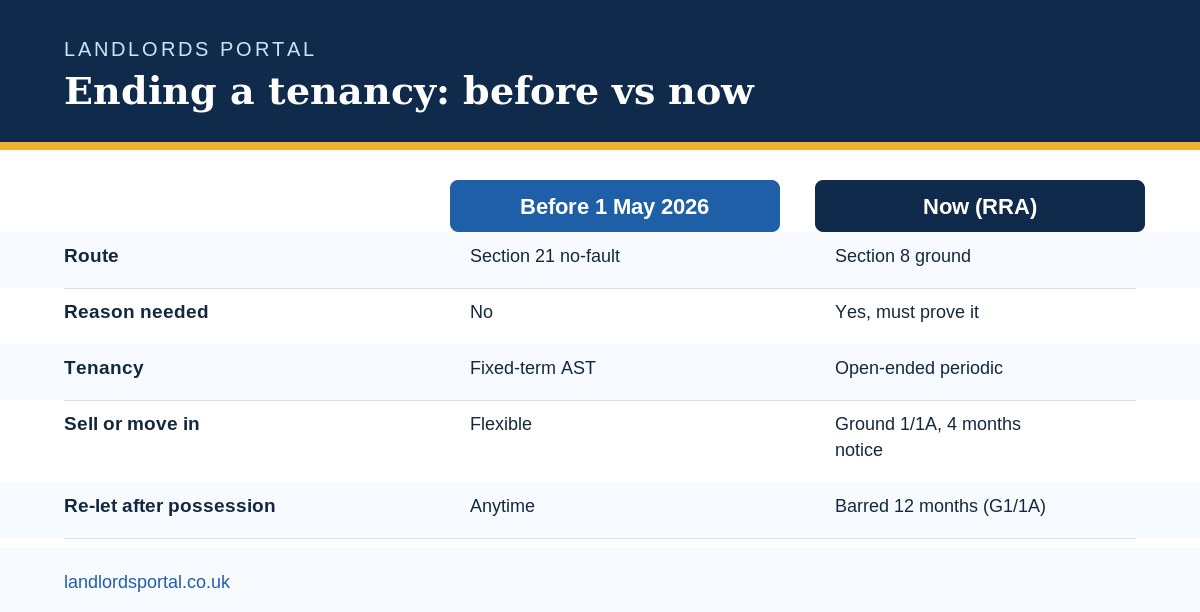
Section 8 grounds fall into two families. Mandatory grounds oblige the court to grant possession if the ground is made out. Discretionary grounds give the court a choice: even if the facts are proved, it grants possession only if it is reasonable to do so. Knowing which is which shapes your strategy, because a mandatory ground is far more predictable than a discretionary one.
The grounds landlords use most
- Ground 1 — you or a close family member want to move in. Mandatory, four months’ notice, and not available in the first 12 months of the tenancy.
- Ground 1A — you intend to sell. Mandatory, four months’ notice, also barred in the first 12 months, with a 12-month restriction on re-letting or re-marketing afterwards.
- Ground 6 — redevelopment. Where you intend to demolish or substantially redevelop and can’t do so with the tenant in place.
- Ground 8 — serious rent arrears. Mandatory, but the threshold rose: you now need at least three months’ (or 13 weeks’) arrears outstanding at both the date of the notice and the date of the hearing, with four weeks’ notice.
- Grounds 10 and 11 — some arrears or persistent late payment. Discretionary alternatives for situations that don’t meet the Ground 8 threshold.
- Ground 14 — anti-social behaviour. Discretionary, with evidence requirements, but can move quickly where behaviour is serious.
Because the move-in and sale grounds can’t be used in the first year and block re-letting afterwards, they can’t be deployed as a back-door no-fault eviction. If you genuinely intend to sell or occupy, they work; if you are really just trying to change tenant, they don’t. If your business model depended on resetting a tenancy each year, read how this plays out for shared houses in our guide to student vs professional HMOs, where a special student ground applies.
Notice periods at a glance
Notice periods now vary by ground rather than being a flat two months. As a rule of thumb, the “landlord circumstance” grounds — moving in, selling, redeveloping — carry the longest notice at four months, reflecting that the tenant has done nothing wrong. Serious rent arrears under Ground 8 carries a much shorter four weeks, because the tenant is in significant default. Anti-social behaviour can be shorter still where the conduct is severe. Always check the exact period for the specific ground before you serve, because serving too short a notice invalidates it and sends you back to the start.
Compliance comes first: what can defeat a claim
One of the biggest practical shifts is that your own paperwork is now on trial alongside the tenant’s conduct. Before you serve any notice, check that:
- the deposit is protected in an approved scheme and the prescribed information was served;
- a valid gas safety record and EICR were provided;
- the How to Rent guide, EPC and the new information sheet were given; and
- required licensing (for HMOs or in selective-licensing areas) is in place.
Gaps in these can delay or defeat a possession claim, so the time to fix them is long before you need to rely on a notice — not in the rush of a dispute. A tenant who is defending a claim, or their adviser, will look hard for exactly these failings.
How to recover possession now, step by step
- Identify a valid ground and check you genuinely meet its conditions and timing.
- Check your compliance is in order — deposit, gas, electrical, alarms and the prescribed documents. Fix gaps first.
- Serve a correct Section 8 notice stating the ground (or grounds) and the right notice period.
- Gather your evidence — a rent statement for arrears, correspondence for breaches, proof of intention for sale or occupation.
- Apply to court if the tenant doesn’t leave, and attend the hearing prepared.
The court process in more detail
If the notice expires and the tenant remains, you apply to the county court for a possession order, supported by your notice, tenancy documents and evidence for the ground. The court will list a hearing; for a defended claim this can take time, and timescales depend heavily on local court capacity. If the court grants a possession order and the tenant still doesn’t leave, you apply for a warrant and county court bailiffs carry out the eviction — you must never attempt to remove a tenant yourself, as that risks a criminal offence of unlawful eviction. Realistically, budget for the whole process to run into months, and keep paying attention to your own compliance throughout, because a defended hearing can turn on a single missing document.
Alternatives to eviction worth considering
Possession is slow, uncertain and expensive, so it’s often worth exploring alternatives first — especially for arrears. A structured repayment plan can recover the money while keeping a paying tenant in place. Where arrears stem from a benefit problem, helping the tenant sort out Universal Credit, or arranging direct payment of the housing element to you, can resolve the issue faster than a court ever would. For behaviour or minor breaches, a clear written warning sometimes does the job. None of this means being a pushover; it means using court as the last resort rather than the first.
Three common scenarios
You want to sell. If the tenancy has run at least 12 months, serve a Ground 1A notice with four months’ notice, then market the property — but remember you can’t re-let it for 12 months if the tenant leaves and the sale falls through. Plan the timing around that restriction.
A family member needs to move in. Ground 1 works on the same four-month, post-12-month basis. Keep evidence of the genuine intention, as a tenant can challenge a ground they believe is a pretext.
The tenant is in serious arrears. If at least three months’ rent is owed, Ground 8 is mandatory with four weeks’ notice — but keep a meticulous rent statement, because the arrears must still meet the threshold at the hearing. If the tenant clears just enough to drop below it, you may have to fall back on the discretionary arrears grounds. For raising rent rather than ending a tenancy, see Section 13 rent increases.
Common mistakes to avoid
- Reaching for Section 21 out of habit. It no longer exists — any claim built on it fails.
- Serving a Section 8 notice with the wrong notice period for the ground used.
- Relying on Ground 8 without a clean rent statement that holds up at the hearing.
- Using the sale or move-in grounds as a pretext — the bars and re-let restriction make that risky and potentially penalised.
- Attempting a “DIY” eviction — only county court bailiffs can lawfully remove a tenant.
- Ignoring your own compliance gaps until the tenant raises them in court.
Written by the Landlords Portal editorial team. This is general information, not legal advice — confirm the current grounds and notice periods on GOV.UK or with the NRLA, and take advice before serving any notice or starting a claim.
Tenant notice: the other side of the coin
It’s easy to focus on how landlords end a tenancy and forget that the Act also reshaped how tenants leave. Under the periodic regime, a tenant can end the tenancy at any time by giving two months’ notice, with no need to wait for a fixed term to expire. That cuts both ways. It means you can’t hold a tenant to a year if they want to go, so you may face more frequent moves and the void periods that come with them. But it also means an unhappy tenant has a clean exit rather than a reason to dig in, and a good tenant who feels fairly treated has every incentive to stay. The practical response is to compete on being a landlord people want to keep renting from: responsive repairs, fair rent reviews, and a property kept in good order. Retention is now a financial strategy, not just a nicety.
Selling with a tenant in situ
Ground 1A is not the only way to sell. If your goal is simply to realise the capital rather than to deliver vacant possession, you can sell the property with the tenant in place to another landlord or an investor, and avoid the possession process entirely. A tenanted sale may achieve a slightly lower price than an empty one in some markets, but it sidesteps the four-month notice, the 12-month bars and the re-let restriction, and it keeps rental income flowing right up to completion. Weigh the two routes deliberately: vacant possession via Ground 1A for the broadest buyer pool and best price, or a tenanted sale for speed, simplicity and continued income. For a fuller treatment, our guides on selling a tenanted property walk through both paths.
Keeping records from day one
The single best preparation for a future possession claim is good record-keeping from the very start of the tenancy, long before any dispute. Keep the signed tenancy agreement, the deposit protection certificate and prescribed information, every safety certificate, proof you served the How to Rent guide, the EPC and the information sheet, a running rent statement, and a dated log of any issues or correspondence. If you ever need to rely on a Section 8 ground, this file is what turns a contestable claim into a straightforward one. Landlords who keep tidy records rarely lose on a technicality; those who don’t are the ones tripped up by a missing certificate or an unprotected deposit at the worst possible moment.
When to take professional advice
Some possession situations are routine; others are not. It’s worth getting professional help — from a solicitor, an experienced agent or a landlord association such as the NRLA — where a tenant is defending the claim, where anti-social behaviour or domestic-abuse issues are involved, where your own compliance has gaps you’re unsure about, or where significant arrears and a vulnerable tenant make the picture complex. The cost of advice is usually small against the cost of a failed claim, a wasted notice period or an unlawful-eviction allegation. Knowing when a situation has moved beyond a standard process is itself a valuable skill.
A shift in mindset, not just rules
Step back and the abolition of Section 21 is really a change of mindset. The old model treated possession as an administrative entitlement; the new one treats it as a reasoned, evidenced step you take for a genuine reason. Landlords who adapt — who reference carefully, document everything, maintain their properties and treat tenancies as long-term relationships — will find the system entirely workable. Those who relied on the threat of a no-fault notice to manage tenancies will find it harder. The grounds exist, they work, and they protect legitimate needs to sell, move in or deal with default; they just ask you to be organised and act in good faith.
Frequently asked questions
Can I still use a Section 21 notice served before May 2026?
Only valid Section 21 notices served before the changeover, and within transitional limits, could still be acted on for a short window. For practical purposes, treat Section 21 as gone and use Section 8.
How do I evict for rent arrears now?
Use Ground 8 for serious arrears (at least three months or 13 weeks owed at both notice and hearing) with four weeks’ notice, or a discretionary arrears ground for smaller sums. Keep a clear, up-to-date rent statement as evidence.
Can I evict to sell the property?
Yes, under Ground 1A, with four months’ notice. You can’t use it in the first 12 months of the tenancy, and you can’t re-let the property for 12 months after using it.
How long does a possession claim take?
It varies with the ground and court capacity, but plan for several months from notice to a possession order, longer if the claim is defended. Good paperwork and evidence are the best way to avoid delay.
Can I remove a tenant myself if they won’t leave?
No. You must obtain a possession order and, if needed, a warrant for county court bailiffs to carry out the eviction. Trying to remove a tenant yourself risks a criminal offence of unlawful eviction.
Does this apply to existing tenancies?
Yes. Existing assured shorthold tenancies converted to periodic tenancies on 1 May 2026 and lost access to Section 21 from that date.
What if my compliance paperwork isn’t up to date?
Fix it before serving any notice. Missing deposit protection, safety records or prescribed documents can delay or defeat a possession claim, so bring everything current first.
Next: back to the Renters’ Rights Act landlord checklist.