
You served notice, the date has come and gone, and your tenant is still living in your property. It is one of the most stressful moments a landlord faces — and in 2026 it comes with a twist. Section 21, the old “no-fault” route many landlords fell back on, was abolished on 1 May 2026. So the reassuring advice you find on older pages no longer applies. The one rule that has not changed, and matters more than any other, is this: a notice does not force anyone out, and you cannot evict them yourself.
This guide explains what a notice actually does, what to do when a tenant ignores it now that Section 21 is gone, and the steps that legally get your property back — without you committing a criminal offence in the process.
The situation in plain terms
Key takeaways
- A notice (Section 8 or, before it was abolished, Section 21) only gives you the right to apply to court — it does not end the tenancy or force the tenant out.
- Section 21 was abolished on 1 May 2026. New possession claims must use Section 8 grounds on the prescribed Form 3A.
- If the tenant won’t leave, you apply to the county court for a possession order, then a warrant of possession if they still stay.
- Changing the locks, removing belongings or cutting off utilities to force a tenant out is an unlawful eviction — a criminal offence under the Protection from Eviction Act 1977.
- Only a county court bailiff or High Court Enforcement Officer can physically remove a tenant.
“Notice to quit” vs the notice you actually need
First, a point of terminology that trips landlords up. A true notice to quit is the document that ends a common-law or excluded tenancy — for example a lodger arrangement. For a standard residential tenant on what is now an assured periodic tenancy, you do not serve a notice to quit; you serve a Section 8 notice citing one or more legal grounds.
Whatever it is called, the effect is the same and worth burning into memory: the notice does not end the tenancy by itself. It sets a date after which, if the tenant has not left, you may ask a court to order possession. Many tenants stay past the date — sometimes because they cannot find anywhere else, sometimes on the advice of the council, who may tell them not to leave until a court orders it. That is lawful on their part, however frustrating.
Step 1: Check your notice was valid
Before spending court fees, make sure the notice actually stands up, because a defective notice is the number-one reason claims fail. Since 1 May 2026 a Section 8 notice must:
- Be on the current prescribed Form 3A (the old Form 3 is invalid);
- State every ground you rely on, with the supporting facts;
- Give the correct notice period — four weeks for rent arrears, longer for several other grounds;
- Be properly served, with proof of how and when.
If any of that is wrong, it is usually faster to serve a fresh, correct notice than to gamble on a flawed one at a hearing.
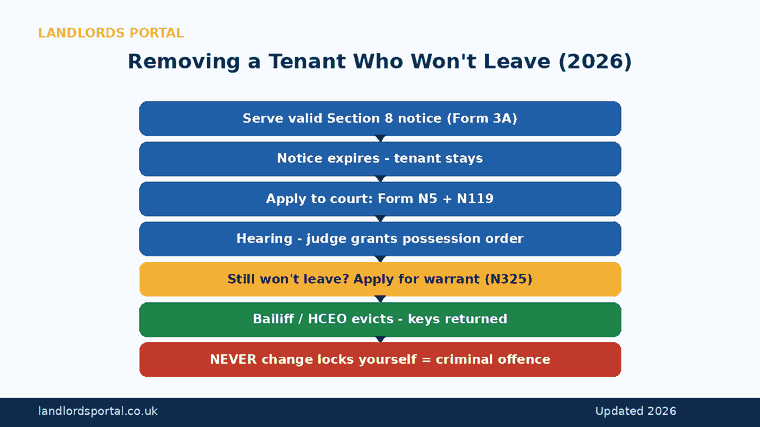
Step 2: Apply to the county court for a possession order
Once a valid notice has expired and the tenant remains, apply to the county court on Form N5 together with Form N119 (the particulars of claim). The standard possession-claim fee rose to £415 on 13 July 2026. The court serves the papers on the tenant, who can file a defence, and then lists a hearing — expect roughly eight weeks’ wait, often more in busy areas.
With Section 21 gone, the old accelerated “no-hearing” route (Form N5B) is no longer available for these claims. Every case now goes through a hearing, so prepare your evidence: the tenancy agreement, the notice and proof of service, and — for arrears — an up-to-date rent statement.
Step 3: The hearing and the order
At the hearing the judge either grants possession or, on discretionary grounds, may make a suspended order allowing the tenant to stay on conditions. An outright order normally gives the tenant 14 days to leave, extendable to six weeks for exceptional hardship. If you relied on a mandatory ground such as Ground 8 and proved it, the court must grant possession.
Step 4: When they still won’t go — the warrant of possession
This is the stage that catches landlords out. Even with a possession order in hand, you still cannot remove the tenant yourself. If they ignore the order, apply for a warrant of possession on Form N325 (fee £152 since 13 July 2026). A county court bailiff is then appointed to carry out the eviction and hand you back the keys.
Bailiff waiting times vary widely — from a few weeks to several months. If the delay is severe, you can ask the court’s permission to transfer enforcement to the High Court, where a High Court Enforcement Officer can usually act faster, at higher cost. Only when the bailiff or HCEO has carried out the eviction do you lawfully have your property back.
What you must never do
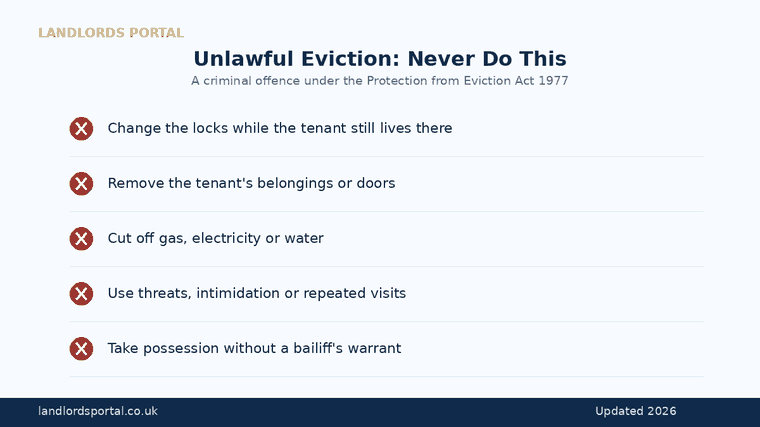
The temptation, when a tenant sits tight for months, is to take matters into your own hands. Don’t. Under the Protection from Eviction Act 1977, it is a criminal offence to evict a residential occupier without a court order, or to harass them into leaving. That includes:
- Changing the locks while the tenant still lives there;
- Removing their belongings or doors;
- Cutting off gas, electricity or water;
- Threats, intimidation or repeated unwanted visits.
Unlawful eviction can lead to prosecution, an unlimited fine, and a substantial damages claim from the tenant. It also hands a defended tenant a powerful counterclaim. However long it takes, stay on the lawful side of the line.
Once you lawfully have the property back
After the bailiff has carried out the eviction and handed you the keys, now you can secure the property — and you should do so immediately. Change the locks the same day, check the property over, and deal with anything left behind under the Torts (Interference with Goods) Act 1977 rather than simply binning it. Securing an empty property promptly also protects you against squatters and insurance problems during the void.
Useful kit for re-securing the property (after lawful possession)
As an Amazon Associate, we earn from qualifying purchases.
- Replacement euro-cylinder locks — change every external lock the day you get the keys back.
- A wall-mounted key safe — manage access for cleaners and contractors during the void.
- A Wi-Fi security camera — deters squatters and helps you monitor an empty property.
For more on preparing the property to re-let quickly, see our guide to reducing void periods, and if items were left behind, our guide to abandoned belongings.
The bottom line
With Section 21 gone, a tenant who won’t leave after notice must be removed through the Section 8 court process — notice, possession order, then bailiff warrant if needed. It is slower and more procedural than the route many landlords remember, and patience is expensive. But the one shortcut that will ruin you is taking possession yourself. Follow the court process to the end, secure the property the moment it is lawfully yours, and re-let with tighter referencing next time.
Written by the Landlords Portal editorial team. General information for UK landlords, reflecting the law in England as of July 2026. It is not legal advice — take advice on your specific circumstances before acting.
Frequently asked questions
My tenant won’t leave after the notice expired — can I change the locks?
No. While the tenant is still in occupation, changing the locks is an unlawful eviction and a criminal offence. You must obtain a possession order and, if necessary, a bailiff’s warrant before anyone can be removed.
Is Section 21 really gone in 2026?
Yes. Section 21 “no-fault” evictions were abolished on 1 May 2026 under the Renters’ Rights Act 2025. All new possession claims must be brought on Section 8 grounds using Form 3A.
How long does it take to remove a tenant who refuses to go?
Realistically four to eight months from serving the Section 8 notice, allowing for the notice period, the wait for a hearing, the possession-order period and bailiff enforcement. Busy court areas can take longer.
What is the difference between a notice to quit and a Section 8 notice?
A notice to quit ends certain common-law or excluded tenancies, such as a lodger arrangement. For a standard assured tenant you serve a Section 8 notice citing legal grounds. Neither, on its own, forces the tenant out.
Can the council really tell my tenant to stay until eviction?
Yes. Councils often advise tenants not to leave until a court orders it, to avoid being treated as intentionally homeless. It is lawful for the tenant to remain until the possession process concludes.
What happens to belongings the tenant leaves behind?
You cannot simply dispose of them. Under the Torts (Interference with Goods) Act 1977 you must give the former tenant reasonable notice to collect their belongings before you can sell or dispose of them.