
Updated October 2026 for the Renters’ Rights Act. England.
When a tenant seems to have vanished, the temptation is to change the locks, clear the flat and re-let. Don’t. A property that looks empty is not legally abandoned, and taking it back too early can turn an unpaid-rent problem into an unlawful eviction claim. This guide explains how to confirm what has happened, the three lawful ways to recover the property, what to do with anything left behind, and how to recover your losses.
Key takeaways
- There is no legal procedure for declaring a property abandoned in England. The tenancy continues until it ends by notice, surrender or court order.
- You can recover possession by an express surrender, an implied surrender (the tenant’s conduct clearly shows they have given up the tenancy), or a Section 8 possession order.
- Changing the locks while the tenancy still exists risks a claim and a criminal offence under the Protection from Eviction Act 1977.
- Belongings left behind are handled under the Torts (Interference with Goods) Act 1977: store them, notify the tenant, and allow a reasonable time before any sale.
- Since 1 May 2026, Ground 8 needs three months’ arrears and four weeks’ notice on Form 3A.
First, is the property really abandoned?
Look for a pattern, not a single sign. Typical indicators are:
- Rent has stopped and the tenant isn’t answering calls, texts or emails
- Post is piling up and neighbours have not seen anyone for weeks
- Utilities have been closed or meters show no use
- Furniture and personal items have gone, or the keys have been returned
A tenant who is in hospital, travelling or in custody has not abandoned the tenancy. Before you act, try every contact route in your file: phone, email, guarantor, emergency contact and forwarding address. Keep a dated log of each attempt, photos of the property and any neighbour statements. That record is your evidence if the tenant reappears.

Getting into the property
The tenant still has the right to occupy, so give at least 24 hours’ written notice before an inspection, as your tenancy agreement and section 11 of the Landlord and Tenant Act 1985 require. Enter without notice only in a genuine emergency, such as a leak or fire risk. If the property is insecure, make it safe (board a broken window, secure a door), but don’t lock the tenant out. If you have to fit a new lock to secure it, put a notice on the door saying where the tenant can collect a key.
Three lawful ways to recover possession
1. Express surrender
The cleanest route. If you can reach the tenant, agree in writing that the tenancy ends on a set date, ideally by deed, with the keys handed back. Joint tenants must all agree.
2. Implied surrender
A surrender can also happen through conduct: the tenant does something clearly inconsistent with the tenancy continuing, such as returning the keys and moving out, and you accept it, for example by re-letting. Unpaid rent and an empty property are not enough on their own. If the evidence is not clear, you carry the risk if the tenant comes back. Many landlords serve a notice at the property and wait a short period before relying on an implied surrender, but that does not remove the risk.
3. A Section 8 possession order
Where surrender is uncertain, the safe route is a court order. Since Section 21 was abolished on 1 May 2026, you need a Section 8 ground, served on Form 3A:
- Ground 8 (mandatory): at least three months’ rent unpaid when you serve the notice and at the hearing; four weeks’ notice
- Grounds 10 and 11 (discretionary): some rent unpaid, or persistent late payment; four weeks’ notice
Serve the notice at the property and any forwarding address, and keep proof of service. Once the PRS Database applies in your region (from 15 December 2026, region by region), you must be registered to obtain a possession order on most grounds.
Belongings left behind
Once the tenancy has ended, goods left in the property are still the tenant’s. You hold them as a bailee and must not destroy them recklessly. The safe sequence is:
- Inventory and photograph everything, and clear only obvious rubbish.
- Store items of value securely.
- Serve a written notice to collect, saying what you hold, where it is, the deadline and that you intend to sell or dispose of it.
- Allow a reasonable period, and at least three months where the tenant owes costs relating to the goods, such as storage.
- If you sell, deduct only reasonable storage and sale costs, and hold the balance for the tenant.
Our full guide, My tenant left belongings behind, explains each step.
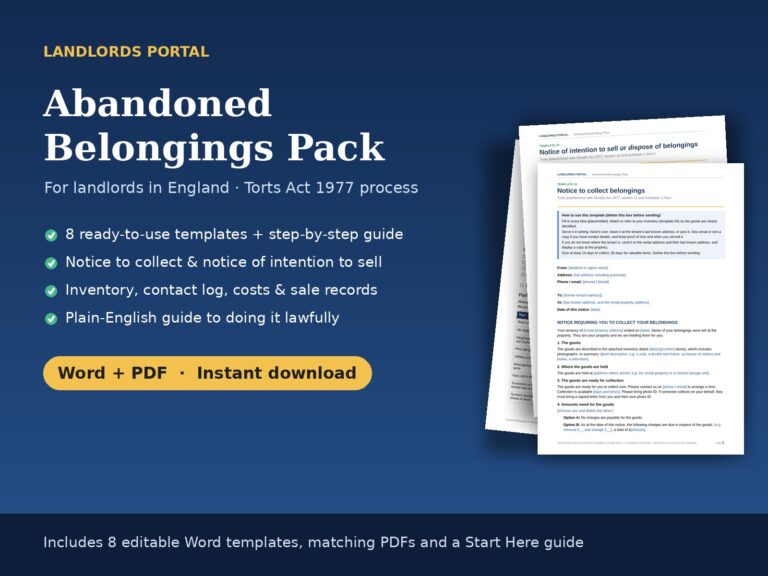
Landlords Portal template pack
Skip the drafting: get the Abandoned Belongings Pack
Every notice and record this guide describes, ready to fill in. Built around the Torts (Interference with Goods) Act 1977 for landlords in England.
- Notice to collect and notice of intention to sell, both following Schedule 1
- “Has the tenant left?” evidence checklist, inventory and contact log
- Storage costs, collection receipt and sale accounting letter
Get the pack – £7.99Word + PDF · instant download
Recovering your losses
- Deposit: claim unpaid rent and damage through the deposit scheme once the tenancy has ended.
- Arrears as a debt: follow the Pre-Action Protocol for Debt Claims, then use the county court small claims track for amounts up to £10,000.
- Guarantor: if there is one, write to them with a rent schedule as soon as arrears build.
- Council tax: tell the council when the tenancy ends. You are usually liable while the property is empty, and long-term empty homes can attract a premium; see our guide to council tax on unoccupied homes.
You cannot use the proceeds of selling the tenant’s goods to clear rent arrears.
Need the notices for this?
The Abandoned Belongings Pack has the notice to collect, the notice of intention to sell and every record you need, as editable Word and PDF.
Preventing abandonment
- Collect emergency contacts, a guarantor where appropriate, and a forwarding-address commitment at move-in.
- Act on the first missed payment, not the third.
- Inspect regularly with proper notice, so you notice early if nobody is living there.
- Include a clause in your written terms explaining how goods left at the end of the tenancy will be handled.
Frequently asked questions
Can I change the locks if my tenant has disappeared?
Only once the tenancy has ended, either by surrender or a court possession order. Changing the locks on a tenancy that still exists can be an unlawful eviction under the Protection from Eviction Act 1977. If the property is insecure, you can make it secure, but leave a notice explaining how the tenant can get access.
Is there a legal procedure to declare a property abandoned?
No. The abandonment procedure in the Housing and Planning Act 2016 was never brought into force. A tenancy ends only by notice, surrender or a court order.
What counts as an implied surrender?
Conduct by the tenant that clearly shows they have given up the tenancy, such as returning the keys and moving out, which the landlord accepts, for example by re-letting. Unpaid rent and an empty property are not enough on their own.
How much rent arrears do I need to use Ground 8?
Since 1 May 2026, at least three months’ rent (13 weeks if rent is paid weekly or fortnightly) when you serve the Section 8 notice and at the hearing. The notice period is four weeks.
Can I keep the tenant’s belongings to cover unpaid rent?
No. Under the Torts (Interference with Goods) Act 1977 you can deduct only the reasonable costs of storage and sale from any proceeds. Claim arrears from the deposit or as a debt.
Does the Renters’ Rights Act change anything?
Yes. Tenancies are now periodic and Section 21 is gone, so you need a surrender or a Section 8 ground to recover possession. Once the PRS Database applies in your region, you must be registered to obtain a possession order on most grounds.
Written by the Landlords Portal Team. General information for landlords in England as at October 2026, not legal advice. Take advice from a solicitor if the position is unclear before recovering possession or disposing of goods.
Template pack from Landlords Portal
Dealing with left-behind belongings? Use the Abandoned Belongings Pack
The notice to collect, the notice of intention to sell and every record you need, built around the Torts (Interference with Goods) Act 1977 for landlords in England.
- Notice to collect and notice of intention to sell, both following Schedule 1
- "Has the tenant left?" evidence checklist, inventory and contact log
- Storage costs, collection receipt and sale accounting letter