
Your tenant has emailed to say they want to leave. Maybe they have bought a house, taken a job in another city, or simply found somewhere cheaper. Your first questions are practical ones: how much notice does the tenant have to give, is their notice valid, and what happens to the rent and the deposit?
Since 1 May 2026, the answer in England has changed. The Renters’ Rights Act 2025 turned most fixed-term assured shorthold tenancies into rolling (periodic) assured tenancies and set a standard tenant notice period of two months. This guide explains exactly what that means when a tenant wants to leave, how to check their notice, when you can agree an earlier exit, and the mistakes that cost landlords money.
Key takeaways
- In England, a tenant must normally give at least two months’ written notice to end an assured tenancy (Protection from Eviction Act 1977, s.5(1ZA), inserted by the Renters’ Rights Act 2025).
- You can agree a shorter notice period in writing, but you cannot require the tenant to give more than two months.
- Fixed terms ended for most private tenancies on 1 May 2026, so a tenant can give notice at any point – even early in the tenancy.
- Government guidance says the notice should end on a rent day or the day before a rent day.
- A tenant who leaves without valid notice or an agreed surrender usually stays liable for rent until the tenancy legally ends.
- Wales (four weeks) and Scotland (28 days) have different rules.
Tenant notice period in 2026: what the law says
For private tenancies in England, the key rule now sits in section 5(1ZA) of the Protection from Eviction Act 1977, added by section 20 of the Renters’ Rights Act 2025. A tenant’s notice to quit under an assured tenancy must be given not less than two months before the date it is to take effect, unless you have agreed a shorter period in writing.
Two months is the ceiling, not just the floor
Many older tenancy agreements asked for one month’s notice; some asked for three. Under the new rules, two months is the standard. You can agree to accept less, but a clause demanding more than two months will not bind the tenant. If your template still says “three months’ notice”, update it.
Fixed terms no longer lock the tenant in
Before May 2026, a tenant on a 12-month fixed term generally could not leave early unless there was a break clause or you agreed. That protection has largely gone. Under the Renters’ Rights Act, most existing assured shorthold tenancies became assured periodic tenancies on 1 May 2026, and any end date in the agreement no longer ends the tenancy on its own. In practice, a tenant can serve two months’ notice in their first week and be gone after roughly two months.
That is now lawful, so the best defence is good referencing, a fair rent and a responsive service – the things that make good tenants want to stay.
The notice must be in writing – but you can’t dictate the method
A tenant’s notice to quit must be in writing. A letter or email both work. The Act adds a new section 5A to the 1977 Act which makes void any term that binds a tenant to a particular means of giving written notice. So you cannot reject an email notice because your agreement says “notice by recorded post only”. If the tenant has put it in writing and it reached you, treat it as served and keep a copy.
When should the tenant’s notice end?
This is the part most tenants get wrong. The government’s Renters’ Rights Act information sheet tells tenants that their notice should end the tenancy on a day when rent is due, or the day before rent is due. The statute itself only sets the two-month minimum, and lawyers have debated whether the old common-law rule (a notice must expire at the end of a tenancy period) still applies. Until the courts settle it, the safest reading for both sides is the one in the information sheet.
Worked example. Rent is due on the 15th of each month. Your tenant emails notice on 3 November 2026. Two months from service takes us to 3 January 2027, which is not a rent day. The next date that fits the guidance is 14 January 2027 (the day before rent is due) or 15 January 2027 (the rent day itself). The tenant owes rent up to that date.
Practical tip: if the date in a tenant’s notice is a few days off, don’t ignore it and hope to rely on a technicality later. Reply in writing, confirm the correct end date you will both work to, and ask the tenant (and any joint tenants) to agree it. A clear, agreed date is worth far more than an argument about validity, especially if the tenant later changes their mind and stays – see our guide on what to do when a tenant won’t leave after their notice to quit.
What to do when a tenant wants to leave: step by step
Handle the next few weeks well and you can move from one tenant to the next with barely a week’s void. Here is the process we recommend.
When a tenant gives notice: your 6 steps
Confirm the date you received the notice and the end date you calculate.
Joint tenancy? Note whether all tenants signed, and talk to anyone who wants to stay.
Give proper notice of viewings and agree times that suit the tenant.
Arrange a check-out inspection against the check-in inventory, with dated photos.
Record every key returned and take final meter readings on the last day.
Propose any deductions with evidence; return the deposit within 10 days of agreeing the amount.
1. Acknowledge the notice and confirm the end date
Reply promptly. State the date you received the notice, the end date you have calculated and the rent due up to that date. Keep this exchange: it is your evidence if the tenant overstays or disputes the final rent.
2. Check the position on joint tenants
Under the long-standing rule for periodic tenancies, a valid notice to quit from just one joint tenant can end the tenancy for everyone, and the new section 5(1ZA) expressly preserves notices given by only some of the tenants. That surprises the tenants who want to stay. You do not have to let them stay on, but if they are good tenants you may want to grant a fresh tenancy to the remaining occupiers once the old one ends. Any agreement to a shorter notice period, however, only counts if all the joint tenants agree. Our guide on joint tenants separating or splitting up covers the options.
3. Arrange viewings properly
Re-letting quickly is how you protect your income, but the tenant still has the right to quiet enjoyment until the tenancy ends. Give reasonable written notice of each viewing, group viewings together and be flexible. If you hit resistance, our article on whether a tenant can refuse access for viewings explains where you stand.
4–5. Check-out, keys and meters
Book a check-out inspection for the last day, ideally with the tenant present. Compare the condition against the check-in inventory, allowing for fair wear and tear, and take dated photos. Count the keys back in and record final meter readings. If you can’t attend in person, a good-quality key safe lets the tenant return keys securely at a set time – see our round-up of the best key safes for landlords.
6. Settle the deposit
Send the tenant a written proposal for any deductions, with evidence and costs. Once you agree the amount, the deposit must be returned within 10 days. If you can’t agree, either side can use the deposit scheme’s free dispute service. Only claim for genuine loss beyond fair wear and tear – our guide on charging a tenant for damages explains what adjudicators accept.
Tenant wants to leave early: your options
Sometimes a tenant wants to go sooner than two months. You are not obliged to agree, but refusing outright often means an empty property with a tenant who has stopped caring about it. Usually a negotiated exit works out better for both sides.
Agree a shorter notice period in writing
The Act allows you to agree any shorter notice period in writing. A simple email works: “We agree that your tenancy will end on [date], and rent is payable up to and including that date.” If there are joint tenants, all of them must agree.
Accept a surrender
A surrender is a mutual agreement to end the tenancy now. It can be express (a signed deed or written agreement) or implied by conduct – for example, the tenant hands over the keys and you accept them and re-let. Put it in writing to avoid any doubt. A joint tenancy can only be surrendered if every joint tenant agrees.
What can you charge for an early exit?
Paragraph 7 of Schedule 1 to the Tenant Fees Act 2019 allows a payment when a tenant asks to leave without giving the full notice, but it must not exceed the loss you suffer as a result (or, for a letting agent, its reasonable costs) – for example, rent until a new tenant moves in and reasonable re-letting costs. Arbitrary “early release fees” are banned. Our detailed guide on early surrender and re-let fees walks through how to negotiate this fairly.

Common scenarios at a glance
| Situation | What the law says (England) | What you should do |
|---|---|---|
| Tenant gives two months’ written notice ending on/before a rent day | Valid notice; tenancy ends on that date | Acknowledge in writing, book viewings and check-out |
| Tenant gives one month’s notice | Too short unless you agree in writing | Either agree the earlier date in writing or confirm the correct two-month end date |
| Notice end date falls mid-period | Validity uncertain; guidance says end on a rent day or the day before | Agree a clear end date in writing with all tenants |
| One joint tenant gives notice, others want to stay | A notice from one joint tenant can end the whole tenancy | Decide whether to offer a new tenancy to those staying |
| Tenant posts keys through the letterbox and leaves | Only an offer to surrender; the tenancy doesn’t end until you accept | Decide quickly whether to accept; confirm in writing |
| Tenant wants to withdraw their notice | Possible only if you both agree in writing before it takes effect | Agree or decline in writing; you are not obliged to agree |
| Property in Wales | Periodic standard contract: at least four weeks’ notice | Follow the Renting Homes (Wales) Act 2016 rules |
| Property in Scotland | Private residential tenancy: at least 28 days’ notice | Confirm any agreed shorter period in writing |
Common mistakes landlords make
- Relying on an old tenancy agreement. Clauses requiring three months’ notice, or notice by recorded post only, no longer bind tenants on assured tenancies.
- Treating abandoned keys as the end of the tenancy. Keys left through the door are an offer to surrender, not a surrender. Accept clearly, in writing, before re-letting.
- Re-letting before the tenancy has ended. If the outgoing tenancy has not legally ended, a new tenant moving in can expose you to an unlawful eviction claim. Get the end date nailed down first.
- Charging penalty fees. Anything beyond your genuine loss or reasonable costs on an early exit breaches the Tenant Fees Act 2019.
- Holding the deposit as leverage. Propose deductions with evidence and return the agreed balance within 10 days.
- Forgetting the transitional cases. If you served a valid Section 21 or Section 8 notice before 1 May 2026, the old rules may still apply to that tenancy, including the old four-week minimum for a tenant’s notice on a periodic tenancy. Take advice if you are unsure.
Different rules in Wales and Scotland
The two-month rule above applies to assured tenancies in England. In Wales, most private lets are occupation contracts under the Renting Homes (Wales) Act 2016, and a contract-holder on a periodic standard contract must give at least four weeks’ notice (Welsh Government FAQ). In Scotland, a tenant with a private residential tenancy must give at least 28 days’ written notice, and all joint tenants must agree to end it (mygov.scot). Northern Ireland has its own separate rules.
Conclusion: turn a tenant’s notice into a smooth handover
When a tenant wants to leave, the rules in England are now simple at their core: two months’ written notice, ending on or just before a rent day, unless you agree something shorter in writing. The money is made or lost in how you respond. Confirm the end date in writing, sort out joint-tenant questions early, market the property straight away, and run a fair check-out and deposit return. Do that and a tenant’s notice becomes a short, managed void rather than a dispute.
For the full legal detail, Shelter’s professional guide on how a tenant ends an assured tenancy is an excellent reference.
Written by The Landlords Portal Team. Last reviewed 29 October 2026. This article is general information about the law in England (with notes on Wales and Scotland) and is not legal advice. Where a dispute or a transitional tenancy is involved, take advice from a solicitor or a landlord association.
FAQ: tenant notice periods and ending a tenancy
How much notice does a tenant have to give in England in 2026?
For an assured tenancy, at least two months’ written notice, unless the landlord agrees a shorter period in writing. You cannot require the tenant to give more than two months.
Can a tenant leave before the end of a fixed term?
Yes, for most private tenancies in England. Since 1 May 2026, fixed terms no longer apply to most assured tenancies, so a tenant can give two months’ notice at any time.
Can a tenant give notice by email?
Yes. The notice must be in writing, and a term restricting the method a tenant uses to give written notice has no effect. Keep a copy of the email and your reply.
What date should the tenant’s notice end on?
Government guidance says the notice should end on a day when rent is due or the day before. If the date is unclear, agree a specific end date in writing with all tenants.
Can one joint tenant end the tenancy for everyone?
Generally yes: a valid notice to quit from one joint tenant on a periodic tenancy can end it for all. You can then offer a new tenancy to those who want to stay.
Does a tenant have to pay rent if they move out early?
Usually yes, until the tenancy legally ends – when the notice expires or you accept a surrender. If you agree an early exit, you can recover your actual loss or reasonable costs, but not a penalty fee.
Can a tenant withdraw their notice?
Only if you both agree in writing before the notice takes effect (and all joint tenants agree). Otherwise the tenancy ends on the notice date.
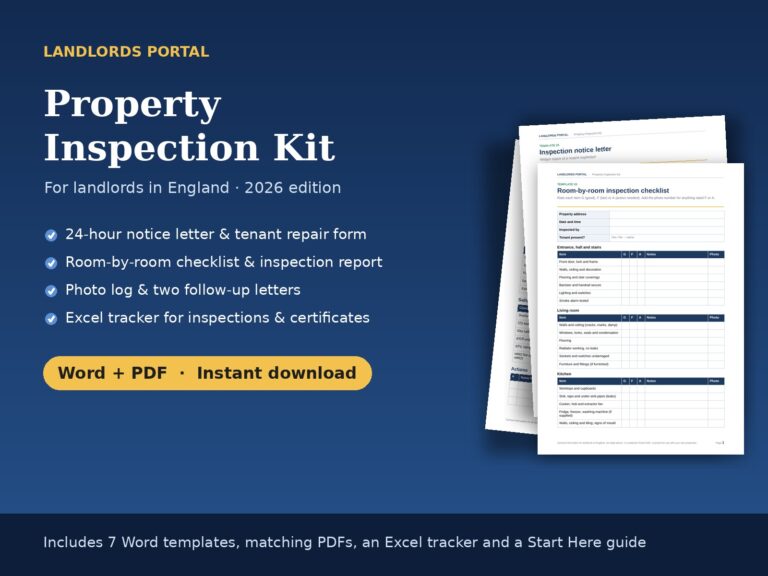
Template pack from Landlords Portal
Run every inspection properly: the Property Inspection Kit
Dated evidence of the property's condition protects you in repair, damp and deposit disputes. This kit gives you every document for an inspection, written for landlords in England.
- 24-hour notice letter and tenant repair report form
- Room-by-room checklist, inspection report and photo log
- Follow-up letters, plus an Excel tracker for gas safety, EICR and EPC dates