
The Chancellor’s Budget on 28 October 2026 added another two percentage points to the tax on rental income. From 6 April 2027, property income will be taxed at 24% (basic rate), 44% (higher rate) and 49% (additional rate), four points above the rates on earned income. Last year’s Budget had already set separate property rates of 22%, 42% and 47%; this Budget lifts them again before they have even started.
For many individual landlords, that changes the sums on whether to keep a property or sell. Here is what was announced, what it costs on a typical let, and how to decide what to do next.
What the Budget announced for landlords
- Property income tax: 24%, 44% and 49% from 6 April 2027 in England, Wales and Northern Ireland. For 2026/27 the rates stay at 20%, 40% and 45%.
- Mortgage interest relief: still a basic-rate tax credit for individual landlords, rising to 24% from April 2027 in line with the property basic rate.
- Capital gains tax: unchanged at 18% or 24% on residential property, with a £3,000 annual exemption.
- Stamp duty: unchanged, including the 5% surcharge on additional homes.
- Local Housing Allowance: the freeze was not lifted, which the NRLA criticised.
- Limited companies: not affected; companies pay corporation tax at 19% to 25%.
The measures still need to pass in the Finance Bill 2026-27, so treat them as announced rather than law. Sources: NRLA Budget briefing and Tax Policy Associates.
The Office for Budget Responsibility expects the change to cut landlords’ returns materially, and judged it more likely than not that the combined measures will push rents up by reducing the supply of rented homes, as reported by Mortgage Solutions.
What it costs on a typical buy-to-let
Take a flat let at £1,200 a month (£14,400 a year) with £2,400 of running costs and £7,200 of mortgage interest, owned by an individual whose rental profit falls entirely in one tax band.
| Taxpayer | Tax in 2026/27 | Tax from 2027/28 | Increase a year |
|---|---|---|---|
| Basic rate | £960 | £1,152 | £192 |
| Higher rate | £3,360 | £3,552 | £192 |
| Additional rate | £3,960 | £4,152 | £192 |
Because the tax rate and the interest credit both rise by four points, the extra tax works out at 4% of your profit after mortgage interest, whatever band you are in. Here that is 4% of £4,800, or £192 a year. Of that, £96 comes from this Budget and £96 from last year’s. A higher-rate landlord in this example keeps £1,248 a year in cash after tax, down from £1,440. Landlords with little or no mortgage feel it most, because they have little interest credit to offset the higher rate.
If you want to see how the rise affects a property you are thinking of buying, our Does It Stack? deal calculator models it, and our guide to allowable expenses explains what you can still deduct.
Sell or keep? Questions to ask now
A higher tax rate on its own rarely makes selling the right answer. The question is whether the property still beats what you could do with the cash after selling costs and capital gains tax. Work through these:
- What would you walk away with? Agent and legal fees, any early repayment charge, and capital gains tax at 18% or 24%, reported and paid within 60 days of completion.
- With tenants or empty? Selling to an investor with the tenants in place avoids a void but usually means a lower price. Selling empty needs Ground 1A, with four months’ notice, not in the first 12 months of the tenancy. See how to sell a rental property with tenants.
- What would the cash earn instead? Compare your after-tax rental return and expected growth with a realistic return on the sale proceeds.
- Would a company structure help? Companies are outside the new rates, but transferring properties usually triggers capital gains tax and stamp duty. Read using limited companies for buy-to-let and take advice first.
- Is timing in your favour? The new rates start in April 2027, so there is no need to rush a sale before the end of this tax year.
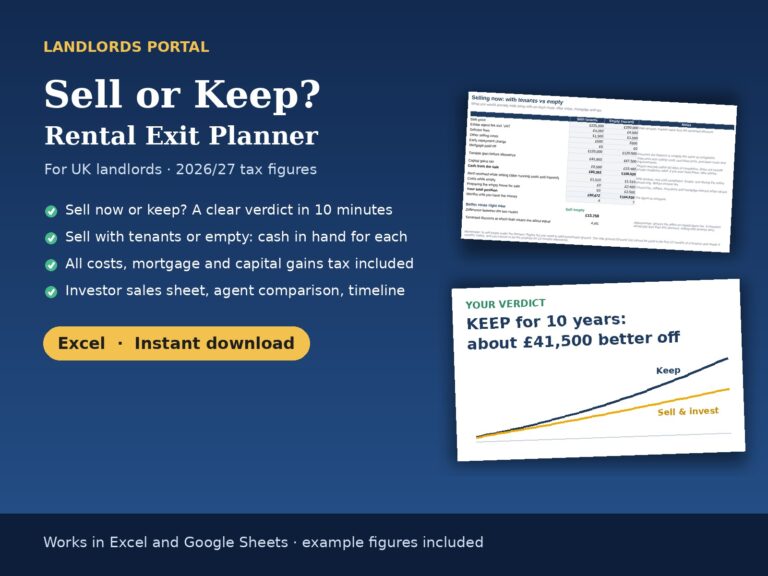
Updated for the October 2026 Budget
Sell or keep? Run your own numbers at the new rates
The Sell or Keep? planner now uses the 24%, 44% and 49% property rates and the 24% mortgage interest credit from April 2027. Enter your figures and get a clear verdict, plus the cash you would walk away with on each selling route.
- Keep vs sell over up to 25 years, after income tax and capital gains tax
- Sell with tenants vs sell empty, side by side
- Investor sales sheet, agent comparison and sale timeline
What to do next
- Recalculate your after-tax return on each property at the 2027/28 rates.
- If you are in Making Tax Digital, check your quarterly figures: the next update is due by 7 November 2026.
- Speak to an accountant before restructuring, selling or incorporating.
- Watch the Finance Bill 2026-27 for the final legislation.
Frequently asked questions
When do the new property income tax rates start?
From 6 April 2027, the start of the 2027/28 tax year. For 2026/27 rental profits are still taxed at 20%, 40% and 45%. The rates need the Finance Bill 2026-27 to become law.
Do the new rates apply in Scotland?
They apply in England, Wales and Northern Ireland. Scottish taxpayers should check what the Scottish Government sets for property income.
What happens to mortgage interest relief?
It stays a basic-rate tax credit rather than a deduction, but the credit rises with the property basic rate, to 24% from April 2027.
Are landlords who own through a limited company affected?
No. Companies pay corporation tax, not income tax, so the property income rates don’t apply to profits made inside the company.
Did capital gains tax or stamp duty change?
No. Capital gains tax on residential property stays at 18% or 24% with a £3,000 annual exemption, and the 5% stamp duty surcharge on additional homes is unchanged.
Written by the Landlords Portal Team. General information for landlords, not tax or financial advice. Figures reflect the Budget announcement of 28 October 2026 and may change before the Finance Bill becomes law.
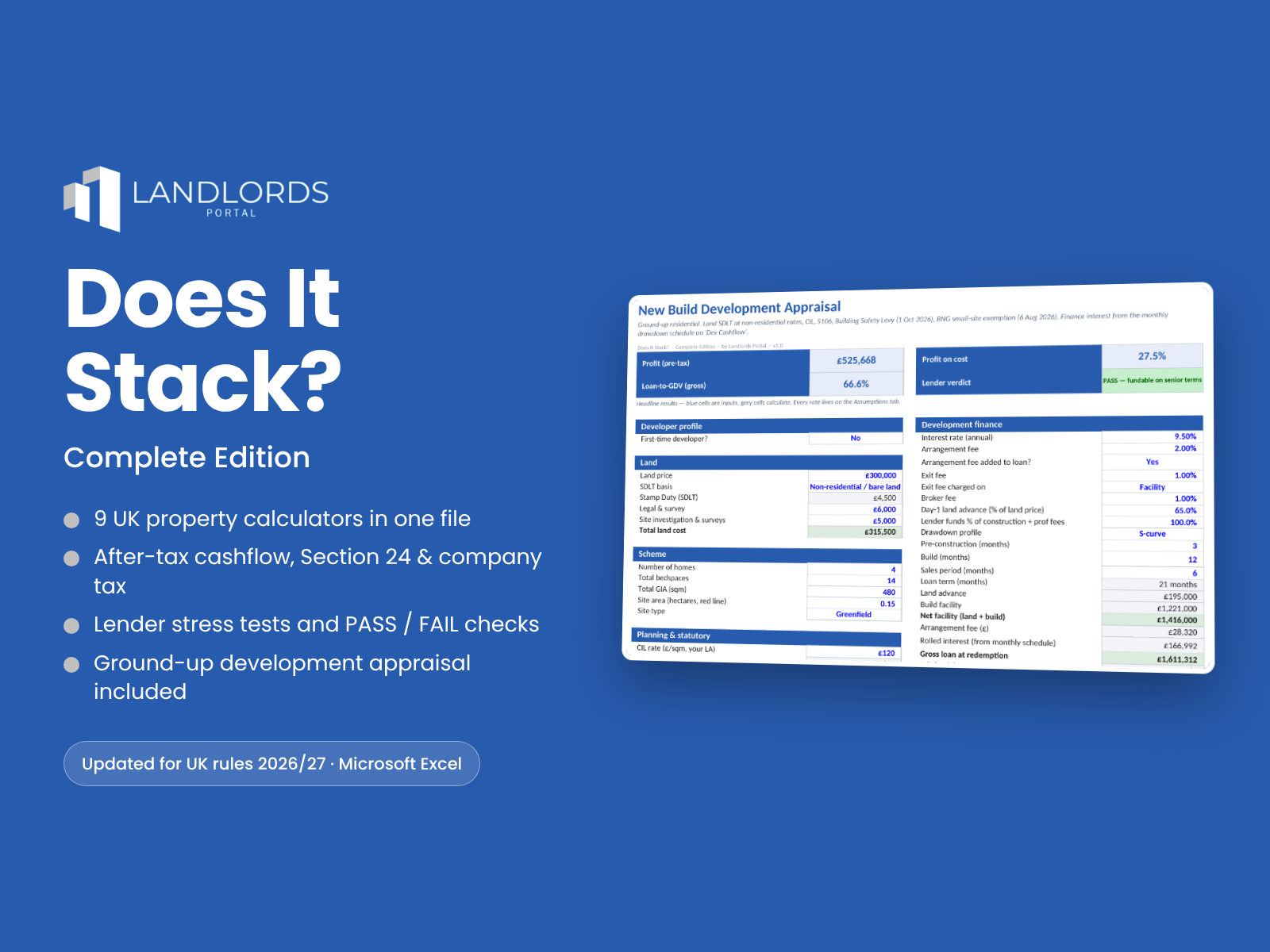
Excel calculator from Landlords Portal
Does the deal stack after tax?
The Does It Stack? calculator shows your cashflow after stamp duty, Section 24 and running costs, and whether a lender will pass the deal.
- Buy-to-let, BRR, HMO, flips, holiday lets and development in one Excel file
- Cashflow after stamp duty, Section 24 and running costs
- Lender stress test before you make an offer