
Since 27 January 2026, running or supplying heat through a communal or district heat network in Great Britain has been a regulated activity overseen by Ofgem. Existing operators and suppliers must register each in-scope network with Ofgem by 26 January 2027, and landlords who own a building where one shared boiler or heat pump serves several flats may be caught.
Key takeaways
- Deadline: existing in-scope heat networks must be registered with Ofgem by 26 January 2027.
- It covers communal systems serving one building divided into separate premises, and district systems serving two or more buildings.
- Ofgem lists exemptions, including a single HMO with a shared heating system and some small conversions with one energy source of no more than 45kWth.
- Ofgem says it can take up to 10 working days just to confirm access to its registration service, so start now.
- If your role includes supplying heat, you must also join the Energy Ombudsman heat network supplier scheme.
What has changed
The Heat Networks (Market Framework) (Great Britain) Regulations 2025 made Ofgem the regulator for heat networks in England, Scotland and Wales. Under regulation 27, anyone already operating or supplying a relevant heat network is treated as authorised during an “initial period”. This is what Ofgem calls deemed authorisation, so existing networks did not have to apply for permission to keep running.
Deemed authorisation does not remove the need to register. Ofgem’s Who should register guidance says you “must identify the operator and supplier for any of your relevant heat networks and register the networks with us by 26 January 2027”. Registration means giving Ofgem details of your organisation, ownership, financial resilience and consumer protection arrangements, plus technical, customer, metering and billing information about each network.
Ofgem has also published a set of rules for operators and suppliers, called authorisation conditions. Suppliers are responsible for consumer outcomes such as billing, complaints handling and communications. That matters if you include heating or hot water in the rent or recharge it to tenants.
Who it affects
Ofgem regulates two roles. The operator controls the network and is responsible for it, even if contractors do the day-to-day maintenance. The supplier handles the contractual and customer-facing side of supplying heat to consumers, a term Ofgem says includes tenants. One person or company can be both.
| Your situation | Likely position |
|---|---|
| You own a building divided into flats, with one central boiler or heat pump serving them | Probably a communal heat network, unless an exemption applies. You are likely the operator and, if you bill or include heat in the rent, the supplier too |
| You let a leasehold flat in a block with communal heating | The freeholder, RTM company or management company is usually the operator. Whether you are also a supplier depends on how the heat is charged, so check (see “What we don’t know yet”) |
| A single HMO with a shared heating system | Exempt under Ofgem’s list of examples |
| A conversion into several dwellings with one energy source of no more than 45kWth | Exempt under Ofgem’s list of examples |
| Each flat has its own boiler or its own heat pump | Not a heat network |
Shared ground loop systems, where each home has its own heat pump on a shared ground or water loop, are in scope but have fewer obligations. Our guide to heat pumps in rental properties covers the difference between individual and shared systems.
What you need to do, and by when
- Now: check whether any building you own has a central heat source supplying more than one flat, or more than one building.
- Now: compare each building against Ofgem’s exemptions. Check the boiler’s rated output in its manual or on its data plate if you are relying on the 45kWth conversion exemption.
- Now: work out who the operator and supplier are. Check leases, management agreements and any RTM or management company, and ask your managing agent.
- By mid-December 2026: nominate a “regulatory contact” and request access to Ofgem’s digital service. Allow up to 10 working days for confirmation, plus the Christmas break.
- Before 26 January 2027: complete registration. If you are only a supplier, create your account first, because the operator has to invite you to register your supply activity.
- If your role includes supply: register with the Energy Ombudsman’s heat network supplier scheme, and check your billing and complaints process against Ofgem’s authorisation conditions.
- 127 January 2026
Regulation begins. Existing operators and suppliers are deemed authorised. - 2Now to mid-December 2026
Check scope and exemptions, identify the operator and supplier, and request access to the digital service. - 3December 2026 to January 2027
Complete the organisation details and the registration for each network. Operators invite their suppliers. - 426 January 2027
Registration deadline for existing in-scope heat networks.
What it means in practice
Illustrative example (figures are hypothetical): a landlord owns a converted Victorian house split into four self-contained flats. One gas boiler, rated at 60kW, heats all four, and heating is included in the rent.
- The building is divided into separate premises and one source supplies them, so it looks like a communal heat network.
- The 45kWth conversion exemption does not apply, because the boiler’s capacity is above that limit.
- The landlord controls the boiler and deals with the tenants, so they are likely to be both operator and supplier. They would need to register by 26 January 2027 and join the Energy Ombudsman scheme.
- If the same conversion had a single 40kW boiler as its only energy source, it would fall within Ofgem’s listed exemption.
Before deciding you are in or out of scope, read the full guidance or take advice. The capacity limit and the other exemption conditions both matter.
What we don’t know yet
- Leaseholder landlords: Ofgem’s guidance does not say directly whether a landlord who lets a leasehold flat and passes communal heating charges to a tenant is a “supplier”. Ofgem says each party should assess its own activities against the definitions, and it offers help at heatnetworksregulation@ofgem.gov.uk.
- Section 257 HMOs: the NRLA’s view is that some section 257 HMOs (certain converted blocks of flats) stay in scope. Ofgem’s short list of exemptions refers only to “a single house in multiple occupation”, so check the detailed registration guidance.
- Missed deadlines: Ofgem can monitor compliance and take enforcement action. According to the NRLA, Ofgem has said it will take a proportionate approach, but exactly how it will treat smaller landlords who register late has not been set out.
Heat charges are also covered by the rules on what fees landlords can charge under the Tenant Fees Act. Ofgem’s regime adds billing and complaints standards on top, so it is worth reviewing how your tenancy agreements describe heating charges. Communal plant still needs repairing as normal, too: see what repairs landlords are legally required to make.
Official sources
- Ofgem: Heat networks, who should register (scope, exemptions, operator and supplier definitions)
- Ofgem: Register or sign in (digital service and access timescales)
- Ofgem: How to prepare for registration
- legislation.gov.uk: Heat Networks (Market Framework) (Great Britain) Regulations 2025, regulation 27
Frequently asked questions
Do I need to register my HMO as a heat network?
Ofgem lists a single house in multiple occupation with a shared heating system as an example of a network that is out of scope. Converted blocks of flats can be different, so check Ofgem’s detailed guidance if your building is divided into self-contained flats.
What is the deadline to register a heat network with Ofgem?
Existing operators and suppliers of in-scope heat networks must register them with Ofgem by 26 January 2027. A new network, or a regulated activity that starts after that date, needs a full authorisation application before it begins.
I let a flat in a block with communal heating. Do I need to register?
Usually the freeholder, RTM company or management company is the operator and starts the registration. Whether you are also a supplier depends on how the heat is charged to your tenant. Ofgem says each party should assess its own role, and you can email heatnetworksregulation@ofgem.gov.uk for help.
Written by The Landlords Portal Team. This article is general information for UK landlords, not legal advice. Check the current position or take professional advice.
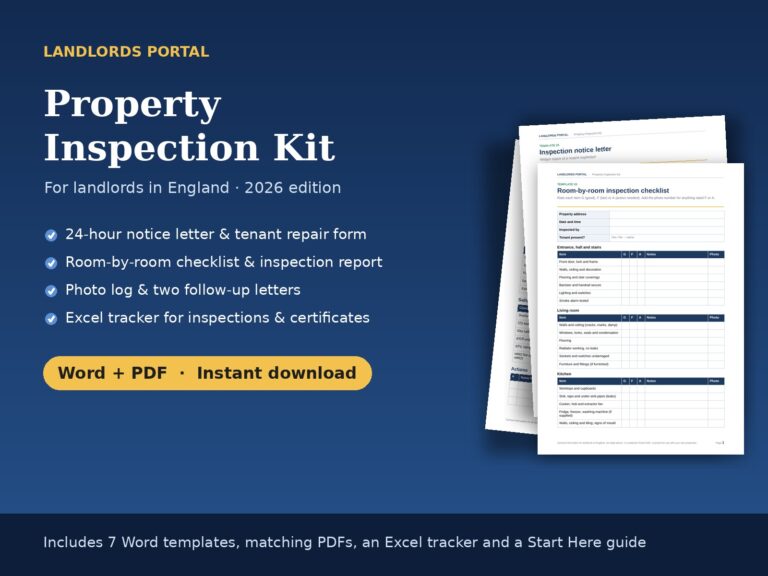
Template pack from Landlords Portal
Run every inspection properly: the Property Inspection Kit
Dated evidence of the property's condition protects you in repair, damp and deposit disputes. This kit gives you every document for an inspection, written for landlords in England.
- 24-hour notice letter and tenant repair report form
- Room-by-room checklist, inspection report and photo log
- Follow-up letters, plus an Excel tracker for gas safety, EICR and EPC dates
Related posts:
 Flood Performance Certificates: government announces pilots for homes in England
 Awaab’s Law to be extended to private rentals: government consults on repair deadlines
 Private rents in England up 4.0% in a year to £1,466, ONS figures show
 Bank of England raises Bank Rate to 4%: what it means for buy-to-let landlords