
The Bank of England raised Bank Rate by 0.25 percentage points, from 3.75% to 4%, on 5 November 2026. Landlords on tracker and variable-rate buy-to-let mortgages are likely to see payments rise, and anyone with a fixed rate ending soon should review their remortgage options and cash flow now.
Key takeaways
- Bank Rate rose from 3.75% to 4% on 5 November 2026, by an 8–1 vote of the Monetary Policy Committee (MPC).
- Tracker mortgages usually move with Bank Rate; standard variable rates may also rise at your lender’s discretion.
- Fixed-rate payments do not change until the fix ends, but new fixed deals are priced off market expectations.
- You cannot simply pass the cost on: rent rises on assured periodic tenancies need a Form 4A section 13 notice, at least two months ahead, once a year.
- The next rate decision is due on 17 December 2026.
What has changed
In its November 2026 Monetary Policy Summary, published on 5 November, the Bank of England’s Monetary Policy Committee voted 8–1 to increase Bank Rate by 0.25 percentage points to 4%. One member, Catherine L Mann, voted for a larger rise to 4.25%. Rates had been held at 3.75% at both the July and September 2026 meetings; in September, three members had already voted for a rise.
The Committee pointed to higher energy prices linked to the conflict in the Middle East, and to economic activity that has been stronger than expected. CPI inflation was 3.5% in September, and the Bank’s near-term projection has inflation rising to around 5% by mid-2027 before easing as energy price effects fade.
On future rates, the MPC said monetary policy “is not on a pre-set path”. Individual members differed: some said further rises may be needed if inflation pressures persist, while another described this as an insurance move rather than the start of a run of rises. In other words, nobody, including the Bank, is promising where rates go next.
Who it affects
- Landlords on tracker mortgages – these normally move with Bank Rate, so expect your lender to confirm a higher monthly payment.
- Landlords on a lender’s standard variable rate (SVR) – SVRs are set by each lender and often follow Bank Rate, but check your lender’s notice.
- Landlords whose fixed rate ends in the next 6–12 months – your current payment is unchanged, but the deals available when you remortgage may be more expensive, and lenders’ rental-cover affordability tests may be harder to pass.
- Landlords planning to buy – borrowing costs feed directly into yield and cash-flow numbers, so re-run your figures.
Who it does not directly affect: landlords who own outright, and landlords on a fixed rate with plenty of time left to run – though it is still worth planning for the end of the fix. Tenants’ rent does not change automatically because Bank Rate has risen.
What you need to do, and by when
- This month: check every mortgage you hold. List each property’s lender, product type (fixed, tracker or SVR), rate and end date. For trackers and SVRs, look out for your lender’s letter confirming the new payment and when it starts.
- Now, if a fixed rate ends within about a year: start your remortgage review. Ask your lender or a broker how far ahead you can secure a new offer, and compare product transfer and remortgage options.
- Before any rent change: follow the section 13 rules. Since 1 May 2026, gov.uk guidance says rent on an assured periodic tenancy can only be increased once a year, not in the first year, using Form 4A served at least two months before the new rent starts. Tenants can ask the First-tier Tribunal to set the rent if they think it is above market rate. Our guide to completing a section 13 notice walks through the form.
- Within the next few weeks: update your cash-flow and tax forecast. Higher interest raises your costs, but for individual landlords the extra mortgage interest only earns a 20% tax reduction rather than a full deduction. See which other costs you can claim in our landlord allowable expenses guide.
- 17 December 2026: watch the next decision. The MPC’s next announcement could move rates again, in either direction.
- 11 May 2026
New rent increase rules: once a year via Form 4A, at least two months’ notice. - 217 September 2026
Bank Rate held at 3.75% (6–3 vote; three members wanted 4%). - 35 November 2026
Bank Rate raised to 4% (8–1 vote). Check trackers and SVRs. - 417 December 2026
Next Bank of England rate decision.
What it means in practice
Illustrative figures only. Take an individual landlord with a £180,000 interest-only tracker mortgage that rises by the full 0.25 percentage points.
| Illustrative item | Amount |
|---|---|
| Mortgage balance (interest-only tracker) | £180,000 |
| Rate increase | 0.25 percentage points |
| Extra interest per year | £450 (£37.50 a month) |
| Tax reduction on the extra interest at 20% | up to £90 |
| Net extra cost per year | about £360 |
Because individual landlords get a basic-rate tax reduction on finance costs rather than deducting them from rental income, a higher-rate taxpayer still bears most of the increase. HMRC’s finance cost relief guidance explains the calculation and its limits. Landlords holding property in a company are taxed differently – see our limited company buy-to-let guide. To test whether a purchase or remortgage still works at today’s rates, use our Does It Stack? property deal calculator.
What we don’t know yet
- How quickly, and by how much, each lender will reprice its SVR and new buy-to-let fixed rates.
- Whether the MPC will raise, hold or cut rates on 17 December 2026 or in 2027 – members’ views differ.
- Whether energy prices fall as the Bank’s projections assume, which would ease the pressure for further rises.
Official sources
- Bank of England – November 2026 Monetary Policy Summary and Minutes
- Bank of England – Interest rates and Bank Rate
- GOV.UK – Assured tenancy agreements: rent increases
- GOV.UK – Tax relief for residential landlords: how it’s worked out
FAQs
Will my buy-to-let mortgage payment go up?
If you are on a tracker, it will normally rise in line with Bank Rate. If you are on your lender’s standard variable rate, it may rise at the lender’s discretion. If you are on a fixed rate, your payment stays the same until the fixed period ends.
Can I raise the rent to cover the higher mortgage cost?
Only through the section 13 process. Under gov.uk guidance, rent on an assured periodic tenancy can be increased once a year (not in the first year) using Form 4A with at least two months’ notice, and the tenant can ask the First-tier Tribunal to set a market rent.
When is the next Bank of England decision?
The Bank of England’s next Bank Rate announcement is due on 17 December 2026.
Written by The Landlords Portal Team. This article is general information for UK landlords, not legal advice. Check the current position or take professional advice.
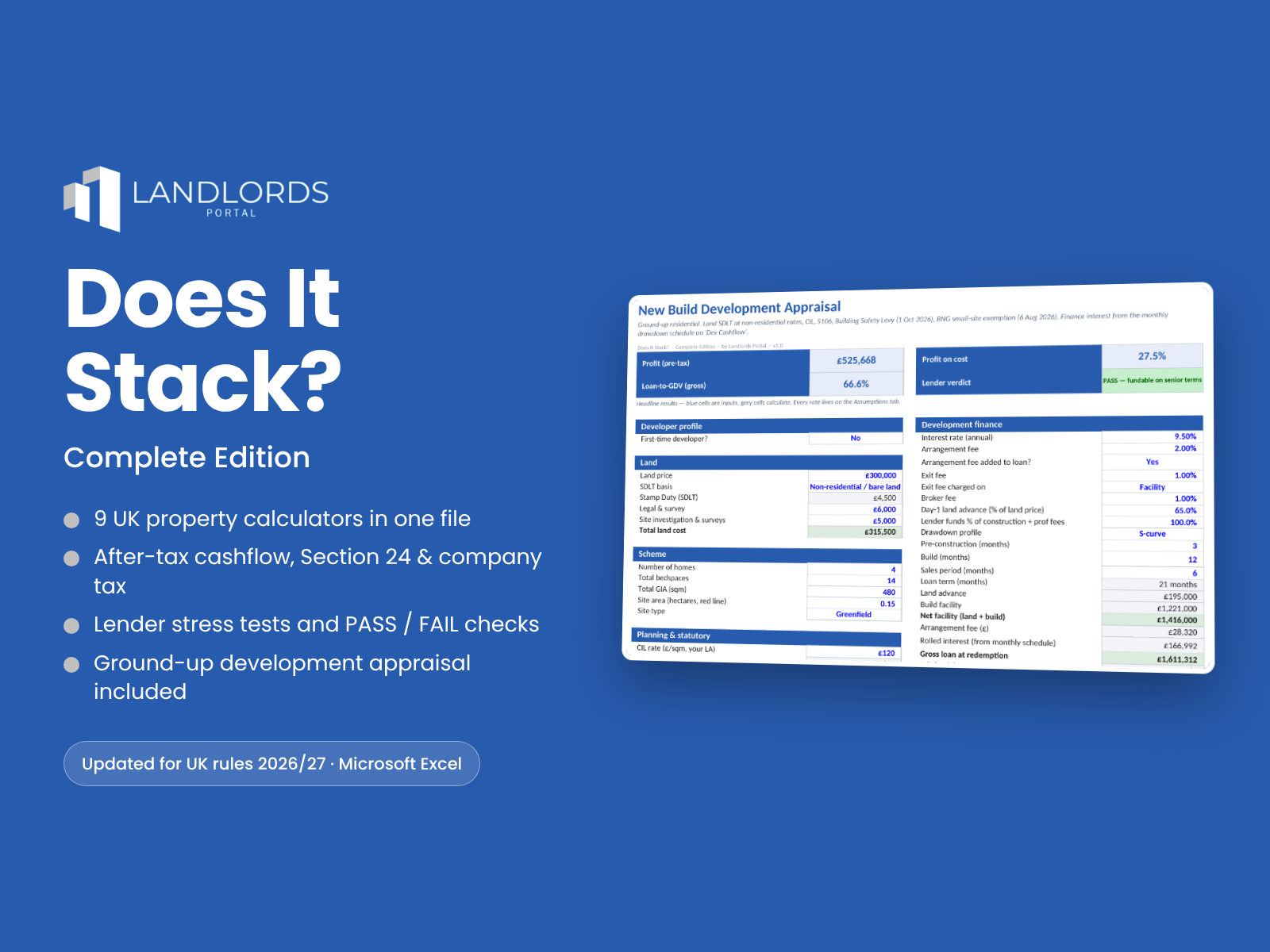
Excel calculator from Landlords Portal
Does the deal stack after tax?
The Does It Stack? calculator shows your cashflow after stamp duty, Section 24 and running costs, and whether a lender will pass the deal.
- Buy-to-let, BRR, HMO, flips, holiday lets and development in one Excel file
- Cashflow after stamp duty, Section 24 and running costs
- Lender stress test before you make an offer
Related posts:
 PRS Database opens 15 December in the West Midlands — what landlords in England need to know
 Budget 2026: Landlord Tax Rises to 24%, 44% and 49% — Sell or Keep?
 Housing Ombudsman Service to run the new private landlord ombudsman, minister confirms
 Gateshead Council fines landlord £3,600 for serving a Section 21 notice after 1 May