
You’ve found a property that looks promising. The agent’s yield figure is healthy, the free calculators say it works, and you’re ready to offer. Then the real costs arrive: a 5% stamp duty surcharge, mortgage interest you can’t deduct, a lender stress test that cuts your borrowing, and compliance costs that didn’t exist a year ago.
That gap between “looks good” and “actually works” is why we built Does It Stack?, a UK property deal calculator that answers the question every landlord and lender asks first. It works out your cashflow after stamp duty, finance, running costs and tax, checks whether a lender is likely to fund the deal, and flags the rule changes coming up. It covers nine strategies in one Excel file, for £14.99.
Key takeaways
- Most deal calculators are built for the US and miss UK stamp duty surcharges, Section 24 and lender stress tests.
- Does It Stack? shows your monthly cashflow after tax, for personal or limited company ownership.
- It runs the buy-to-let stress test lenders use, and sizes BRR refinances by both LTV and rent cover.
- The Complete Edition covers buy-to-let, BRR, flips, HMOs, rent-to-rent, holiday lets, stamp duty and ground-up development.
- £14.99, with a six-page guide and free updates for 12 months as the rules change.
Why most property deal calculators get UK deals wrong
Search for a property investment calculator and most of what you find was built for the American market. They talk about “cap rates” and “closing costs” and ignore the rules that decide whether a UK deal makes money. Even many UK spreadsheets stop at gross yield and a mortgage payment. Here is what they typically leave out.
Stamp duty for landlords
Since 31 October 2024, buying an additional residential property in England or Northern Ireland adds a 5% surcharge on top of every band, on the whole price (GOV.UK SDLT rates). On a £250,000 buy-to-let that’s £15,000, against £5,000 for a home mover. Bare development land is different again: it pays non-residential rates. Our free buy-to-let stamp duty calculator gives you the figure on its own; Does It Stack? feeds it straight into your returns.
Section 24 and the 2027 tax rise
If you own property in your own name, you can’t deduct mortgage interest from rental profit. You get a tax credit at the basic rate instead. From 6 April 2027, tax on property income rises by two percentage points, to 22%, 42% and 47% (ACCA summary of the Budget change). A deal that cashflows before tax can lose money after it, especially for higher-rate taxpayers. That’s why so many landlords now compare buying through a limited company, and the calculator lets you switch between the two with one dropdown.
The lender stress test
Buy-to-let lenders don’t just check loan-to-value. They test whether the rent covers the mortgage interest by a margin: typically 125% for basic-rate taxpayers and limited companies, and 145% for higher-rate taxpayers, at the higher of your pay rate or around 5.5%. On a BRR deal, this often limits your refinance more than the valuation does, leaving more money in the deal than you planned. With Bank Rate held at 3.75% and some policymakers voting to raise it (our base rate explainer), it pays to test your numbers before you offer.
New compliance costs
The Renters’ Rights Act 2025 ended Section 21 on 1 May 2026 and brings a mandatory PRS Database with an annual fee and, later, a Landlord Ombudsman (GOV.UK implementation roadmap). Privately rented homes must also reach EPC C by 1 October 2030, with spending capped at £10,000 per property (see our EPC C upgrade guide). The calculator builds these into your running costs and flags any property below C.
Four UK rules your calculator must include
What’s inside the Does It Stack? property deal calculator
The Complete Edition is one Excel workbook with a tab for each strategy. Every tab follows the same layout: four headline results at the top, your inputs in blue, and status checks that turn green, amber or red.
| Calculator | You enter | It tells you |
|---|---|---|
| Buy to Let | Price, rent, mortgage, running costs | Monthly cashflow after tax, stress test, EPC flag, 10-year equity |
| BRR | Price, bridge terms, refurb, end value, rent | Money left in, refinance limit, maximum purchase price |
| Flip | Price, works, bridge, sale price | Profit after tax, return on cash, annualised return |
| HMO | Room rents, bills, conversion costs | Cashflow after tax, licensing and Article 4 flags |
| Rent-to-Rent | Set-up costs, rent to owner, room rents | Monthly profit, payback in months, margin check |
| Holiday Let | Nightly rate, occupancy, platform fees | Cashflow after tax, break-even occupancy |
| New Build Dev | Land, build cost, fees, finance, sales values | Profit on cost, lender PASS / FAIL, maximum land price |
| Stamp Duty | Price, buyer type | SDLT for every buyer type side by side |
Every rate the calculator uses lives on one Assumptions tab, and a Regulatory Log lists each rule change, its date and its source. If you run HMOs, it goes further than our free HMO deal stacker, adding tax, financing and the lender test. For short lets, it reflects the end of the furnished holiday lettings regime, so holiday lets are taxed like any other rental (more on short-term vs long-term obligations).
A worked example: a £250,000 buy-to-let
Here’s the example deal that comes loaded in the Buy to Let tab. A limited company buys a £250,000 flat with a 75% interest-only mortgage at 5.25%, and lets it for £1,450 a month with three weeks of voids allowed.
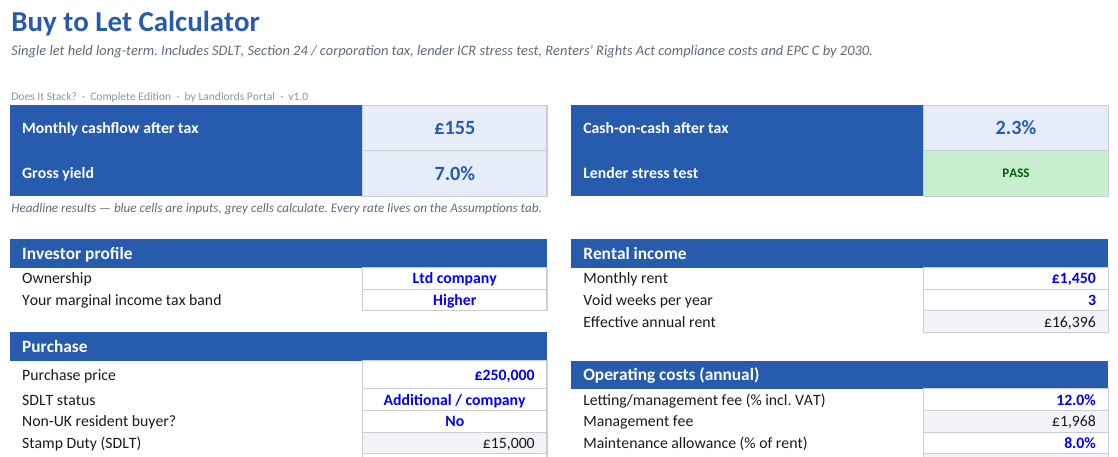
- Stamp duty: £15,000 at the additional-property rates.
- Cash needed: about £80,400 including deposit, fees and costs.
- Gross yield: 7.0%.
- Cashflow after corporation tax: about £155 a month, a 2.3% cash-on-cash return.
- Lender stress test: passes, with rent cover of 167% against the 125% required.
Switch the ownership to personal and the tax band to higher rate, and the same deal looks very different: Section 24 and the 145% stress test both bite. That’s the comparison most investors never run until it’s too late. These are illustrative figures, so overwrite them with your own deal.
For developers: see what a lender sees
The New Build Development tab is a full appraisal for small residential schemes. It covers land stamp duty, CIL, Section 106, the Building Safety Levy for schemes of 10 or more homes (live since 1 October 2026), biodiversity net gain with the exemption for sites of 0.2 hectares or less, build costs with contingency, professional fees and sales costs. Finance interest comes from a month-by-month drawdown schedule, not a rule-of-thumb guess.
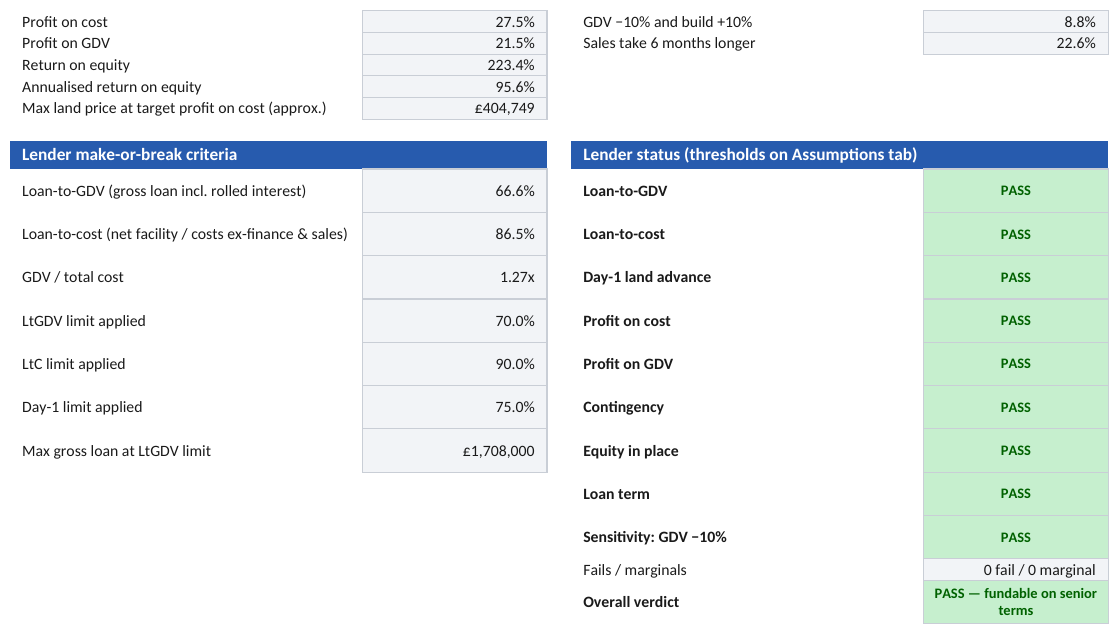
It then checks the scheme against the tests development lenders apply: loan-to-GDV, loan-to-cost, day-1 land advance, profit on cost and on GDV, contingency, your equity, the loan term and a 10% fall in values. Each comes back PASS, MARGINAL or FAIL, with a setting for the tighter limits most lenders apply to first-time developers. Use it before you approach a broker, so you know which numbers you need to fix.
What you get for £14.99
- The Complete Edition workbook (.xlsx) with nine calculators, the Assumptions tab and the Regulatory Log.
- A six-page Quick-Start Guide (PDF), tab by tab, with troubleshooting.
- Free updates for 12 months. When the rules change, for example after a Budget, your original download link gives you the new version.
- Protected formulas so you can’t break anything by accident, with the password included if you want to customise.
It works best in Microsoft Excel on Windows, Mac or the web. Rules are modelled for England and Northern Ireland; Scotland and Wales have their own property transaction taxes.
Does It Stack? — Complete Edition
Nine UK property calculators, a Quick-Start Guide and 12 months of updates.
Buy now — £14.99Instant download. Secure checkout by Payhip.
Who it’s for
Does It Stack? is for landlords and investors who want to check a deal properly before they offer: first-time buy-to-let buyers, portfolio landlords comparing personal and company ownership, BRR and HMO investors, holiday-let owners weighing up a switch, and small developers preparing a finance proposal. It isn’t a substitute for advice. Use it to narrow down deals and prepare questions, then check tax and lending with your accountant and broker.
Frequently asked questions
Does it work in Google Sheets?
It’s built and tested in Microsoft Excel. Google Sheets can import the file, but sheet protection doesn’t carry across, so take care not to type over calculated cells.
Does it cover Scotland and Wales?
Not yet. Stamp duty and the rules modelled are for England and Northern Ireland. Scotland uses LBTT and Wales uses LTT.
How do updates work?
When rules change, we update the file on Payhip. Your original download link always gives you the latest version for 12 months, and we email buyers when there’s a new one.
Can I change the formulas?
Yes. Formulas are protected to prevent accidents, and the password to unlock them is in the guide. Keep an untouched copy, because we can only help with unedited files.
Is this tax or financial advice?
No. It gives estimates to help you appraise a deal. Tax assumes your rental profit falls in the band you choose. Always check with a qualified adviser before you commit.
Can I use it for more than one property?
Yes. Save a copy of the file for each deal you analyse. The licence covers your own property decisions; please don’t share or resell the file.
Does It Stack? is made by the Landlords Portal team. This article is general information, not legal, tax or financial advice. Rules are correct as at October 2026 and may change, including at the Autumn Budget on 28 October 2026.