
Updated November 2026, after the 28 October Budget. Selling a buy-to-let? You will usually owe capital gains tax on the profit, and you have just 60 days from completion to report it and pay. This guide shows how the calculation works, the reliefs that genuinely cut the bill, and the deadlines that catch landlords out.

Selling a rental property is rarely as simple as “sale price minus purchase price”. Capital gains tax on selling a rental property is charged on your gain after allowable costs and reliefs, and the residential rates are 18% and 24% for 2026/27. Get the calculation wrong and you can overpay by thousands; miss the 60-day reporting deadline and HMRC adds interest and penalties.
The rules come from the Taxation of Chargeable Gains Act 1992 and HMRC guidance. The Autumn Budget on 28 October 2026 left CGT rates unchanged, but it raised the tax on rental income from April 2027, which changes the sell-or-keep maths for many landlords. We cover both below.
Key takeaways
- Rates: 18% on gains within your unused basic-rate band, 24% above it (2026/27).
- Tax-free allowance: the annual exempt amount is £3,000 per person, per tax year.
- Deadline: report and pay within 60 days of completion, not at the January Self Assessment deadline.
- Reliefs: Private Residence Relief can cover years you lived there plus the final 9 months. Letting relief now only applies if you lived there at the same time as your tenant.
- Records win: purchase costs, selling costs and capital improvements all reduce the gain, but only if you can prove them.
What counts as a disposal of a rental property
CGT is triggered by more than an ordinary sale. Each of these is a disposal:
- Selling the property to a third party.
- Gifting it, for example to an adult child. HMRC uses market value even though no money changes hands.
- Transferring it into your own limited company. This is also treated as a sale at market value, and the company usually pays stamp duty on the way in. Incorporation relief only helps where the letting genuinely amounts to a business, so take advice first. See our guide to limited companies for buy-to-let.
- Part-disposals, such as selling a share in the property.
- Transferring it to a spouse or civil partner you live with. This is a disposal, but at “no gain, no loss”: no tax is due now, and your spouse inherits your original cost.
Death is the big exception. There is no CGT on death, and whoever inherits takes the property at its market value on the date of death. That “uplift” wipes out the lifetime gain for CGT purposes, although inheritance tax may apply to the estate instead.
How to calculate CGT on selling a rental property
Working out your CGT bill, step by step
Or market value if you gifted the property or sold it to a connected person.
Purchase price, stamp duty, legal and survey fees, estate agent fees on the sale.
Extensions, loft conversions, a kitchen that is a genuine upgrade. Not repairs.
Private Residence Relief, any letting relief, capital losses you have reported.
18% on the part that fits in your unused basic-rate band, 24% on the rest.
Allowable costs: repairs versus improvements
This is where most errors happen. A repair restores the property to how it was: replacing a broken boiler, fixing a roof, redecorating. Repairs are claimed against rental income while you own the property, so they cannot be deducted again from the gain. An improvement adds something new or better: an extension, a loft conversion, a second bathroom. Improvements are deducted from the gain, provided they are still reflected in the property when you sell.
| Cost | Deductible from the gain? |
|---|---|
| Purchase price and stamp duty paid | Yes |
| Solicitor and survey fees on purchase | Yes |
| Estate agent and solicitor fees on the sale | Yes |
| Extension, loft conversion, new bathroom where there was none | Yes (capital improvement) |
| Like-for-like boiler, kitchen refresh, redecorating | No (repair, claimed against rent instead) |
| Mortgage interest and arrangement fees | No |
| Fees for a tax adviser to work out your CGT | No |
Keep every invoice from the day you buy until the day you sell. Landlords who sell after 10 or 15 years often cannot evidence improvements they paid for, and HMRC can disallow anything you cannot prove. Our list of hidden buy-to-let costs is a useful prompt for what to track.
Reliefs that cut your CGT bill
Private Residence Relief (PRR)
If the property was your only or main home at any point, the periods you lived there are exempt, and so are the final 9 months of ownership, wherever you were living by then. Relief is time-apportioned across your ownership. For an accidental landlord who let out their old home, PRR can remove a large share of the gain.
Letting relief (now very limited)
Older guides say letting relief exempts up to £40,000 for anyone who moved out and let their former home. That stopped on 6 April 2020. Letting relief now applies only where you were in shared occupancy with your tenant, for example a lodger arrangement where you lived in the property at the same time. Where it does apply, it is capped at the lowest of £40,000, the PRR amount, and the gain on the let part. Most buy-to-let landlords will get nothing from it.
Spouse and civil partner transfers
Transfers between spouses or civil partners who live together are at no gain, no loss. If your partner has unused basic-rate band, or has not used their own £3,000 allowance, moving a share into joint names before the sale can reduce the total tax. The transfer must be genuine and outright. Watch stamp duty too: if your spouse takes on part of the mortgage, that can count as consideration for SDLT.
Capital losses
Losses on other assets, such as shares, can be set against the gain. A loss must be claimed within four years of the end of the tax year in which it arose. If you never reported it, it may already be too late.
The 60-day reporting and payment deadline
When you sell UK residential property at a gain that leaves tax to pay, you must report it and pay the estimated tax within 60 days of completion using HMRC’s Report and pay Capital Gains Tax on UK property service. The clock runs from completion, not exchange.
- You pay an estimate within 60 days. The final figure is settled on your Self Assessment return for that tax year.
- Late payment interest runs from day 61, and late-filing penalties start at £100.
- Budget 2026 change: for returns delivered from 28 October 2026, further late-filing penalties stop building up once the sale is included on your Self Assessment return (subject to legislation). The 60-day deadline itself has not moved.
- If no tax is due, for example because the gain is covered by reliefs and the allowance, you generally do not need a 60-day return, but you may still need to include the sale on Self Assessment.
Worked examples
Example 1: a landlord on a £40,000 salary
Bought for £200,000, paying £2,000 stamp duty and £1,500 legal fees. Sold for £320,000, paying £3,000 in selling fees. Gain: £320,000 − £200,000 − £2,000 − £1,500 − £3,000 = £113,500. After the £3,000 allowance, £110,500 is taxable.
With £40,000 of income, £10,270 of the basic-rate band is unused. That slice is taxed at 18% (£1,848.60) and the remaining £100,230 at 24% (£24,055.20). Total CGT: about £25,904. Many basic-rate taxpayers are surprised that most of a large gain is taxed at 24%, because the gain itself uses up the band.
Example 2: an accidental landlord with PRR
Owned for 10 years: lived there for 5, then let it for 5. Gain £150,000. PRR covers the 5 years of residence plus the final 9 months, so 5.75 of 10 years (57.5%), which is £86,250. Letting relief does not apply because the owner never shared the home with the tenants. Taxable: £150,000 − £86,250 − £3,000 = £60,750, at 24% = £14,580. Without PRR, the bill would have been £35,280.
| Example 1 | Example 2 | |
|---|---|---|
| Gain before reliefs | £113,500 | £150,000 |
| PRR | £0 | £86,250 |
| Annual exempt amount | £3,000 | £3,000 |
| Taxable gain | £110,500 | £60,750 |
| CGT due (approx.) | £25,904 | £14,580 |
Sell or keep after Budget 2026?
CGT rates did not change at the 28 October 2026 Budget, but tax on rental profits will. From 6 April 2027, property income is due to be taxed at 24%, 44% and 49% in England, Wales and Northern Ireland. That makes keeping a low-yielding property more expensive each year, while the cost of selling stays the same. Run both sides of the decision before you act: our Budget 2026 sell-or-keep guide walks through it, and if the property is tenanted, read how to sell a property with a tenant.
Common mistakes landlords make
- Waiting for January. Assuming CGT on a property sale is paid with the Self Assessment return. It is due within 60 days.
- Claiming repairs as improvements. A like-for-like replacement is a repair. Claiming it against the gain invites an HMRC challenge.
- Relying on old letting relief rules. Since April 2020 it only helps if you lived with your tenant.
- Forgetting the gain can push you into the 24% band. Your unused basic-rate band is usually much smaller than the gain.
- Losing records. No invoices, no deduction. Keep a simple log of purchase costs, fees and every improvement with dates.
When to get professional help
A simple sale is manageable on HMRC’s online service. Pay for advice if you ever lived in the property, are transferring to a spouse or company, have losses to use, or are selling several properties. Advice fees are not deductible from the gain, but they are usually small next to the tax at stake.
Frequently asked questions
Do I pay CGT when I sell a rental property?
Yes, if your gain after costs, reliefs and the £3,000 annual exempt amount is above zero. Residential gains are taxed at 18% or 24% for 2026/27, and you must report and pay within 60 days of completion.
What is the CGT allowance for 2026/27?
£3,000 per person. It covers all your gains in the tax year, not each property, and it cannot be carried forward.
Can I avoid CGT by reinvesting in another property?
No. Rollover relief does not apply to ordinary residential lettings, so reinvesting the proceeds does not defer the tax.
Can I still claim letting relief?
Only if you lived in the property at the same time as your tenant. If you moved out and then let it, letting relief is not available for disposals since 6 April 2020.
When must I pay CGT after selling?
Within 60 days of completion for UK residential property. Interest runs from day 61 and late-filing penalties can apply.
Do I need to report a sale at a loss?
There is no 60-day return if no tax is due, but you should claim the loss through Self Assessment within four years so you can use it against future gains.
Did the 2026 Budget change capital gains tax on property?
The rates and the 60-day deadline did not change. The Budget did ease late-filing penalties once a disposal is on your Self Assessment return, and it raised tax on rental income from April 2027.
Written by The Landlords Portal Team. Figures checked against GOV.UK and HMRC guidance in November 2026. This is general information, not tax advice; speak to a qualified tax adviser about your own sale. Related: buy-to-let stamp duty calculator · renting a buy-to-let to family.
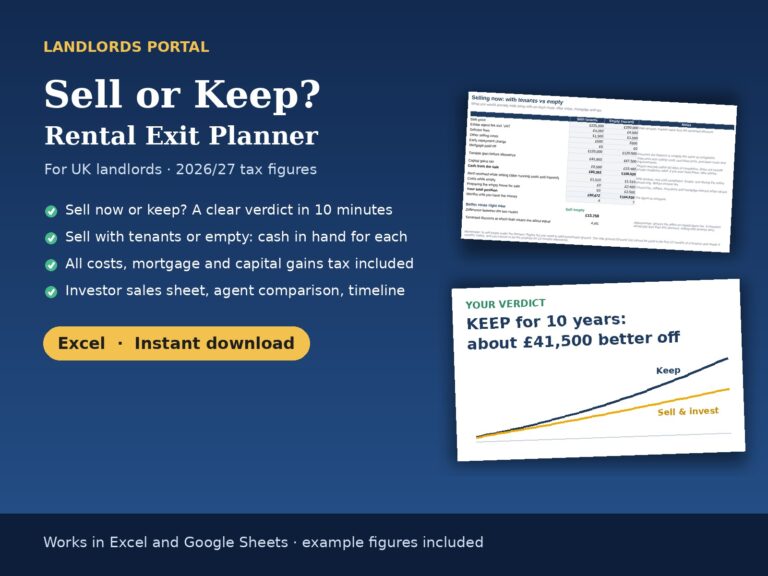
Excel planner from Landlords Portal
Sell or keep? Find out what you would really walk away with
Enter your figures and get a clear verdict: sell now or keep, and whether to sell with the tenants in place or wait until it is empty. Fees, mortgage, capital gains tax and lost rent all included.
- Cash in hand selling with tenants vs selling empty
- Keep vs sell projection up to 25 years, with a clear verdict
- Investor sales sheet, agent comparison and sale timeline