
Raising the rent is no longer a quiet letter and a handshake. Under the Renters’ Rights Act, the only lawful way to increase rent on a periodic assured tenancy is a Section 13 notice — once a year, on the right form, with at least two months’ notice — and your tenant can challenge it at the First-tier Tribunal. Get the process wrong and the increase simply doesn’t take effect. This guide shows you how to do it properly.
It’s a supporting guide to our Renters’ Rights Act 2026 landlord checklist.
Key takeaways
- One increase per year. Rent can rise only once in any 12-month period.
- Section 13 notice, Form 4A. It’s the only valid route — rent-review clauses no longer work.
- At least two months’ notice before the new rent starts.
- Tenants can challenge at the tribunal, which can’t set the rent higher than you proposed.
- No backdating. A tribunal-decided rent takes effect from the decision, not the original date.
How rent increases work now
Because every tenancy is now an open-ended periodic tenancy, the old idea of agreeing a new rent at renewal has gone — there is no renewal. Instead, a landlord who wants more rent must serve a statutory Section 13 notice on Form 4A, proposing a new rent and a date it starts. You can do this only once every 12 months, and the notice must give the tenant at least two months before the new figure applies. Any rent-increase clause buried in a tenancy agreement is no longer effective; Section 13 is the only mechanism.
The proposed rent should be in line with local market rents. If it isn’t, the tenant has a clear route to push back.
The tenant’s right to challenge
A tenant who thinks the proposed rent is above market can apply to the First-tier Tribunal (Property Chamber) before the increase takes effect. Two changes under the Renters’ Rights Act tilt this firmly toward tenants:
- The tribunal can’t set the rent higher than you proposed. Previously it could determine the true market rent even if that was above your figure; now your proposed rent is the ceiling.
- No backdating. If the tribunal sets a rent, it applies from the date of the decision (or later), not the date in your original notice — so a drawn-out challenge no longer benefits the landlord.
In practice this means a sensible, evidenced increase is more likely to stick than an ambitious one, because there’s no upside to over-asking and a real risk of delay if the tenant challenges.
Serving a Section 13 notice: a quick checklist
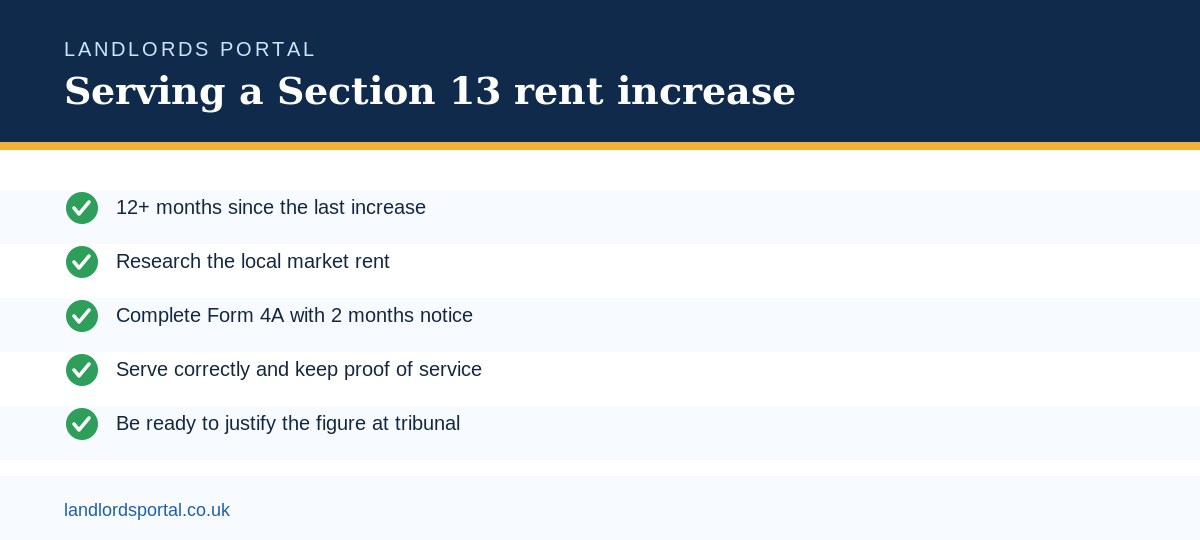
- Check the timing — at least 12 months since the last increase (or the tenancy start).
- Research the market rent for comparable local properties and keep your evidence.
- Complete Form 4A with the new rent and a start date at least two months ahead.
- Serve it correctly and keep proof of service.
- Be ready to justify the figure if the tenant applies to the tribunal.
For the wider rules on what you can and can’t ask for at the start of a tenancy, see rent in advance and the bidding ban, and our general guide to increasing rent during a tenancy.
Written by the Landlords Portal editorial team. General information, not legal or financial advice — confirm the current forms and tribunal rules on GOV.UK before serving a notice.
Why the old approach no longer works
For years, most rent rises happened informally — a conversation, a letter, perhaps a rent-review clause in the tenancy agreement that bumped the figure each year. None of that survives the Renters’ Rights Act. Because there is no longer a fixed term to renew, there is nothing to renegotiate at; the tenancy simply rolls on. The only lever you have is the statutory Section 13 mechanism, and it works on the Act’s terms, not yours. A rent-review clause in an old agreement is now legally inert, and a rent rise agreed by a friendly handshake has no standing if the tenant later disputes it. Treat Section 13 as the single, formal route and you avoid a world of trouble.
Working out a defensible market rent
Because the tenant can challenge your figure at the tribunal, the quality of your evidence matters as much as the figure itself. The aim is a rent you can stand behind as the genuine market rate for a comparable property in the same area. Build your case from several sources rather than a single guess.
- Like-for-like comparables. Find currently advertised properties of similar size, condition and location, and keep dated screenshots.
- Local letting agents. A written rental appraisal from an agent who knows the area carries weight.
- Portal data. The major property portals show asking rents that help establish a range.
- The property’s own features. Be honest about condition — a tired kitchen or a dated bathroom pulls the defensible figure down, while recent improvements push it up.
If you genuinely can’t find comparables that support your figure, that is a signal to lower it. There is no upside to over-asking, as the next section explains.
A worked example
Suppose your tenant pays £1,000 a month and local comparables sit around £1,100. You serve a Section 13 notice proposing £1,100, with at least two months’ notice, having not increased the rent in the past 12 months. If the tenant accepts, the new rent starts on the date in the notice. If the tenant challenges, the tribunal will assess the market rent — but it cannot set a figure above your proposed £1,100, even if the true market rate is £1,150. And if the tribunal decides £1,080 is right, that new rent applies from the tribunal’s decision, not the date you originally proposed. The lesson is clear: a realistic, evidenced £1,100 is far more useful than an ambitious £1,250 that invites a challenge, delays the rise and can only ever be capped, never enhanced.
What the tribunal looks at
The First-tier Tribunal (Property Chamber) assesses the open-market rent the property could reasonably achieve, let on the same terms, in its actual condition. It does not consider your costs, your mortgage, or the tenant’s ability to pay — only the market. It will weigh the property’s size, location, condition and any disrepair, and it will look at the comparables both sides put forward. Because the process is evidence-led, a landlord who turns up with solid comparables usually fares better than one who simply asserts a figure. Two reforms now shape the outcome decisively: the tribunal cannot exceed your proposed rent, and any rent it sets is not backdated. Together these remove the old incentive for landlords to aim high and the old risk to tenants of challenging.
Timing and strategy
With only one increase permitted every 12 months, timing matters. Many landlords will settle into an annual review on the anniversary of the tenancy, keeping it predictable for the tenant and simple to administer. Build a diary reminder so you don’t miss a year or, worse, try to increase twice. Bear in mind too that a sharp jump after years of holding rent flat is more likely to be challenged than steady, modest annual rises that track the local market — and a good, long-term tenant who pays on time and looks after the place has a value that an extra few pounds a month rarely outweighs.
Special situations
Tenants on Universal Credit. A rent rise can affect the housing element a tenant receives, so give plenty of notice and, where you can, point them to support in updating their claim. A rise that tips a tenant into arrears helps nobody.
After improvements. If you’ve genuinely upgraded the property — a new kitchen, better insulation, a fresh bathroom — your defensible market rent rises accordingly, and your comparables should reflect the improved specification. Keep before-and-after evidence.
Common mistakes to avoid
- Relying on a rent-review clause. It no longer works; only a Section 13 notice does.
- Trying to increase more than once in 12 months. The second notice is invalid.
- Giving less than two months’ notice before the new rent starts.
- Over-asking. The tribunal can only cap your figure, never raise it, so an inflated proposal is all downside.
- Keeping no evidence of the market rent you relied on.
Serving the Section 13 notice correctly
The mechanics matter, because a defective notice simply doesn’t take effect and you have to start again — losing months in the process. The notice must be the prescribed form, Form 4A, completed in full: the property, the names of all tenants, the current rent, the proposed new rent and the date it is to begin. That start date must be at least two months after you serve the notice, and it must not fall earlier than 12 months after the last increase (or the start of the tenancy). Serve it on every tenant named on the agreement, not just one, and keep clear proof of how and when you served it — a dated email, a certificate of posting, or a witnessed hand delivery. If you use a letting agent, make sure they are using the current form and the right timescales on your behalf, because the legal responsibility ultimately rests with you.
Small errors are the usual undoing of a rent increase: an out-of-date form, a start date a few days too soon, or a notice served on only one of two joint tenants. Slow down and check each field before it goes out.
What happens after you serve it
Once served, one of three things happens. The tenant accepts, expressly or by simply paying the new rent, and the increase takes effect on the date in the notice. The tenant does nothing and doesn’t apply to the tribunal, in which case the new rent also takes effect as proposed. Or the tenant applies to the First-tier Tribunal before the start date, which pauses the increase until the tribunal decides. There is no need for you to do anything further unless the tenant challenges; you don’t apply to the tribunal yourself. If the tenant applies, you’ll be asked to provide your evidence of the market rent, so keep the comparables you gathered ready to submit.
Rent rises, arrears and the relationship
It’s worth stepping back from the mechanics to the commercial reality. A rent increase that pushes a reliable tenant into hardship can convert a problem-free tenancy into one with arrears, stress and, eventually, the slow and costly possession process the Act now requires. Because you can no longer simply end a tenancy with a Section 21 notice if things sour, the value of keeping a good tenant has gone up, not down. Many landlords will conclude that a steady, defensible, slightly-below-the-ceiling increase each year — applied consistently and communicated clearly — protects both their income and the relationship far better than an aggressive jump that triggers a challenge or breeds resentment.
If arrears do build up despite a fair rent, that is a possession question rather than a rent-increase one, and our guide to how possession works now that Section 21 has ended walks through the Section 8 grounds and the court process.
Keep a clean record
Whatever the outcome, keep a tidy file for each property: the served Form 4A, proof of service, the comparables you relied on, and any correspondence with the tenant. If a future increase is ever challenged, a clear paper trail showing reasonable, evidenced rises year on year is your best defence. It also makes the annual review quicker each time, because you’re building on last year’s evidence rather than starting from scratch.
Setting the rent at the start of a new tenancy
It’s worth being clear about what Section 13 does and doesn’t govern. At the start of a brand-new tenancy you are free to agree the opening rent with the incoming tenant at whatever the market will bear — subject to the separate ban on rental bidding, which means you must advertise a fixed asking rent and can’t invite or accept offers above it. Section 13 only governs increases during an ongoing periodic tenancy. So the strategic decision splits in two: price the initial let accurately to start from the right base, then use disciplined annual Section 13 increases to keep pace with the market over time. Getting the opening figure right matters more than ever, because catching up later is slow, capped and challengeable.
If a tenant would rather leave than pay
Because tenancies are now open-ended and tenants can leave on two months’ notice, a tenant faced with an increase they consider too high has a simple alternative to a tribunal challenge: they can give notice and go. For a landlord, that means a rent rise is always an implicit negotiation about whether the tenant stays. Weigh the extra income against the cost of a void period, re-advertising, referencing and the risk of an unknown new tenant. In many cases a modest, fair increase that keeps a proven tenant in place is the better financial outcome than a maximal one that triggers a move. The Act has quietly made tenant retention a core part of rent strategy.
The bottom line
Rent increases under the Renters’ Rights Act are entirely workable, but they reward discipline. Use the Section 13 notice on Form 4A, once a year, with at least two months’ notice; price to a defensible market rent backed by real comparables; expect that the tribunal can only ever cap your figure, never raise it, and won’t backdate; and keep clean records throughout. Do that, and you can grow your income steadily and lawfully while keeping the good tenants who make a rental business profitable in the first place.
A note on agents and managed properties
If a letting agent manages your property, they will usually serve the Section 13 notice for you — but the legal responsibility, and the financial consequences of getting it wrong, still rest with you as the landlord. Confirm in writing that your agent is using the current Form 4A, observing the once-a-year limit and the two-month notice period, and keeping evidence of service and the comparables relied on. Ask to see the notice before it goes out, and keep your own copy on file. A capable agent makes the process effortless; an inattentive one can cost you a year’s increase on a technicality, so it’s worth checking rather than assuming.
Frequently asked questions
How often can I increase the rent?
Once in any 12-month period, using a Section 13 notice on Form 4A with at least two months’ notice before the new rent applies.
Can I still use a rent-review clause in the tenancy agreement?
No. On a periodic assured tenancy the Section 13 process is the only lawful way to raise rent, regardless of what an old agreement says.
Can the tribunal raise my rent higher than I asked?
No. Under the Renters’ Rights Act the tribunal cannot set a rent above the figure you proposed, so there’s no risk to the tenant in challenging — and no benefit to you in over-asking.
If the tenant challenges, when does the new rent start?
From the date the tribunal decides (or a later date), not the date in your original notice. Increases are no longer backdated, so challenges can delay the rise.
Next: back to the Renters’ Rights Act landlord checklist.