
Last updated:
Damp and mould are the most common reasons tenants complain to councils, and since the death of two-year-old Awaab Ishak in 2020 they have become a priority for regulators. As a landlord in England you are responsible for damp caused by the building, and for dealing with mould quickly even when the tenant’s habits play a part. This guide explains the three types of damp, the law that applies today, what Awaab’s Law will mean for private landlords, and a step-by-step process for handling a report.
Key takeaways
- Your home must be fit to live in at the start of and throughout the tenancy. Serious damp and mould can make it unfit.
- You must repair the structure and exterior, which covers most penetrating and rising damp.
- Condensation is not automatically the tenant’s fault. Poor ventilation, insulation or heating are the landlord’s responsibility.
- Awaab’s Law already applies to social housing. The government is consulting on extending it to private rentals, with the earliest start in 2027.
- Respond to every report in writing, inspect quickly, find the cause, and keep a record of what you did.
Condensation, penetrating and rising damp: know the difference
The fix depends on the cause, so diagnose before you treat. Painting over mould without finding the source almost always brings it back.
Condensation
Signs: black mould in corners, behind furniture, on window frames; streaming windows
Cause: moist air meeting cold surfaces
Fix: extraction, ventilation, insulation, steady heating
Penetrating damp
Signs: damp patches that grow after rain, often on outside walls or ceilings
Cause: leaking gutters, roofs, pipes, cracked render, failed pointing
Fix: repair the defect, then let the wall dry out
Rising damp
Signs: a tide mark up to about 1 metre, salts, crumbling plaster at the base of walls
Cause: failed or bridged damp-proof course
Fix: clear bridging (raised soil, render), then repair the DPC if needed
True rising damp is less common than often claimed. Check for bridging and leaks first.
A damp meter helps you record readings, but a surface meter reading alone is not a diagnosis. For persistent or structural damp, use an independent surveyor rather than a company that sells damp-proofing.
Save time with our template
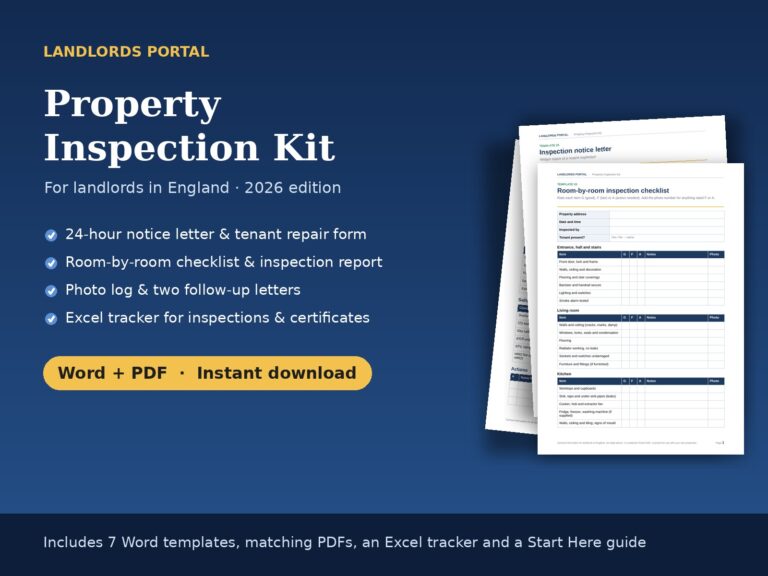
Property Inspection Kit
Notice letter, room-by-room checklist, photo log and compliance tracker, so every visit leaves dated evidence.
Get the kit - £9.99Instant downloadNeed more than one? Get all four template packs for £24.99 (save almost 40%).
Your legal duties today
| Law | What it requires | Who enforces it |
|---|---|---|
| Landlord and Tenant Act 1985, section 11 | Keep the structure, exterior, and water, heating and sanitation installations in repair | The tenant, through the courts |
| Homes (Fitness for Human Habitation) Act 2018 | The home must be fit to live in at the start and throughout; damp and mould is one of the listed hazards | The tenant, through the courts |
| Housing Act 2004 (HHSRS) | Councils assess hazards, including damp and mould growth, and can serve improvement notices | The local council, with civil penalties or prosecution |
| Renters’ Rights Act 2025 | Gives powers to apply Awaab’s Law and a Decent Homes Standard to private rentals | To be set out in regulations |
Your repairing duty usually starts once you know about the problem, which is why a clear reporting route for tenants and a quick response matter. See our guides to fitness for human habitation and what repairs landlords are responsible for.
Awaab’s Law and private landlords
Awaab’s Law has applied to social housing since 27 October 2025. It sets legal deadlines to investigate and fix serious hazards, starting with damp and mould. The Renters’ Rights Act allows the same requirements to be applied to private tenancies. The government opened a consultation on Awaab’s Law for private rentals on 9 October 2026. It closes on 18 December 2026, and the earliest start date it suggests is 2027.
The final deadlines for private landlords have not been set. The consultation uses the social housing rules as a starting point, including investigating a potential significant hazard within 10 working days and acting on an emergency within 24 hours. Building a fast process now means you will not need to change much later. Our guide to Awaab’s Law and the Decent Homes Standard covers the background.
How to handle a damp or mould report: step by step
- Acknowledge it in writing the same day. Thank the tenant, ask for photos, and arrange a visit.
- Inspect within days, not weeks. Take dated photos, meter readings and notes on location, extent and any obvious cause. Check gutters, downpipes and the outside of the wall too.
- Decide whether it is urgent. Widespread mould in a bedroom, or a household with a baby, an elderly person, or someone with a respiratory condition, needs faster action.
- Treat the mould and fix the cause. Clean affected areas with a fungicidal wash, then repair leaks, improve extraction or insulation, or get a specialist to diagnose.
- Write to the tenant with your findings and plan, including dates. If their habits are contributing, explain practical steps in a helpful tone.
- Follow up after 4 to 6 weeks to check the problem has not returned, and record the result.
A consistent inspection record protects you if the case reaches a council or court. The Property Inspection Kit includes room-by-room forms with a damp and mould section you can use for each visit.
Fixes that work for condensation
| Fix | Typical effect | Notes |
|---|---|---|
| Humidistat extractor fans in kitchen and bathroom | High | Runs automatically, so it does not depend on the tenant |
| Positive input ventilation (PIV) | High in houses with whole-house condensation | One loft unit gently pushes filtered air through the home |
| Trickle vents on windows | Medium | Cheap to retrofit; ask tenants to keep them open |
| Loft and cavity insulation | Medium to high | Warmer walls mean less condensation, and also helps your EPC |
| Affordable, controllable heating | Medium | Cold homes get mould; programmable controls help tenants heat steadily |
| Dehumidifier | Short-term | Useful while drying out; see our best dehumidifiers for rental properties |
When tenant behaviour is the cause
Drying clothes indoors, blocking vents and not heating the home can all cause condensation. Even so, the government’s guidance on damp and mould is clear that landlords should not blame “lifestyle” without first checking the property. Give the tenant practical advice in writing, provide the means to ventilate (working fans, a place to dry clothes), and record what you asked and when. Our guide to damp, mould and tenant behaviour explains how to gather fair evidence.
Common mistakes
- Painting over mould or using anti-mould paint without fixing the cause.
- Telling the tenant to “open a window” and taking no other action.
- Delaying a visit for weeks after the first report.
- Buying an expensive damp-proof course for what is actually condensation or a leaking gutter.
- Not keeping photos and dates of what you did.
Written by The Landlords Portal Team and checked against GOV.UK guidance in November 2026. Applies to private rented homes in England. This is general information, not legal or surveying advice.
Frequently asked questions
Is the landlord responsible for mould in a rented property?
Usually, yes. You are responsible for damp caused by disrepair, and for making sure the home is fit to live in. Condensation mould caused partly by how the home is used still needs you to check ventilation, insulation and heating.
Does Awaab’s Law apply to private landlords?
Not yet. It applies to social housing from 27 October 2025. The government is consulting until 18 December 2026 on applying it to private rentals, with 2027 as the earliest start.
How quickly must a landlord fix damp and mould?
There is no fixed private-sector deadline yet, but you must act within a reasonable time once you know about it. Acknowledge the report the same day and inspect within days.
Can a tenant withhold rent because of mould?
Withholding rent is risky for tenants and can lead to arrears. Tenants can instead complain to the council or bring a claim for disrepair or unfitness, so it is in your interest to resolve reports quickly.
Get the landlord updates that actually matter
Rule changes, deadlines and the enforcement cases that catch landlords out — one short email when something changes. Free, and you can leave any time.
Template pack from Landlords Portal
Run every inspection properly: the Property Inspection Kit
Dated evidence of the property's condition protects you in repair, damp and deposit disputes. This kit gives you every document for an inspection, written for landlords in England.
- 24-hour notice letter and tenant repair report form
- Room-by-room checklist, inspection report and photo log
- Follow-up letters, plus an Excel tracker for gas safety, EICR and EPC dates