
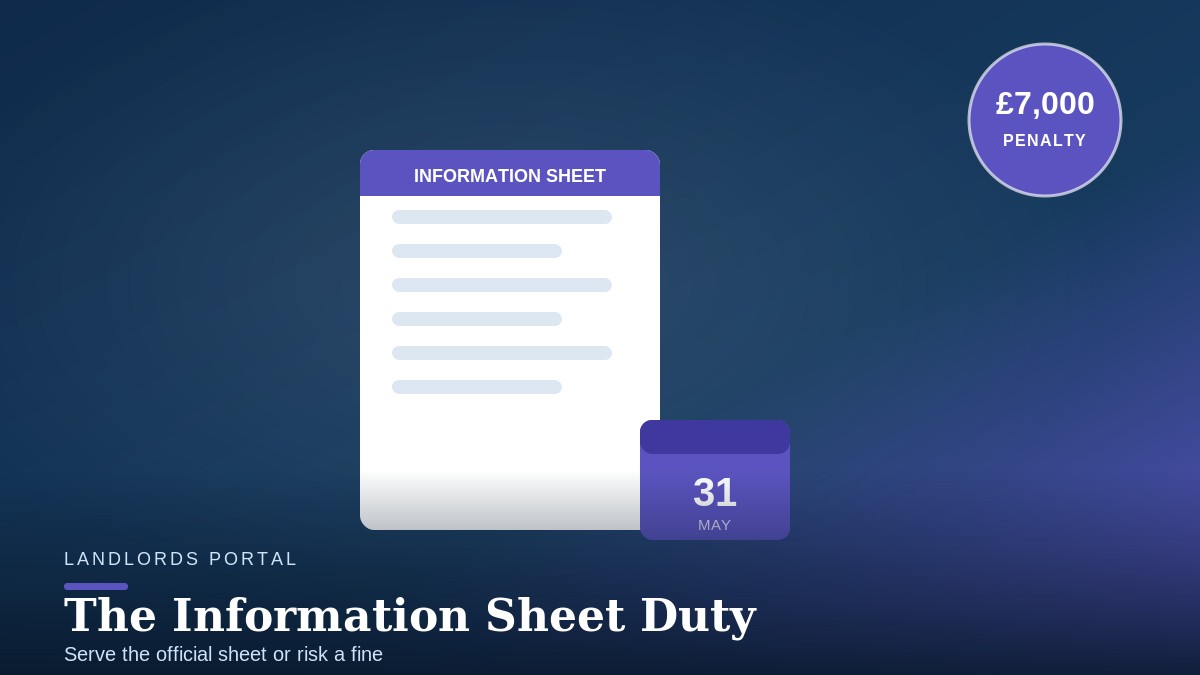
One of the easiest Renters’ Rights Act duties to overlook is also one of the easiest to enforce: giving your tenants the official information sheet. Existing tenants should have received it by the 31 May 2026 deadline, and every new tenant must get it at the start of the tenancy. Miss it and you risk a fine of up to £7,000. This guide explains exactly what the information sheet is, who needs it, and how to serve it properly — including what to do if you’ve missed the deadline.
It’s a supporting guide to our Renters’ Rights Act 2026 landlord checklist.
Key takeaways
- Existing tenants: deadline was 31 May 2026. If you haven’t served it, do so now to limit your exposure.
- New tenants: serve it at the start of every new tenancy.
- Use the exact government PDF. Only the official document downloaded from GOV.UK counts.
- Penalty up to £7,000 for failing to provide it.
- Keep proof of delivery — you may need to show you served it.
What is the information sheet?
The Renters’ Rights Act information sheet is a short government document that explains the changes the Act makes and how they affect a tenancy. Its purpose is to make sure tenants understand their new rights — the end of Section 21, the move to periodic tenancies, the new rent and pet rules. The government published the official version, and only that exact PDF, downloaded from the GOV.UK information sheet page, satisfies the duty — you can’t write your own summary instead.
Who needs it, and by when
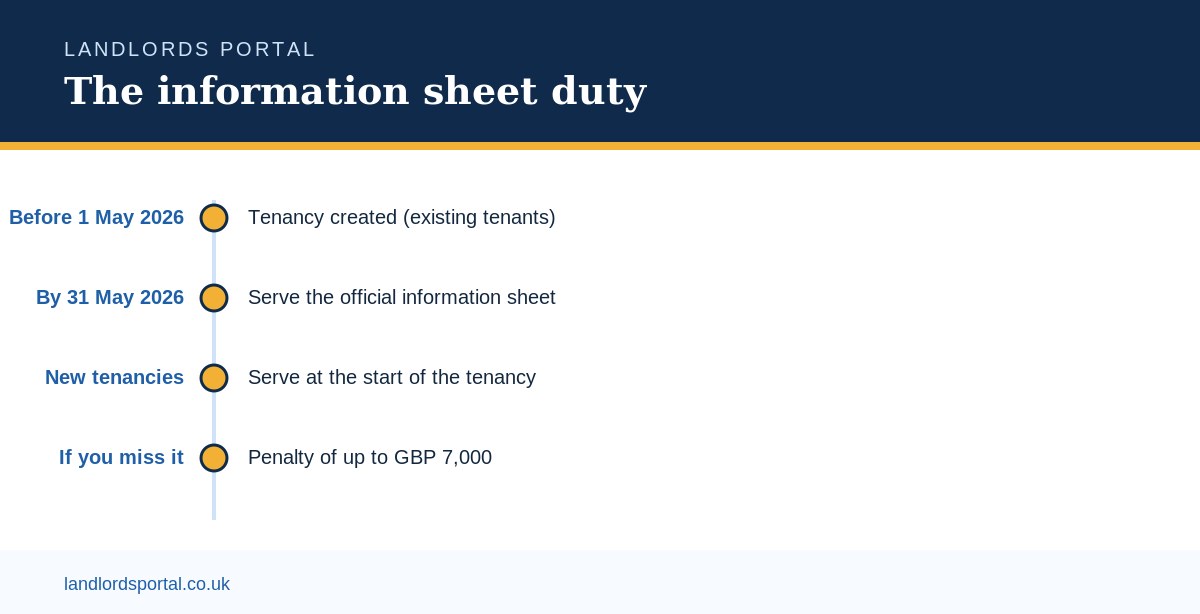
- Existing tenants on an assured or assured shorthold tenancy created before 1 May 2026 had to be given the sheet by 31 May 2026. A copy must go to every tenant named on the agreement.
- New tenants must receive it at the start of the tenancy.
- Verbal tenancies made before 1 May 2026 require a written statement of the key terms instead.
You don’t need to change or re-issue existing tenancy agreements — the sheet sits alongside them. It can be served digitally or on paper, but either way you should keep evidence that you sent it.
What if you’ve missed the deadline?
If 31 May 2026 has passed and you haven’t served the sheet, serve it now rather than leaving it — acting promptly limits your exposure and gets you compliant for the rest of the tenancy. Send the official PDF to every named tenant, record the date and method, and keep that proof on file. Then fold it into your standard onboarding so every future tenant receives it automatically at sign-up.
How to serve it properly
- Download the current official PDF from GOV.UK — don’t use a cached or third-party copy.
- Send it to every named tenant, by email or hard copy.
- Record the date and method, and keep a copy of the email or a delivery note.
- Add it to your new-tenancy checklist so it’s served every time.
Written by the Landlords Portal editorial team. General information, not legal advice — download the current information sheet and confirm the duty on GOV.UK or with the NRLA.
What the information sheet contains
The information sheet is a plain-English summary, produced by the government, of what the Renters’ Rights Act means for a tenancy. It explains the headline changes — the end of Section 21 and fixed terms, the move to open-ended periodic tenancies, the new rules on rent increases and rent in advance, and the right to request a pet — and points tenants to where they can get help if something goes wrong. The purpose is simple: to make sure tenants actually understand the new rights the Act gives them, rather than relying on landlords or agents to explain it. Because it is an official document, only the exact version downloaded from GOV.UK satisfies the duty; a paraphrase or a home-made summary does not count, however accurate.
The wider prescribed-information picture
The information sheet is a new addition to a stack of documents landlords already have to provide, and it helps to see them together. For a typical new assured tenancy you should be giving the tenant: the deposit protection certificate and prescribed information within 30 days of taking a deposit; a valid gas safety record before they move in and annually thereafter; an Electrical Installation Condition Report (EICR); a valid Energy Performance Certificate (EPC); the government’s How to Rent guide; and now the Renters’ Rights Act information sheet. Missing items from this list don’t just risk a penalty — several of them can also block a future possession claim. Treating the whole set as a single onboarding checklist is the simplest way to stay on top of it.
Existing, new and verbal tenancies
The duty applies differently depending on when and how the tenancy began. For existing assured and assured shorthold tenancies that were already running before 1 May 2026, landlords had to provide the information sheet by 31 May 2026, giving a copy to every tenant named on the agreement. For new tenancies created on or after 1 May 2026, the sheet must be provided at the outset, as part of setting the tenancy up. And for verbal tenancies made before 1 May 2026 — where there is no written agreement — landlords must additionally provide a written statement of the key terms, so the tenant has a clear record of what was agreed. If you have a mix of these across a portfolio, work through them tenancy by tenancy so none slips through.
How to serve it and prove it
You can serve the sheet digitally or on paper. Email is perfectly acceptable and has the advantage of creating its own timestamped record; if you hand over or post a paper copy, note the date and method and, ideally, get the tenant to acknowledge receipt. The crucial discipline is evidence: keep a copy of exactly what you sent, to whom and when. If a dispute ever arises about whether you complied, a dated email or a signed acknowledgement settles it instantly, whereas “I’m sure I gave it to them” does not. Save the proof in the same per-property file as your other compliance documents.
Penalties and enforcement
The duty is enforced by local councils through civil penalties rather than relying on tenants to act, which means a failure can be picked up and penalised without the tenant doing anything. Failing to provide the information sheet can attract a penalty of up to £7,000, and as with other parts of the Act, serious, repeated or continuing non-compliance can be treated more severely. Set against the few minutes it takes to email a PDF and save the proof, the risk is entirely avoidable — which is exactly why it’s worth building into a routine rather than leaving to memory.
Building it into your onboarding
The reliable way to never miss this duty is to make it a fixed step in how you set up every tenancy. Add “send the information sheet and save proof” to your move-in checklist, right alongside protecting the deposit and providing the gas record, EICR, EPC and How to Rent guide. If you use an agent, confirm in writing that they are serving the current version and keeping evidence on your behalf. Download a fresh copy from GOV.UK periodically rather than reusing an old file, in case the document is updated. Done this way, compliance becomes automatic and you never have to think about the deadline again.
Common mistakes to avoid
- Using a home-made summary. Only the exact official PDF counts.
- Serving only one of several named tenants. Every tenant needs a copy.
- Keeping no proof of service. Without evidence, you can’t show you complied.
- Forgetting new tenancies once the 31 May 2026 deadline passed — the duty continues for every new let.
- Reusing an old downloaded file if the official sheet has since been updated.
The bottom line
The information sheet is one of the cheapest and easiest duties under the Renters’ Rights Act to get right, and one of the easiest to be fined for getting wrong. Serve the exact official PDF to every named tenant — existing tenants by the 31 May 2026 deadline and new tenants at the start — keep proof, and fold it into your standard onboarding alongside your other prescribed documents. A few minutes of routine removes a £7,000 risk entirely.
Why the information sheet matters to tenants
From a tenant’s point of view, the Renters’ Rights Act changed a lot very quickly, and not everyone follows housing law. The information sheet is the government’s way of making sure every renter gets a clear, consistent explanation of their new position — that they can no longer be evicted with a no-fault notice, that their tenancy is now open-ended, that rent can only rise in a particular way, and that they have a right to request a pet. For landlords, providing it is partly about compliance and partly about setting expectations: a tenant who understands the rules is less likely to misunderstand a rent notice or a possession ground later, which makes for fewer disputes down the line.
Where it sits in the tenancy timeline
It helps to picture exactly when the sheet is handed over. For a brand-new tenancy, it goes out at the start, bundled with the tenancy agreement, the deposit paperwork and your other prescribed documents — think of it as part of the welcome pack. For tenancies that already existed when the Act’s main provisions began, it was a one-off catch-up exercise to be completed by 31 May 2026. After that date, the duty doesn’t disappear; it simply settles into the routine, applying afresh to every new tenant you take on. The cleanest mental model is: existing tenants got it once as a catch-up, and every new tenant gets it as standard from now on.
A quick-reference for the whole document set
Because the information sheet joins a list of documents, it’s worth keeping a simple mental checklist for every new let. Protect the deposit and serve the prescribed information within 30 days. Provide a valid gas safety record before move-in and renew it annually. Provide the EICR for the electrical installation. Provide a valid EPC. Hand over the current How to Rent guide. And provide the Renters’ Rights Act information sheet. Tick those six off for every tenancy and you’ve covered the core prescribed-information duties in one pass. Several of them also protect your ability to recover possession later, so the checklist does double duty: it keeps you penalty-free and keeps your options open.
Digital or paper: practical tips
Most landlords will serve the sheet by email, which is sensible: it’s instant, free and self-documenting. If you do, send it as an attachment with a short covering message that names the document, and keep the sent email. If a tenant prefers paper, print the current version and either hand it over against a signed acknowledgement or post it with a certificate of posting. Avoid sending only a link, in case the tenant can’t or doesn’t open it — attach the actual PDF. And whichever method you use, file the proof immediately rather than trusting you’ll remember; the whole value of the evidence is that it exists when you need it months later.
Handling a mixed portfolio
If you own several properties, the duty is easiest to manage by working through them methodically rather than relying on memory. List every tenancy, note whether each one is a pre-1 May 2026 existing tenancy (catch-up served, with proof on file) or a newer one (served at the start), and flag any verbal tenancies that also need a written statement of key terms. A simple spreadsheet with a “sheet served” and “proof saved” column turns a vague worry into a closed task. The same record then doubles as your audit trail if a council ever asks you to demonstrate compliance.
How it connects to the rest of the Act
The information sheet is deliberately a gateway document: it points tenants to the bigger changes covered elsewhere in your obligations — the end of Section 21, the Section 13 route for rent increases, the cap on rent in advance, and the right to request a pet. That makes it a natural companion to the rest of this cluster. If you’re getting one tenancy fully compliant, serving the sheet is the moment to also check the deposit, the safety certificates and the tenancy type are all in order. Work through the full Renters’ Rights Act landlord checklist to see how the pieces fit together.
If a tenant says they didn’t receive it
This is precisely the situation your evidence exists for. If a tenant later claims they never got the information sheet, a dated email with the PDF attached, or a signed acknowledgement of a paper copy, resolves it at once. If you genuinely can’t show you served it, the safest course is to serve it again now and keep the proof — late service is far better than none, and it limits your exposure going forward. The lesson, as ever, is that the proof matters as much as the act: serving the sheet without keeping evidence leaves you unable to demonstrate you did.
Keep the document current
Government documents are updated from time to time, so don’t rely indefinitely on a copy you downloaded months ago. When you take on a new tenant, download a fresh copy from GOV.UK so you’re always serving the current version. It takes seconds and avoids any argument that you served an out-of-date sheet. The same applies to the How to Rent guide, which is also periodically revised — make “download the latest version” part of your onboarding rather than reusing an old file.
Your two-minute information-sheet routine
Reduced to its essentials, compliance here is a short routine you can run for every tenant. Download the current information sheet from GOV.UK. Email it, as an attachment, to every tenant named on the agreement, with a one-line covering note. Save the sent email in that property’s file. Add a line to your tenancy record confirming the date served. That’s it — four small steps that close off a £7,000 risk and take about as long as making a cup of tea. The landlords who never get caught out by this duty are simply the ones who turned it into a habit.
Frequently asked questions
What was the deadline for the information sheet?
Existing assured and assured shorthold tenants (tenancies created before 1 May 2026) had to be given the sheet by 31 May 2026. New tenants must receive it at the start of the tenancy.
Can I write my own version?
No. Only the exact official PDF from GOV.UK satisfies the duty. A self-written summary doesn’t count.
What’s the penalty for not serving it?
A civil penalty of up to £7,000 for failing to provide the information sheet. Serving it late is better than not at all.
Do I need to re-issue tenancy agreements as well?
No. Existing agreements stay as they are; the information sheet is provided alongside them. Verbal tenancies made before 1 May 2026 instead need a written statement of key terms.
Next: back to the Renters’ Rights Act landlord checklist.